
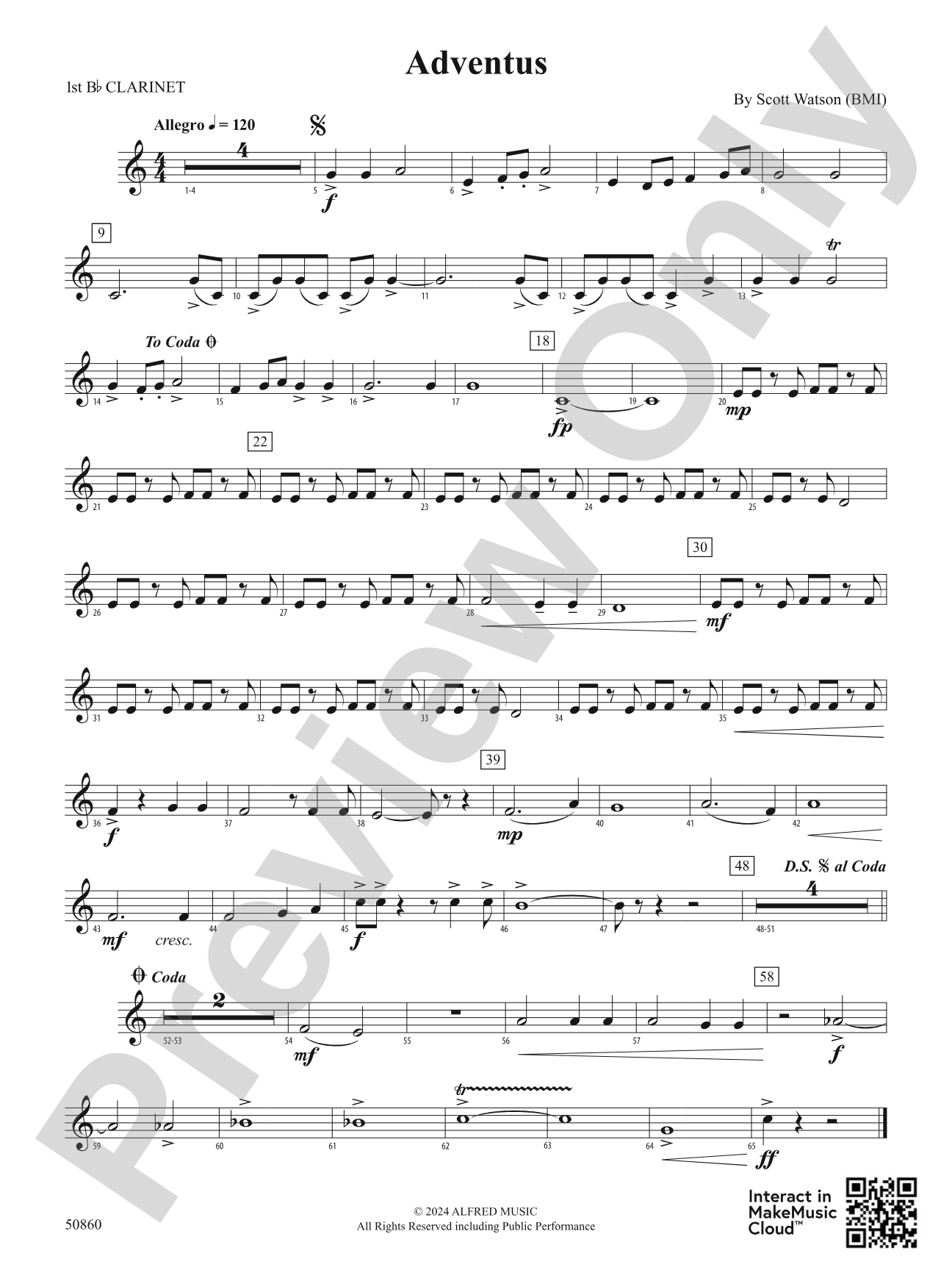

Adventus: 1st B-flat Clarinet
By Scott Watson
Grade: 1
Item: 00-PC-0019194_C1
$3.00
Pickup currently not available
Description
Adventus, meaning "arrival" or "debut" and celebratory in nature, was written to showcase the playing achievements of students. After a bold fanfare statement, the main theme is developed (first playfully, then with more grandeur). A contrasting moment of calm transitions to the exciting return of the opening theme, followed by triumphant closing material. Written squarely for Grade 1 players but with an attractive, mature sound that belies its level, Adventus, by Scott Watson, would make the perfect concert opener or closer. (2:30) Correlates to Sound Innovations, Book 1, Level 5.


Don't just read it, hear it, play along with it, and watch your students grow with it. In MakeMusic Cloud, Adventus: 1st B-flat Clarinet comes alive with professional accompaniment, adjustable tempo, and built-in practice tools that turn solo practice into real progress.
Open in the Player
Jump straight in and assign it today.
Start Your Free Trial
Open this title and explore the full library in minutes.
Sample Audio
1
Audio File
--:--
0:00
0:00
Sample Video
Additional Details
Series:
Sound Innovations for Concert Band
Publisher:
Alfred Music
SKU:
00-PC-0019194_C1
More about this title
About the Composer: Scott Watson

Scott Watson spent 35 years teaching instrumental music in the Parkland School District (Allentown, PA), where he directed the high school band program and later coordinated the elementary band and strings curriculum across the district. His work as an educator runs parallel to a prolific composing career; he has published more than 120 pieces for concert band, string orchestra, and chamber ensembles at every level, with performances documented at venues including the Academy of Music in Philadelphia, the Midwest Clinic in Chicago, and the White House.
Watson's compositional voice draws from dual expertise in contemporary concert art music and the band world, giving his work a sophistication that serves young players without condescension. He currently serves as Associate Professor of Music at Cairn University in Langhorne, PA, and is an exclusive composer and clinician for Alfred Publications. Beyond composing and teaching, Watson has authored the music education text Using Technology to Unlock Musical Creativity (Oxford University Press, 2011) and regularly leads workshops and guest conducting clinics for festival and honor bands.
Why we love this
Adventus delivers genuine musical substance at Grade 1, which is rare. Watson knows exactly how to write for early-level ensembles without padding the score or resorting to simplistic melodic material. The piece opens with authority, develops its themes in varied ways, and closes with real triumph—giving students an immediate sense of musical accomplishment while sounding entirely appropriate for a concert program.
What to expect
Adventus begins with ceremonial fanfare and unfolds as a celebration of arrival and accomplishment. The music moves from bold to playful, then inward and reflective, before surging back with the confidence of a piece that knows its own worth. Throughout, the orchestration feels generous and mature despite the accessible writing level.
Who it's for
Grade 1 concert bands looking for an opener or closer with genuine musical authority. Directors seeking pieces that build student confidence and deliver an attractive sound without requiring advanced technique.
How to get the most out of it
- Shape the initial fanfare with clarity and confidence; this opening sets the tone for the entire piece. Ask your players to think of it as a formal announcement rather than just a loud gesture.
- Balance the playful theme development by keeping the articulation light and clean during the lighter section. This contrast will make the subsequent grandeur section land with greater impact.
- During the calm transitional moment, focus on sustained tone quality and musical phrasing rather than technical precision. This is where listeners hear your students' ability to listen to one another.
- Bring the closing material to a genuine forte without overshooting it. Grade 1 players often interpret 'triumphant' as 'as loud as possible,' so model what controlled power sounds like.
How to use it
Adventus shines as a concert opener, where its confident fanfare immediately establishes a professional tone for the entire program. It also works beautifully as a closing piece, allowing students to exit on a note of triumph and giving the audience a memorable final impression.
Skills your students will build
- Sustained phrasing in contrasting sections (bold, playful, calm, triumphant)
- Dynamic contrast and controlled forte playing
- Listening for balance and blend during harmonic transitions
- Ensemble coordination across multiple theme statements and varied textures