
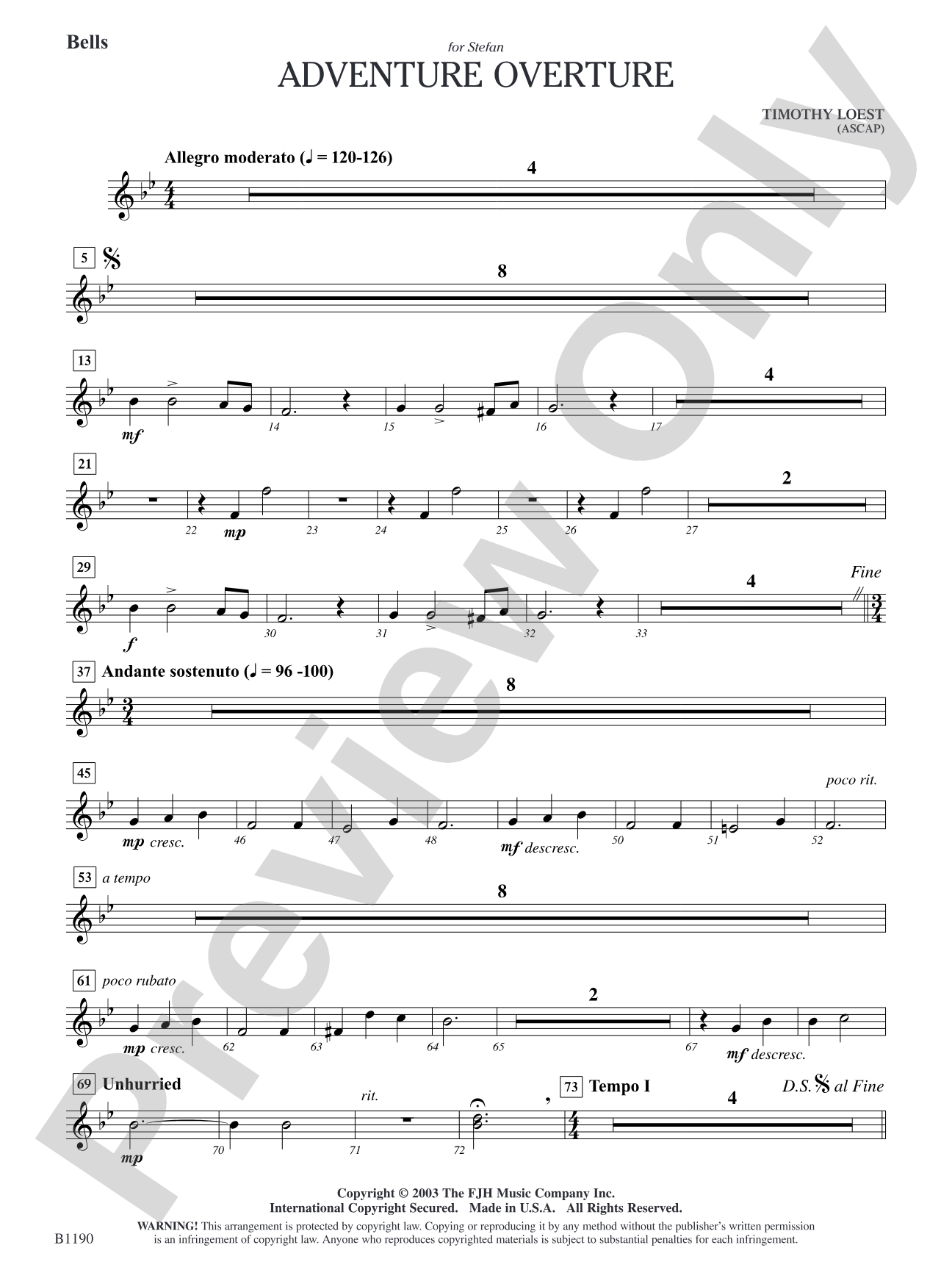

Adventure Overture: Bells
By Timothy Loest
Grade: 1.5
Item: 98-PC-DB1190_B
$7.00
Pickup currently not available
Description
This three-part overture is extremely easy to put together and is an ideal transition from beginning band literature. Special attention is given to low brass parts, insuring that they are not too difficult. A lush lyrical section provides for some more interesting harmonies, yet is very approachable by bands at all levels. Use this section to work on balance and musicality with your ensemble. A D.C. al Fine completes the framework of this piece.


Adventure Overture: Bells isn't in MakeMusic Cloud just yet...but it could be. Let us know you'd like to see it, and you'll help shape what comes next. In the meantime, start a free trial and dive into thousands of interactive titles your students can play along with today.
Request This Title
Tell us you want it.
Start Your Free Trial
Explore everything that's ready to play right now.
Sample Audio
1
Audio File
--:--
0:00
0:00
Sample Video
No sample videos found.
Additional Details
Series:
FJH Developing Band
Publisher:
The FJH Music Company, Inc.
SKU:
98-PC-DB1190_B
More about this title
About the Composer: Timothy Loest

Timothy Loest has built a career on writing music that speaks directly to the classroom teacher's needs. His works appear regularly at state and national festivals, and his influence extends beyond the concert hall through pedagogical methods used by thousands of young musicians. In 2017, his composition Cloud Gate drew over 5,000 listeners at Chicago's Millennium Park, and that same year he received the Illinois Grade School Music Association's highest honor, the Cloyd Myers Memorial Award for Excellence in Music Education.
With more than thirty years teaching at the middle school level, Loest understands the specific challenges and triumphs of developing musicians. He has published with major houses including Warner Bros. Publications, C.L. Barnhouse Company, and FJH Music Company, and founded Fanfare Music Press in 2022 to focus on high-quality band compositions and arrangements. His collaborative work on best-selling methods such as Measures of Success and Warm-ups and Beyond reflects his commitment to systematic musicianship. Loest holds degrees from Illinois State University and Northwestern University and remains active in commissioning work for ensembles.
Why we love this
Loest understands the exact moment when a beginning band is ready to move beyond simple arrangements but still needs confidence in execution. The three-part structure keeps things manageable while the lyrical section gives your ensemble something genuinely rewarding to shape, making rehearsal time feel purposeful rather than repetitive. The low brass writing respects where students actually are technically, which means your entire section can focus on musicality instead of survival.
What to expect
The overture has genuine forward motion and purpose, opening with energy before settling into a lyrical heart where the harmonic palette opens up. This section feels genuinely expansive for players used to simple voicings, and the return to the opening material lands with satisfaction rather than repetition.
Who it's for
Bands transitioning out of beginner method books who need a piece with real musical content but without unmanageable technical demands. First and second-year students benefit from the straightforward structure, while more experienced ensembles use it to refine balance and phrasing without wrestling with complicated passages.
How to get the most out of it
- Treat the lyrical section as a dedicated balance study; isolate the woodwind harmonies first, then layer in the brass to hear how inner voices support the melody.
- The D.C. al Fine returns to familiar material, so use that structural clarity to work on consistency between the first and final playings without over-rehearsing.
- Support your low brass with specific dynamic targets during the lyrical section; mark exact dynamic levels in their parts rather than assuming they'll follow the ensemble.
How to use it
Program this early in a concert to build momentum and confidence in your ensemble; the successful execution of a well-structured three-part form sets a positive tone for longer or more complex pieces. It works equally well as a festival selection where judges appreciate clean, musical performance without technical showing off.
Skills your students will build
- Three-part structural awareness (exposition, lyrical section, recapitulation)
- Balance and blend in harmonic writing
- Sustaining musicality over repeated passages (D.C. al Fine)
- Low brass independence and confidence
- Phrasing in lyrical material at beginning-to-early-intermediate level