
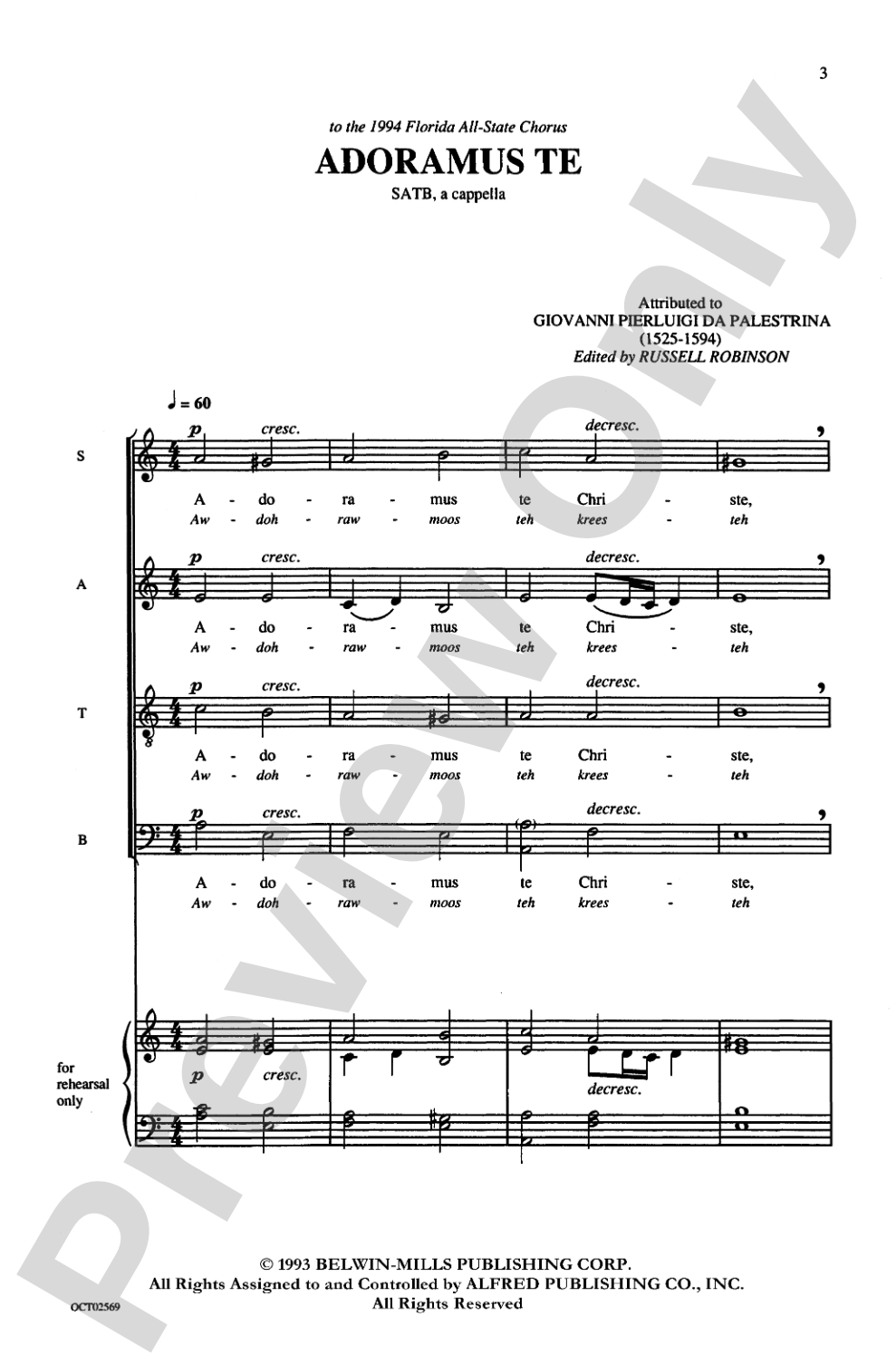

Adoramus Te: SATB, a cappella Choral Octavo
By Giovanni Pierluigi da Palestrina / ed. Russell Robinson
Level: Moderate
Item: 00-PO-0005139
$2.25
Minimum order quantity: 20 copies
Pickup currently not available
Related Items
Adoramus Te: SATB, a cappella Choral Octavo |
$2.25
|
View |
Description
Long a standard in the choral repertoire, Palestrina's Adoramus Te continues to be a favorite for contest or festival. Range is excellent for the SATB junior high choir.


Adoramus Te: SATB, a cappella Choral Octavo isn't in MakeMusic Cloud just yet...but it could be. Let us know you'd like to see it, and you'll help shape what comes next. In the meantime, start a free trial and dive into thousands of interactive titles your students can play along with today.
Request This Title
Tell us you want it.
Start Your Free Trial
Explore everything that's ready to play right now.
Sample Audio
1
Audio File
--:--
0:00
0:00
Sample Video
No sample videos found.
Additional Details
Series:
Alfred Archive Edition: Belwin Festival Series
Publisher:
Alfred Music
Page Count:
8
SKU:
00-PO-0005139
More about this title
About the Composer: Giovanni Pierluigi da Palestrina
Giovanni Pierluigi da Palestrina (1525-1594) was the most celebrated composer of the Roman Renaissance and shaped the sound of sacred choral music for centuries. His mastery of polyphonic writing and gift for balancing theological weight with vocal beauty made him the gold standard for church composers during the Counter-Reformation. Palestrina's works remain essential to the choral repertoire because they demonstrate how technical sophistication and spiritual expression can coexist seamlessly.
His influence on music education endures not through theory but through direct engagement with his scores. Every student who learns to sing Palestrina's balanced voice leading, transparent texture, and elegant phrasing is studying from the source. His music teaches clarity, intonation, and respect for the text without ever feeling like a lesson.
Why we love this
Adoramus Te survives as contest and festival repertoire because it sounds harder than it is. The piece rewards careful preparation without demanding extreme ranges or complex rhythmic coordination, making it an ideal vehicle for junior high choirs stepping into Renaissance polyphony. Palestrina's writing is genuinely moving rather than merely historically correct.
What to expect
Palestrina's Adoramus Te draws you inward. The piece unfolds with liturgical calm, the voices moving in gentle counterpoint rather than dramatic declaration. There is reverence in every phrase, a sense that something precious is being named and honored carefully. The emotional core is intimate and contemplative, never showy.
Who it's for
This octavo belongs in the changing repertoire of any junior high choir that has moved beyond unison and homophonic writing. Students with solid vocal control and basic music reading skills will find the ranges manageable and the four-part texture engaging without overwhelming difficulty. Directors preparing for contest or festival programming should recognize this as repertoire that sits at the ideal intersection of authentic Renaissance repertoire and age-appropriate challenge.
How to get the most out of it
- Establish a clear vowel shape across all four voices before worrying about blend. Palestrina's text-painting depends on clean articulation of 'Adoramus' and 'Te,' and careless vowels will muddy the transparency his writing requires.
- Shape the longer note values with gentle dynamic movement rather than holding them flat. A semibreve that sustains without any inner life will expose intonation issues; let the line breathe naturally toward and away from cadence points.
- Use a slower rehearsal tempo initially to lock accurate interval relationships between voice parts. Once the inner ear absorbs the harmonic structure, the piece will move at its proper liturgical pace.
- Balance the soprano and alto carefully in the upper register. The soprano should not dominate; Palestrina wrote these lines to intersect and share color, not to create a melody-and-accompaniment texture.
How to use it
Program this as the centerpiece of a sacred music concert or alongside other Renaissance motets to create a stylistic block that educates your audience about polyphonic writing. It also works beautifully as a processional or recessional in worship settings. The moderate length and contest-appropriate difficulty make it an excellent choice for state or regional festival competition where your junior high singers can demonstrate both vocal maturity and musical intelligence.
Skills your students will build
- Reading and singing independent polyphonic lines with secure intonation
- Understanding Renaissance harmonic language and voice-leading conventions
- Balancing tone and dynamics across four SATB parts with no accompaniment
- Interpreting Latin sacred text with appropriate phrasing and vowel consistency
- Sustaining focus and musicality across a cappella singing where every voice is exposed