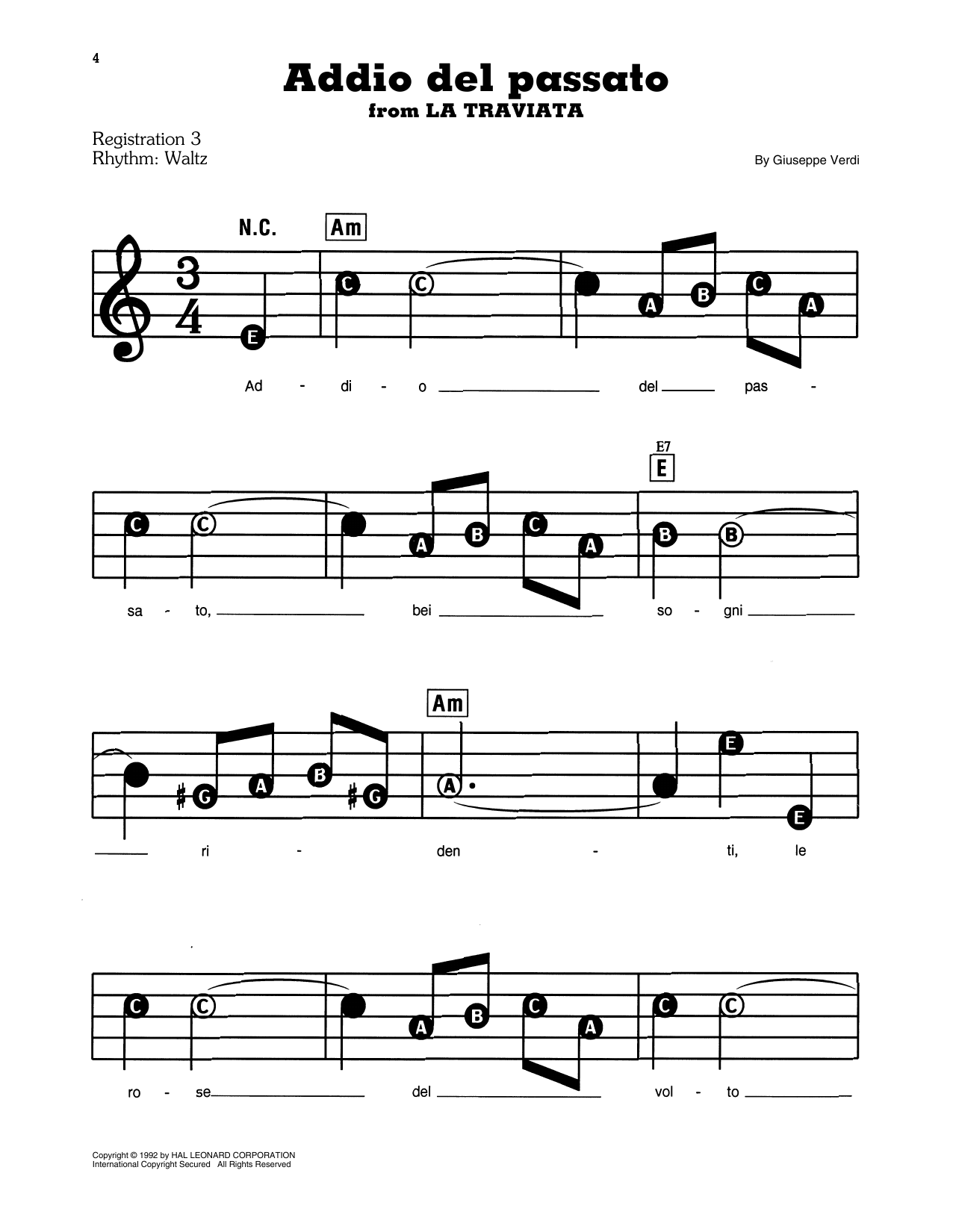
Addio del passato Sheet Music Preview

Addio del passato: E-Z Play Today

Item: 35-DS00836512

Digital Download
$4.99
Description

Addio del passato: E-Z Play Today isn't in MakeMusic Cloud just yet...but it could be. Let us know you'd like to see it, and you'll help shape what comes next. In the meantime, start a free trial and dive into thousands of interactive titles your students can play along with today.

Sample Audio
No sample audio found.
Sample Video
Additional Details
Publisher: Hal Leonard
Page Count: 5
SKU: 35-DS00836512

More about this title

About the Creator: Giuseppe Verdi

Giuseppe Verdi (1813-1901) shaped Italian opera into a vehicle for both vocal grandeur and human emotion. His gift for memorable melody and dramatic pacing made him one of the most performed composers in the world, with works that remain central to opera houses everywhere.

Verdi's ability to write for the human voice set a standard for subsequent generations. He understood how to craft lines that sit naturally in the voice while remaining dramatically urgent, a balance that has inspired musicians across centuries.

Why we love this

This E-Z Play arrangement makes one of opera's most touching moments accessible to intermediate pianists without sacrificing the emotional weight of Violetta's farewell. The five-page format gives students a manageable introduction to operatic character and phrasing while preserving the harmonic and melodic integrity that makes this aria unforgettable.

What to expect

Wistful and tender, with an undercurrent of resignation. The music dwells in a space between acceptance and heartbreak, where each phrase feels like a small goodbye. There is nobility in Violetta's farewell, even in her sorrow.

Who it's for

Intermediate pianists who want to tackle classical operatic repertoire in a form that doesn't require operatic training. This arrangement works equally well for solo performance, collaborative study with a vocalist, or self-directed exploration of one of Verdi's most performed arias.

How to get the most out of it

  • Shape the melodic line with clear direction from phrase to phrase; Verdi wrote this to express resignation tinged with lingering affection, so avoid treating it as purely mournful.
  • Balance the accompaniment texture so that Violetta's voice always sits comfortably above; resist the urge to thicken the texture beyond what the page indicates.
  • Listen for the harmonic shifts that signal Violetta's internal conflict, especially where the key moves or the chords turn unexpected, and let those guide your expressive choices.
  • Take the tempo steadily enough that the emotional arc remains clear; rushing diminishes the gravity of what she is relinquishing.

How to use it

Pair this with other operatic transcriptions to create a recital segment that introduces students to the emotional world of opera without requiring a full production. It also serves as a bridge between classical and contemporary repertoire, showing how dramatic narratives can be expressed through purely instrumental music.

Skills your students will build

  • Singing phrasing at the keyboard (shaping longer lines with clear direction)
  • Harmonic awareness (recognizing key shifts and unexpected chords as emotional markers)
  • Balancing texture (maintaining clarity between melody and accompaniment)
  • Legit tempo and pacing (sustaining emotional weight without rushing)
  • Stylistic interpretation of 19th-century opera

You May Also Like