
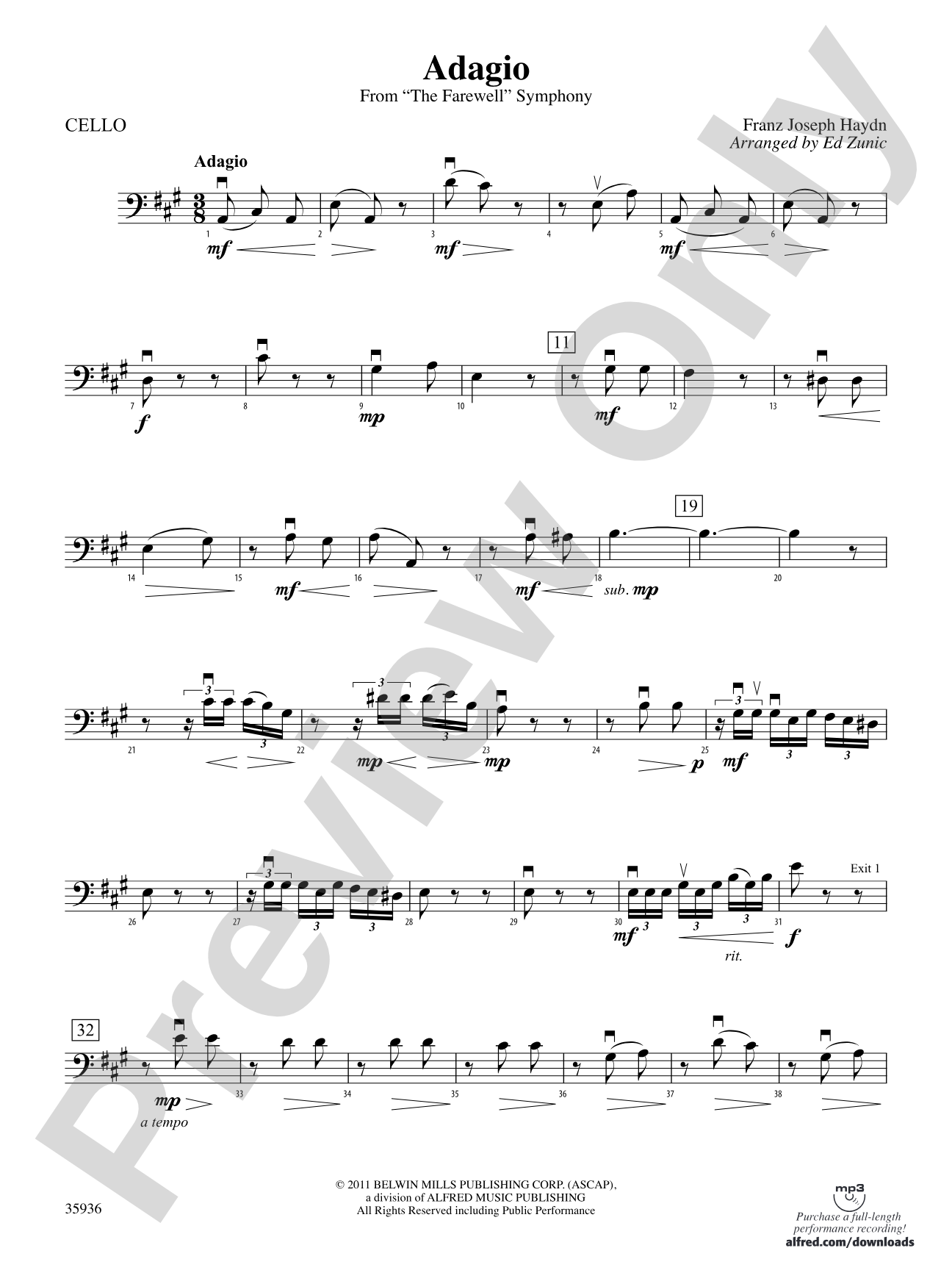

Adagio (from the Farewell Symphony): Cello
By Franz Joseph Haydn / arr. Ed Zunic
Grade: 4
Item: 00-PC-0015018_VC1
$5.99
Pickup currently not available
Description
Composed by Haydn in 1772 to let Prince Nikolaus know it was time for the musicians to go home to their families, this arrangement features solo parts in all voices. Say "goodbye" to your graduating students in a dramatic fashion. This title is available in MakeMusic Cloud.


Don't just read it, hear it, play along with it, and watch your students grow with it. In MakeMusic Cloud, Adagio (from the Farewell Symphony): Cello comes alive with professional accompaniment, adjustable tempo, and built-in practice tools that turn solo practice into real progress.
Open in the Player
Jump straight in and assign it today.
Start Your Free Trial
Open this title and explore the full library in minutes.
Sample Audio
1
Audio File
--:--
0:00
0:00
Sample Video
No sample videos found.
Additional Details
Series:
Belwin Concert String Orchestra
Publisher:
Alfred Music
Page Count:
124
SKU:
00-PC-0015018_VC1
Instrumentation:
string
More about this title
About the Composer: Franz Joseph Haydn
Franz Joseph Haydn (1732-1809) shaped the symphony and string quartet into the foundation of Classical music. Working for decades at the court of Prince Nikolaus Esterházy, he composed with both structural rigor and imaginative wit, leaving 104 symphonies and 68 string quartets that remain essential to orchestral and chamber repertoire.
Haydn's gift for storytelling through instrumental music appears throughout his work. The Farewell Symphony, composed in 1772, demonstrates his ingenuity: a piece with a specific purpose and personality, it reveals how a master composer could embed meaning into pure music without words or program notes.
Why we love this
This arrangement captures a moment of genuine music history and genuine emotion. Rather than a ceremonial send-off piece that feels generic, Ed Zunic's scoring brings Haydn's original concept into sharp focus: the gradual departure of musicians from the stage creates a natural, moving farewell that resonates with graduating students and their families without heavy-handedness. The solo writing across all sections ensures every player has a moment to shine as they take their final bow.
What to expect
Dignified and wistful, with an undercurrent of humor that Haydn never quite lets disappear. The music unfolding in Classical grace while one by one the musicians stand and depart creates a bittersweet beauty; you feel both the sadness of goodbye and the rightness of it. By the final measures, what began as a full ensemble has become something intimate and almost fragile.
Who it's for
String orchestra directors seeking a meaningful closer for graduation concerts, particularly Grade 4 ensembles with solid intonation and musical maturity. This arrangement works equally well for chamber orchestras, advanced middle school groups, and smaller high school programs looking for a piece with real ceremony and emotional depth.
How to get the most out of it
- Balance the solo voices carefully so that departing players are always audible but never isolated. The overall sound should remain cohesive even as sections thin.
- Work out the stage logistics in advance. Coordinate with your graduating students on timing and spacing so the exit feels intentional rather than chaotic.
- Shape phrases with gentle rubato and allow the music to breathe. This is a farewell, not a march; the pacing should reflect the emotional weight of the moment.
- Consider having remaining players sustain softly under the solos, creating a supportive foundation as each section takes its moment.
How to use it
Reserve this for the final concert of the year, ideally as the closing piece after all other program selections. It works beautifully as an encore that sends graduating musicians off with dignity, or as the penultimate piece if you need another selection to follow. The Grade 4 level and 124-page score suggest a full orchestra can handle the technical demands, making it suitable for spring concerts when students have had the full school year to prepare.
Skills your students will build
- Balancing solo and ensemble textures while maintaining intonation
- Sustaining long tones with consistent tone quality and dynamic control
- Playing with expression and rubato in the Classical style
- Understanding Haydn's orchestration and the function of each string voice
- Coordinating ensemble timing during a piece with unconventional staging demands