
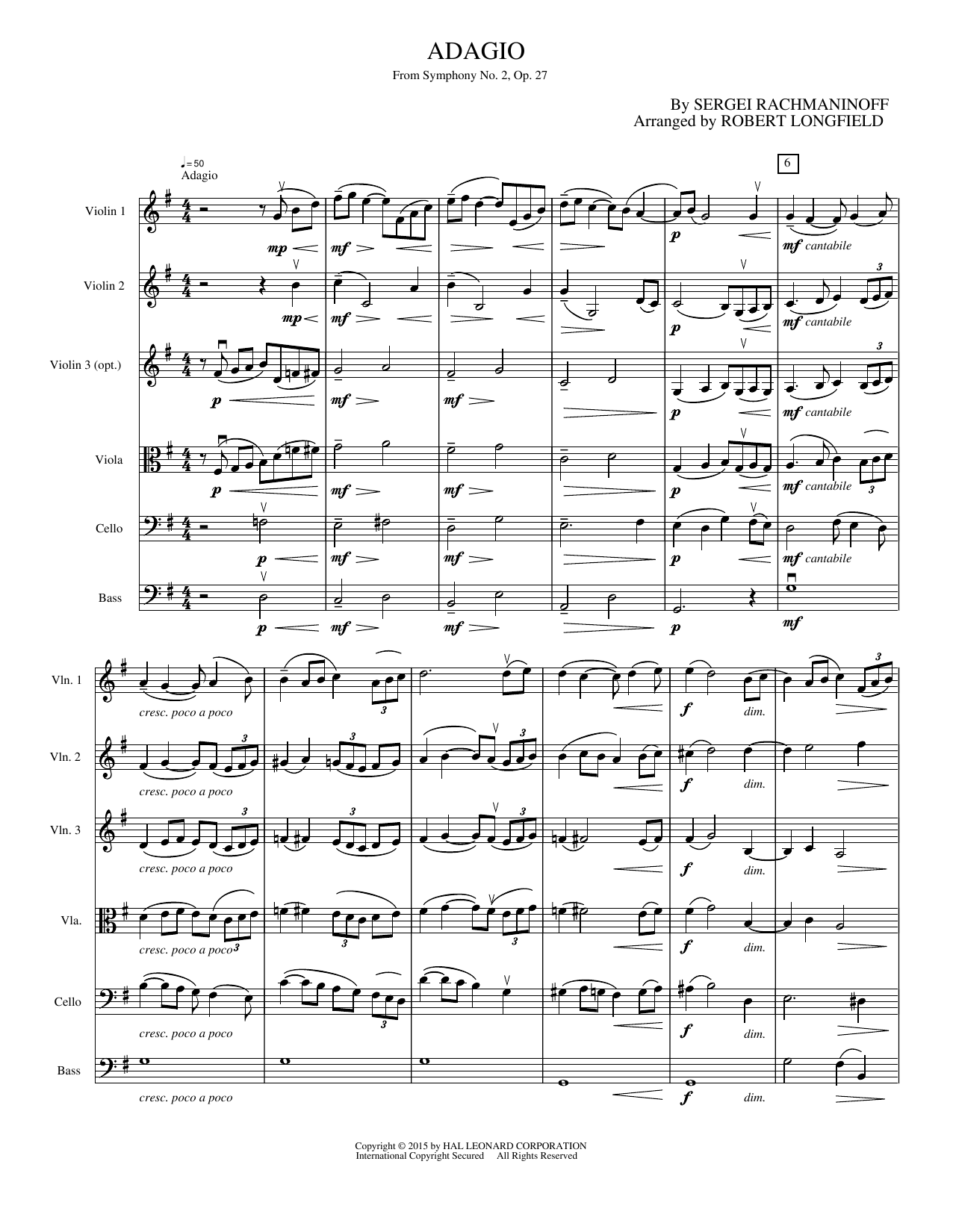

Adagio from Symphony No. 2: String Orchestra Conductor Score & Parts
By Sergei Rachmaninoff / Arranged by Robert Longfield
Grade: 2
Item: 35-PK00426769
$40.00
Pickup currently not available
Buy Extra Parts (Digital PDF Download)
| Product | Price | Quantity |
|---|---|---|
| Adagio from Symphony No. 2 - Full Score | $40.00 |
Parts Added to Cart!
Description
Adagio from Symphony No. 2


Discover MakeMusic Cloud: thousands of interactive titles your students can play along with today.
Sample Audio
No sample audio found.
Sample Video
No sample videos found.
Additional Details
Publisher:
Hal Leonard
SKU:
35-PK00426769
More about this title
About the Composer: Sergei Rachmaninoff
Sergei Rachmaninoff (1873–1943) was a Russian composer and pianist whose music bridges Romanticism and modernism with uncompromising emotional depth. His four symphonies showcase orchestral writing of remarkable sophistication, yet his melodies remain immediately accessible to both performers and audiences. For music educators, Rachmaninoff's work represents the gold standard of late-Romantic orchestration: transparent textures, singable lines, and harmonic language that rewards careful listening.
Rachmaninoff's influence on string writing cannot be overstated. He understood the expressive capabilities of the string section so thoroughly that even his most complex passages feel natural under the fingers. This arrangement of the Adagio from Symphony No. 2 distills that mastery into a form accessible to developing orchestras.
Why we love this
This arrangement captures the architectural beauty of Rachmaninoff's original without overwhelming a developing string section. Robert Longfield has preserved the essential harmonic and melodic content while scaling the technical demands, allowing your students to inhabit a genuinely sophisticated musical statement from their first rehearsal onward. The Grade 2 scoring opens a door to music that usually lives beyond reach at this level.
What to expect
Meditative and introspective, this Adagio unfolds without haste. The harmonic language carries an almost nocturnal quality, with rich chromatic movement beneath the principal melody. Students will experience the satisfaction of sustaining a genuinely singing tone over extended passages while the orchestration around them creates an atmosphere of quiet contemplation.
Who it's for
String orchestras in grades 7 through 9 ready to engage with substantial musical content without abandoning technical accessibility. This works equally well for community youth orchestras, prep ensembles, and high school groups seeking repertoire that rewards careful musicianship without requiring virtuosity.
How to get the most out of it
- Shape the long melodic lines as a unit rather than from bar to bar. Rachmaninoff's harmonic rhythm moves slowly in this movement; let that deliberation guide your phrasing choices across multiple measures.
- Attend to the inner voices in the accompanying parts. What appears simple on the surface often contains supporting harmonies that need definition. A second violin or viola line that moves even slightly must be heard.
- Balance the melody generously but not oppressively. This music invites warmth from the section carrying the tune, but the surrounding texture should remain audible as counterpoint rather than disappearing into accompaniment.
- Build the emotional arc across the entire movement rather than within any single phrase. Rachmaninoff's slow movements exist in long waves; your rehearsal conversations should reflect that structural thinking.
How to use it
This movement serves beautifully as the reflective centerpiece of a concert built around Romantic string repertoire, or as a bridge between lighter opening works and more dramatic finale selections. Consider pairing it with shorter, more energetic pieces on the same program to highlight its introspective character. It also functions as an excellent teaching tool mid-season when students are ready to deepen their approach to tone production and sustained phrasing.
Skills your students will build
- Sustaining long, singing melodic lines with consistent tone quality
- Balancing ensemble texture when the melody sits in multiple voices simultaneously
- Reading and performing chromatic harmonic movement
- Shaping phrases across slow harmonic rhythm and extended measures
- Listening for inner voice independence within a predominantly homophonic texture