
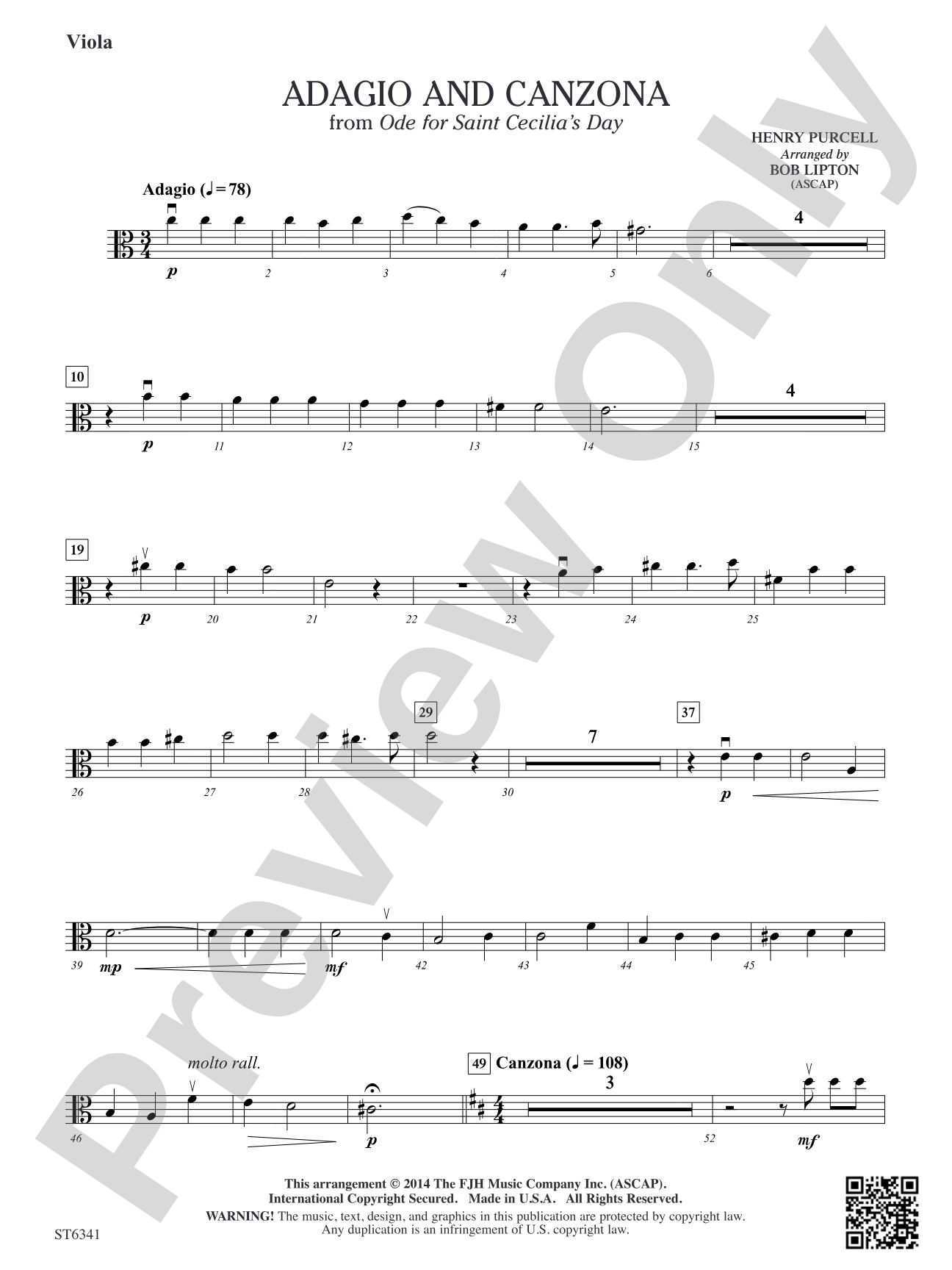

Adagio and Canzona: Viola
Arranged by Bob Lipton
Grade: 3.5
Item: 98-PC-DST6341_VA1
$7.00
Pickup currently not available
Description
A slow and starkly beautiful Adagio is followed by a riot of joyous counterpoint in this example of English Baroque writing at its finest. Paying tribute to Saint Cecilia (patron Saint of Musicians), this wonderful music comes from the introduction of the original and features a trio of 2 violins and cello.


Don't just read it, hear it, play along with it, and watch your students grow with it. In MakeMusic Cloud, Adagio and Canzona: Viola comes alive with professional accompaniment, adjustable tempo, and built-in practice tools that turn solo practice into real progress.
Open in the Player
Jump straight in and assign it today.
Start Your Free Trial
Open this title and explore the full library in minutes.
Sample Audio
1
Audio File
--:--
0:00
0:00
Sample Video
No sample videos found.
Additional Details
Series:
FJH String Orchestra
Publisher:
The FJH Music Company, Inc.
SKU:
98-PC-DST6341_VA1
More about this title
About the Arranger: Bob Lipton
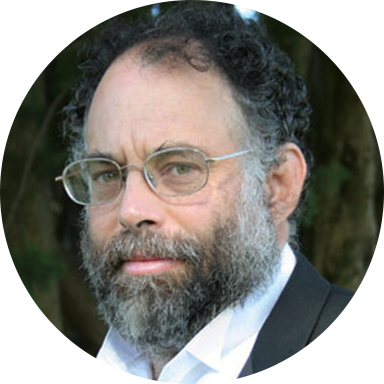
Bob Lipton earned his B.M. in music education from San Francisco State University, where he graduated with honors. For the past 19 years, he has directed orchestra and band programs at the middle school level in Silicon Valley, California.
As a tuba performer, Lipton has maintained an active presence in the Bay Area classical music scene, appearing with the San Jose, Oakland, Napa, Monterey, and Berkeley symphonies. His performance experience extends well beyond orchestral work: he was a member of the San Francisco 49ers band, toured internationally with the Colombia Artists Bel Canto Brass, performed at the San Francisco and Frankfurt jazz festivals, and appeared at the Filmfare Awards in Mumbai. Lipton writes extensively for student string orchestras and bands, and he continues to arrange and perform music for brass quintet.
Why we love this
Lipton's arrangement captures the architectural elegance of English Baroque style while keeping the texture transparent enough for a Grade 3.5 ensemble to execute with confidence. The dramatic arc from austere beauty to exuberant counterpoint gives students a tangible sense of compositional contrast and structure; they aren't just reading notes, they're inhabiting two distinct musical worlds in a single piece. For festival and contest programs, this work stands out precisely because it honors the original's sophistication without inflating the technical demands.
What to expect
The Adagio unfolds like a prayer, spare and introspective; the writing leaves space for silence to matter. Then the music pivots sharply into the Canzona, where multiple melodic lines dance around each other in infectious conversation, creating a sense of momentum and playfulness that feels earned after the opening's restraint. The whole arc feels both emotionally complete and musically alive.
Who it's for
String orchestras at the Grade 3.5 level who are ready to tackle Baroque counterpoint and want to program a work that feels substantial without demanding virtuosity. Directors preparing for festivals or contests will find this arrangement meets the mark for both musical credibility and realistic student achievement. Advanced middle school orchestras and young high school ensembles will find the piece rewarding and performable.
How to get the most out of it
- Shape the opening Adagio with long, connected phrases rather than treating each measure as an isolated unit; encourage string players to think of the melody as one continuous line that breathes at cadences, not stops.
- In the Canzona section, clarify the individual voice lines within the counterpoint by ensuring each part stands forward in its turn; balance matters more than volume here, so lighter bow pressure with good articulation will help the inner voices sing through.
- Mark entrances in the fugal passages clearly so no section is surprised by its cue; the joy of counterpoint only reads as organized chaos without precise ensemble awareness.
- Use the conductor score to anticipate harmonic shifts and textural changes; this will help you guide students through the Baroque voice-leading, which may feel unfamiliar if they've been working primarily in homophonic repertoire.
How to use it
Open a concert or festival set with this piece to establish sophistication early; the Adagio's quiet beauty immediately signals that your ensemble takes repertoire seriously, and the Canzona's brilliance sends the audience into the rest of the program with energy. It also pairs well on a concert that explores the Baroque era, serving as a bridge between slower choral literature and faster dance-form pieces. The tribute to Saint Cecilia makes it a natural choice for a spring or end-of-year concert that celebrates music-making itself.
Skills your students will build
- Sustaining long melodic lines with musical shape and purpose
- Identifying and maintaining independent voice lines within contrapuntal textures
- Balancing multiple melodic strands so no single line overwhelms the ensemble
- Executing phrase structure across multiple measures without losing continuity
- Responding to Baroque harmonic language and voice-leading conventions
- Collaborating as an ensemble to create rhythmic precision in fugal passages