Adagietto from Symphony No. 5: Viola Sheet Music Preview

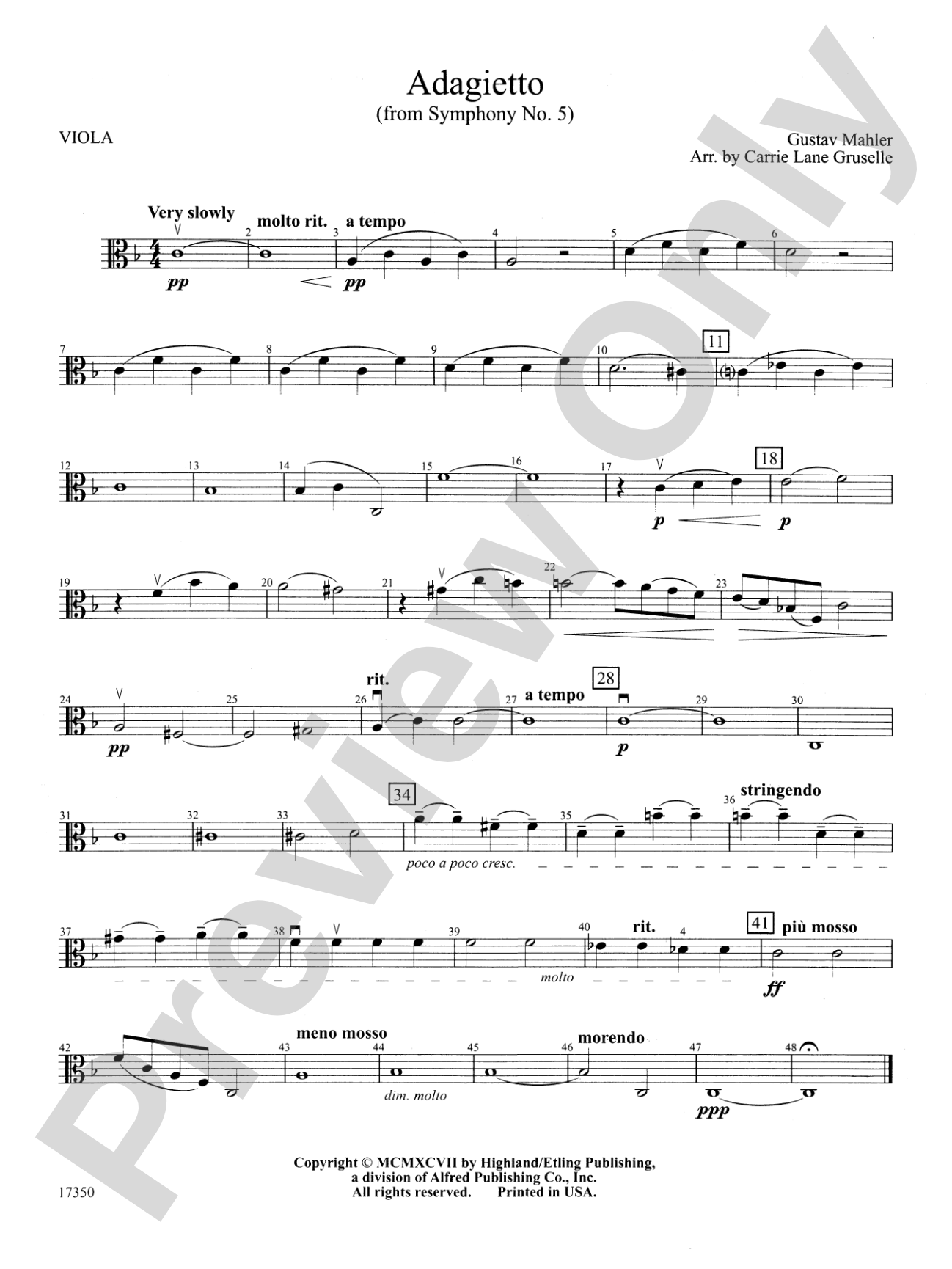
Adagietto from Symphony No. 5: Viola

By Gustav Mahler / arr. Carrie Lane Gruselle

Grade: 3

Item: 00-PC-0000229_VA1

Digital Download
$5.99
Description
This incredibly expressive movement from Mahler's 5th Symphony has been masterfully adapted for young string orchestra by Carrie Lane Gruselle. This work includes a simplified harp part playable on student harps (or alternatively on piano or synthesizer). This revered classic is a great vehicle for developing expressive playing. This title is available in MakeMusic Cloud.

Don't just read it, hear it, play along with it, and watch your students grow with it. In MakeMusic Cloud, Adagietto from Symphony No. 5: Viola comes alive with professional accompaniment, adjustable tempo, and built-in practice tools that turn solo practice into real progress.

Sample Audio
0:00
0:00
Sample Video
Additional Details
Series: Highland/Etling String Orchestra
Publisher: Alfred Music
Page Count: 66
SKU: 00-PC-0000229_VA1

More about this title

About the Composer: Gustav Mahler

Gustav Mahler (1860-1911) was an Austrian composer and conductor whose ten symphonies stand among the most ambitious works in the repertoire. His music bridges the Romantic and early modern eras, combining lush orchestration with profound emotional depth and structural innovation. Mahler's influence on twentieth-century composition is immense, and his works remain central to concert programming worldwide.

Why we love this

This arrangement opens one of the great masterworks to young musicians without compromising the piece's emotional core. Gruselle's adaptation respects Mahler's orchestration while making the part demands genuinely playable for middle school and early high school string players, and the optional harp part (playable on piano or synthesizer) solves a real logistical challenge in school settings. The Grade 3 designation means your students can experience authentic Romantic expression and contest-worthy repertoire in the same rehearsal.

What to expect

The Adagietto radiates quiet intensity and introspection. Long singing lines move through gentle harmonic shifts while sustained chords create a luminous backdrop; there's an undercurrent of longing beneath the surface calm. The arrangement preserves Mahler's ability to make simple material feel profound through orchestration and pacing.

Who it's for

This score and parts set is designed for middle school and early high school string orchestras seeking accessible arrangements of significant classical repertoire. The Grade 3 level makes it suitable for standard school orchestras while the Mahler name and contest eligibility appeal to programs ready to program with ambition. Directors preparing for festivals or looking to build student experience with large Romantic-era forms will find this especially valuable.

How to get the most out of it

  • Shape the opening violin melody with a long-line approach rather than phrase-by-phrase articulation; Mahler's Adagietto breathes but doesn't fragment.
  • Balance the harp or synthesizer part carefully against the strings so it provides harmonic color without overwhelming the string lines.
  • Work the sustained passages gradually, giving players time to understand where the natural peaks occur so they don't fade prematurely.
  • Use the recorded accompaniment (available separately) as a rehearsal tool to help string players hear how their parts fit within Mahler's original orchestration.

How to use it

Program this as a concert centerpiece that demonstrates your orchestra's ability to sustain lyrical playing and manage dynamic nuance. It pairs beautifully with earlier Romantic repertoire or with more contemporary works, creating programming that spans musical eras while maintaining emotional coherence. The arrangement's accessibility also makes it a strong festival entry for orchestras developing their contest repertoire.

Skills your students will build

  • Sustaining long melodic lines without losing shape or intonation
  • Balancing individual voice independence within a harmonic texture
  • Responding to subtle dynamic and expressive gestures from the conductor
  • Reading and playing with score awareness across multiple string parts
  • Managing the technical and musical demands of Romantic-era string writing

You May Also Like