
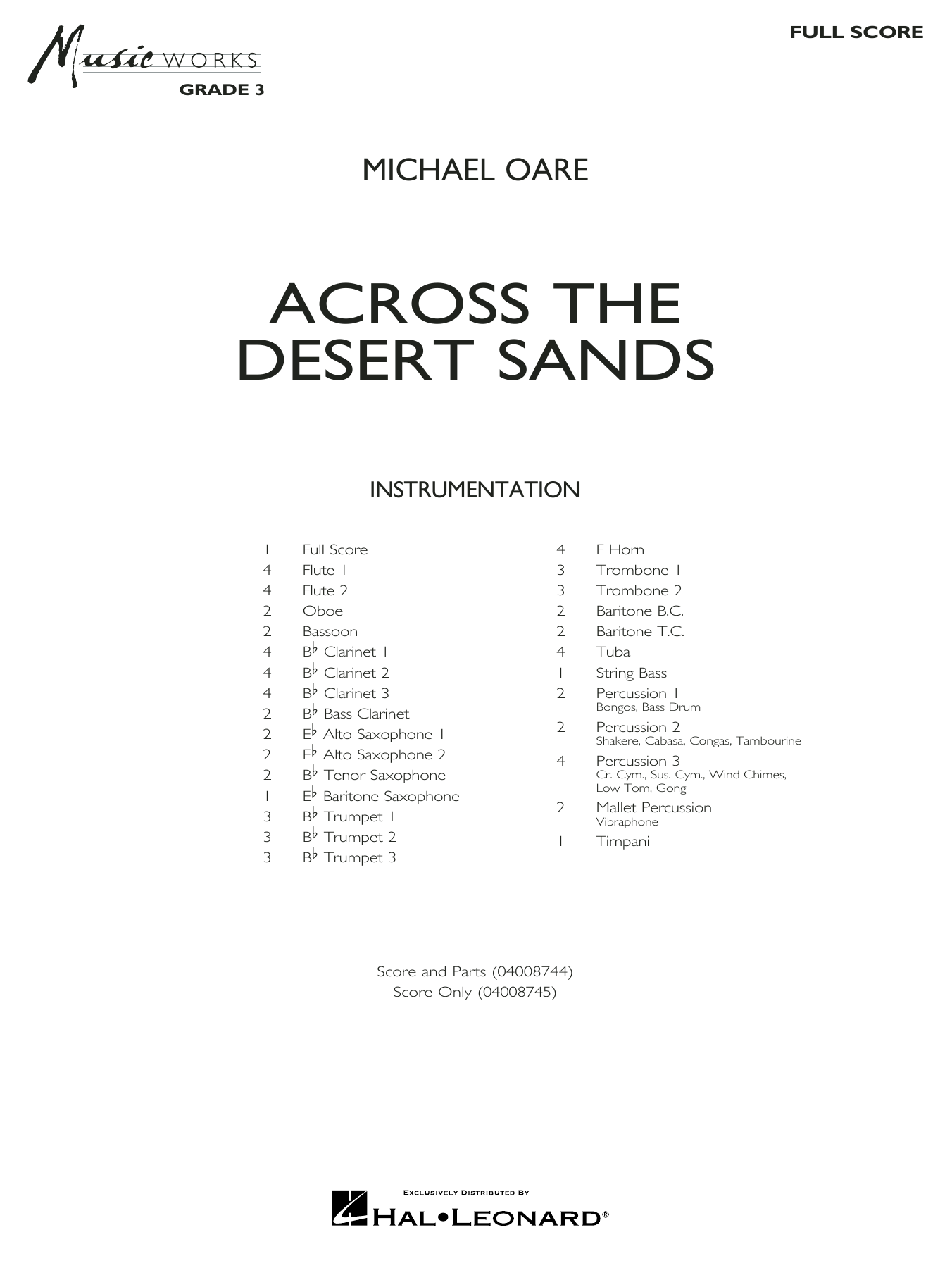

Across The Desert Sands: Concert Band Conductor Score & Parts
By Michael Oare
Grade: 3
Item: 35-PK01451527
$75.00
Pickup currently not available
Buy Extra Parts (Digital PDF Download)
Parts Added to Cart!
Description
Take your students on a captivating musical journey inspired by the vast landscapes and rich culture of desert dwelling peoples! The opening is bold and majestic before leading to a percussion driven faster section. The exotic flute melody evolves throughout the ensemble and leads to a dance-like celebration. The pace quickens and the intensity builds to an exhilarating and dramatic finish. Unique and striking! Dur: ca. 3:00


Discover MakeMusic Cloud: thousands of interactive titles your students can play along with today.
Sample Audio
No sample audio found.
Sample Video
Additional Details
Publisher:
Hal Leonard
SKU:
35-PK01451527
More about this title
About the Composer: Michael Oare

Michael Oare trained in composition and music education at Old Dominian University and spent 33 years as Director of Bands at Great Bridge Middle School in Chesapeake, Virginia. During his tenure, his ensembles earned superior ratings consistently, including 30 consecutive years of straight superiors on grade 3 and 4 literature. His work has been recognized in the GIA Publications "Teaching Music Through Performance" series, and he received the National Band Association's Citation of Excellence twice.
Beyond the classroom, Oare maintains an active presence as a composer, arranger, adjudicator, and conductor. He currently leads the Bay Youth Orchestras of Virginia Concert Band and performs with the Virginia Wind Symphony. His contributions to music education earned him Chesapeake Public Schools' Middle School Teacher of the Year in 2016, and he holds memberships in ASCAP, Phi Beta Mu, and numerous state and national professional organizations.
Why we love this
Oare builds programmatic interest through contrasting sections without sacrificing the tightly written clarity that Grade 3 players need. The journey from majestic opening through percussion-driven momentum to a dance-like finale gives your ensemble genuine dramatic arc to execute, and that engagement translates directly into focused rehearsals. His decades of classroom experience show in every measure; the orchestration works, the part writing sits well, and students feel the payoff of their preparation.
What to expect
The opening sweeps listeners into an expansive landscape, sun-bleached and austere. Energy shifts when percussion enters, driving the music forward into something rhythmically alive and celebratory, before the final push becomes almost frenzied, propelled by rising intensity and overlapping momentum.
Who it's for
Grade 3 concert bands ready to tackle music with real narrative structure and ensemble sophistication. This works equally well for middle school groups seeking a show-stopping contest piece and for high school bands introducing younger players to programmatic composition.
How to get the most out of it
- Balance the bold opening by anchoring the brass attacks with your low brass section; have them shape each phrase as a unified line rather than striking individual notes.
- When the percussion takes the rhythmic lead in the faster section, rehearse the winds independently so they lock into the groove without over-relying on the drums to carry them.
- Shape the flute melody as it passes through the ensemble by identifying exactly where it lives in each new section and marking those transfers clearly in parts; continuity of line matters more than volume.
- Push the final acceleration deliberately; resist the urge to rush the buildup, and let the intensity come from tighter ensemble precision rather than faster tempos.
How to use it
Pair this as a centerpiece on a concert that explores geographical inspiration or cultural storytelling in music. Its three-minute duration slots neatly into most concert formats, and the dramatic arc gives your opening or closing spot genuine impact. Consider programming it after a more lyrical work to demonstrate your band's range of character and style.
Skills your students will build
- Maintaining steady rhythmic foundation while melodic content shifts across sections
- Executing rhythmic precision in ensemble when percussion drives the texture
- Reading and executing dynamic buildups and accelerations without losing control
- Tracking thematic material as it transfers between instrumental families
- Responding to programmatic structure by adjusting character and color at sectional boundaries