
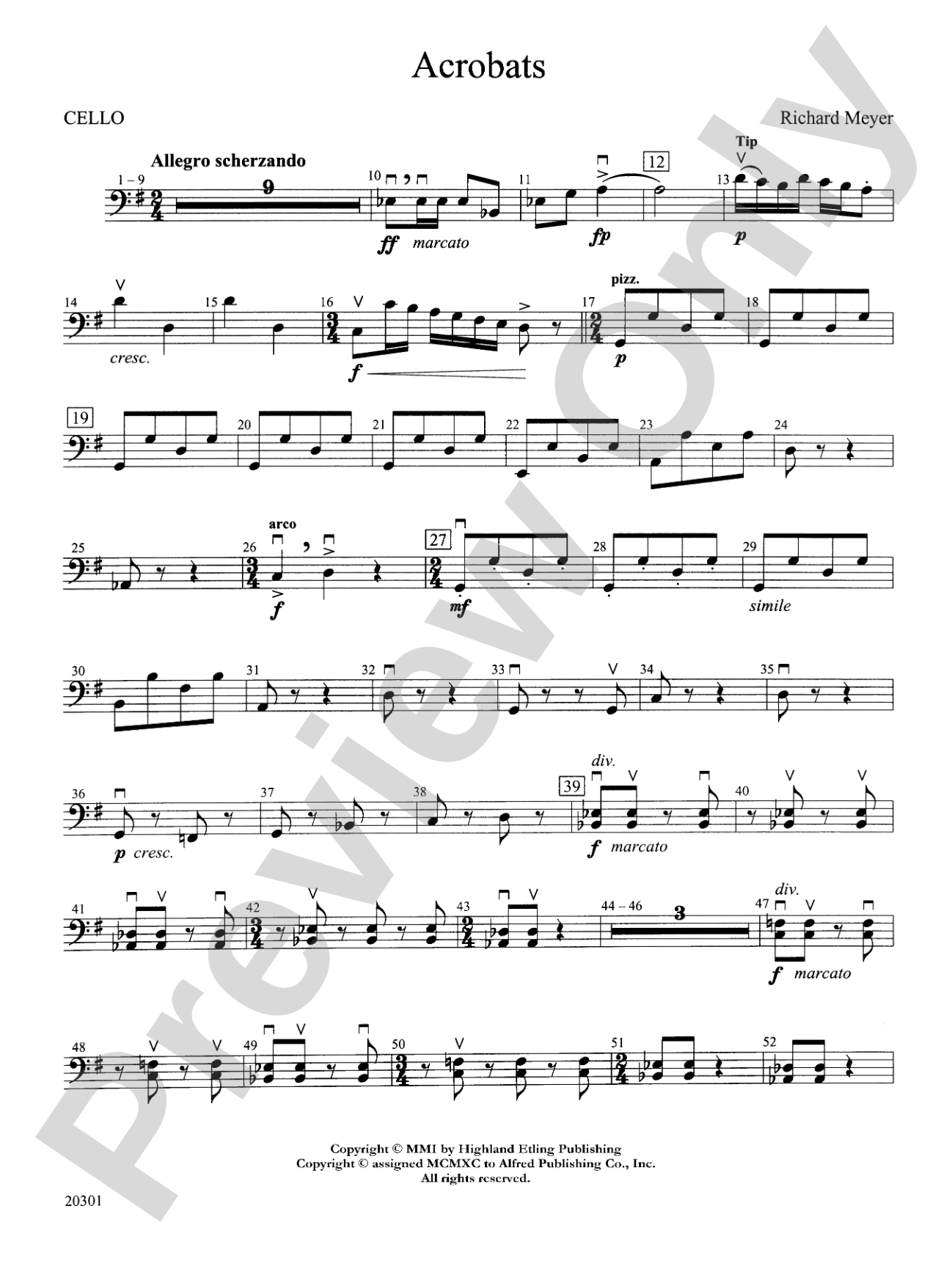

Acrobats: Cello
By Richard Meyer
Grade: 4
Item: 00-PC-0000385_VC1
$5.99
Pickup currently not available
Description
This original work depicts an exciting performance given by a troupe of acrobats, jugglers and gymnasts. Full of energy, it gives high school-level orchestra members a chance to show off their technical abilities. The rapidly shifting key centers and time signatures create a French Impressionistic flavor and will challenge every section. From the opening flourish of rapid sixteenth notes to the grand and graceful middle section and the wildly exciting "molto accelerando" conclusion, this work's high-spirited writing proves to be a tour-de-force of the advanced orchestra! This title is available in MakeMusic Cloud. (3:32)


Don't just read it, hear it, play along with it, and watch your students grow with it. In MakeMusic Cloud, Acrobats: Cello comes alive with professional accompaniment, adjustable tempo, and built-in practice tools that turn solo practice into real progress.
Open in the Player
Jump straight in and assign it today.
Start Your Free Trial
Open this title and explore the full library in minutes.
Sample Audio
1
Audio File
--:--
0:00
0:00
Sample Video
Additional Details
Series:
Highland/Etling String Orchestra
Publisher:
Alfred Music
Page Count:
124
SKU:
00-PC-0000385_VC1
More about this title
About the Composer: Richard Meyer

Richard Meyer brings three decades of string pedagogy into his compositions, having built one of Southern California's largest orchestra programs from the ground up. At Oak Avenue Intermediate School, he grew the string enrollment from 29 to 200 students while simultaneously directing the city's elementary string initiative, demonstrating a rare gift for scaling rigorous training across age groups. His "Giving Bach" program earned national recognition for using interactive concerts to reach underserved student populations, a philosophy that shapes his writing: accessible yet ambitious, fun yet technically demanding.
Beyond the classroom, Meyer has guest-conducted All-State and Honor Orchestras across multiple states and led the Pasadena Youth Symphony Orchestra on international tours spanning Vienna, Australia, and Canada. As a clinician, he has presented at the A.S.T.A. National Conference and regional workshops. Meyer's portfolio includes over 190 published works and a 16-year tenure as string editor for Alfred Publishing Company, where he also co-authored the String Explorer Series and Sight-read It for Strings. His dual expertise in teaching and composition means every piece he writes reflects what students can actually accomplish when given clear, engaging musical challenges.
Why we love this
Meyer captures the unpredictable energy of a live acrobatic performance without sacrificing musical coherence. The French Impressionistic language (shifting key centers and meter changes) keeps advanced high school orchestras engaged intellectually while the narrative arc from dazzling opening to graceful middle section to accelerating finale gives the piece theatrical momentum that makes rehearsal and performance genuinely exciting.
What to expect
The music tumbles and ricochets like acrobats in mid-flight, with rapid sixteenth-note passages creating the sense of aerial momentum. The middle section offers a serene, almost dreamlike respite before the final molto accelerando throws everything back into gleeful chaos, landing with confidence and style.
Who it's for
High school orchestra directors seeking a programmatic work that demands technical facility from every section without becoming gratuitously difficult. Advanced ensembles at the Grade 4 level thrive on pieces that reward careful intonation, rhythmic precision, and interpretive sensitivity while providing a satisfying performance experience for both players and audience.
How to get the most out of it
- Prepare the opening sixteenth-note flourish as a unified articulation study; mark exactly where each section breathes and which desks lead the cascade to create clarity without losing the tumbling energy.
- Use rehearsals of the middle section to establish the contrast between the rapid technical passages and the sustained, "graceful" writing so the ensemble doesn't blur these distinct moods together.
- Lock the tempo relationships between sections before drilling the molto accelerando conclusion; without a clear reference point for the opening tempo, the final push can feel unfocused rather than thrilling.
- Invest time in the key modulations and time signature changes as ensemble events, not individual section concerns; mark structural signposts in the score so everyone hears the harmonic journey together.
How to use it
Pair this as a centerpiece for a concert highlighting program music or twentieth-century string writing; its three-and-a-half minute runtime makes it an ideal bridge between a classical multimovement work and a contemporary arrangement. The programmatic clarity and technical display make it equally at home in a spring orchestra showcase or festival competition setting.
Skills your students will build
- Rapid sixteenth-note passages at performance tempo
- Reading shifting key centers and harmonic movement in Impressionistic language
- Coordination across meter changes (time signature reading and ensemble entrances)
- Sustaining lyrical, cantabile lines with proper weight and tone quality
- Building and executing accelerandi as a unified ensemble
- Balancing technical display with musical phrasing and character