
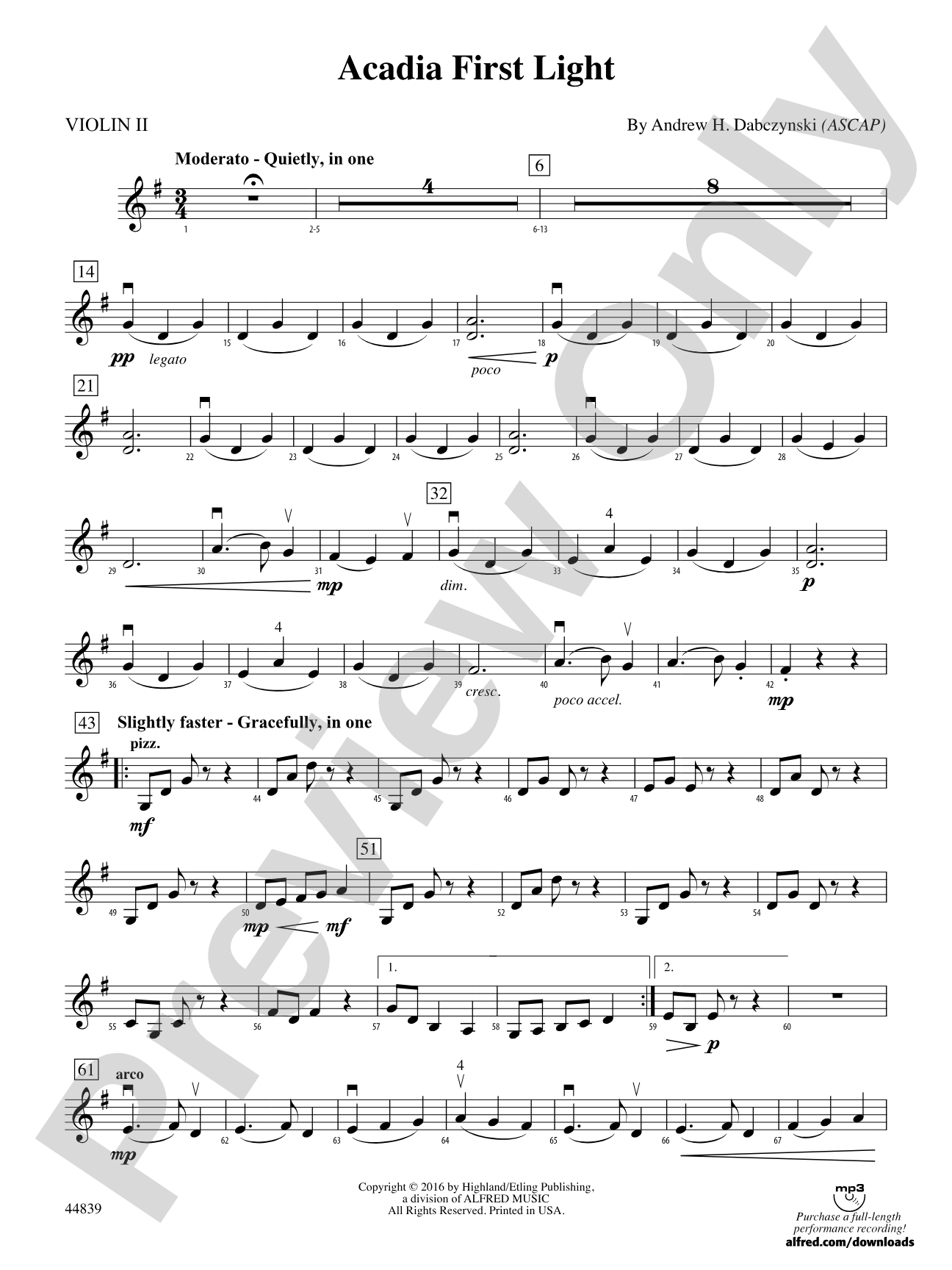

Acadia First Light: 2nd Violin
By Andrew H. Dabczynski
Grade: 2.5
Item: 00-PC-0017356_VN2
$5.99
Pickup currently not available
Description
This work sensitively conveys the rising sun as it first greets America each morning on Cadillac Mountain at Acadia National Park. Written by Andrew H. Dabczynski in celebration of that park's centennial, this enchanting piece provides an opportunity for young string players to musically express the magic of dawn on the mountain, of light sparkling on the ocean, of swelling seas as a squall approaches, and of the returning calm as the light recedes. "Acadia First Light" will transport players and audiences alike to Acadia, that treasured national gem. (3:30)


Don't just read it, hear it, play along with it, and watch your students grow with it. In MakeMusic Cloud, Acadia First Light: 2nd Violin comes alive with professional accompaniment, adjustable tempo, and built-in practice tools that turn solo practice into real progress.
Open in the Player
Jump straight in and assign it today.
Start Your Free Trial
Open this title and explore the full library in minutes.
Sample Audio
1
Audio File
--:--
0:00
0:00
Sample Video
Additional Details
Series:
Highland/Etling String Orchestra
Publisher:
Alfred Music
Page Count:
124
SKU:
00-PC-0017356_VN2
More about this title
About the Composer: Andrew H. Dabczynski

Andrew H. Dabczynski served as Emeritus Professor of Music Education at Brigham Young University, where he founded and directed the "New Horizons Orchestra," a beginning string ensemble for adult learners that also functioned as a training laboratory for string educators. His contributions to music education earned him BYU's Joseph E. White Fellowship for Teaching and Learning, and Utah ASTA recognized him as their Higher Education Teacher of the Year in 2005 and again in 2014 for his sustained impact on the field.
Throughout his career, Dabczynski held positions at the Eastman School of Music and in several public school districts, including serving as Supervisor of Fine Arts Education in Waterford, Michigan. A trained violist with performance experience in regional orchestras including the Rochester Philharmonic and Hartford Symphony, he has also co-authored the widely adopted String Explorer method series and pursued research in folk music traditions and fiddling pedagogy. His work reflects a deep commitment to accessible, meaningful string music education.
Why we love this
This piece channels a specific, vivid landscape into orchestral language that beginners can actually play. Rather than asking young string players to imagine an abstract concept, Dabczynski gives them a concrete journey from dawn to approaching storm to calm, complete with accompaniment material that feels natural under the fingers at Grade 2.5. The score captures a genuine sense of place without requiring advanced technical facility.
What to expect
Acadia First Light moves like dawn itself: unhurried, luminous, and gradually revealing. The opening is quiet and tentative, the orchestration thin and warm as light first touches the mountain. As the piece builds, listeners are drawn into richer harmonies and swelling motion, the brightness intensifying until a sudden squall brings darker, more agitated textures. The final return to calm feels earned rather than rushed, settling into the same peaceful space where the music began.
Who it's for
String orchestras at the Grade 2.5 level, including school orchestras with mixed experience and community ensembles beginning their repertoire journey. Teachers seeking music that balances technical accessibility with genuine artistic depth will find this accessible without feeling juvenile.
How to get the most out of it
- Shape the opening sunrise passage with soft dynamic swells; young players often play too steadily, so use rehearsal time to explore how light actually breaks across a mountain rather than arriving all at once.
- Balance the orchestration carefully during the ocean imagery sections. Parts are well-distributed across the ensemble, but confirm that lower voices and inner parts are audible without overpowering the primary melodic line.
- Mark the transition into the squall section clearly in parts so players understand the shift in character and tempo. This moment should feel like a genuine weather change, not just a louder passage.
- Allow time for the ensemble to settle into the final return to calm. The musical descent mirrors the sunrise in reverse, and rushing this section loses the contemplative power that makes the piece memorable.
How to use it
Program this as the opening piece of a spring concert to create an immediate sense of place and mood that transports the audience before the main repertoire begins. It works equally well as a festival entry or standalone recital offering that demonstrates your ensemble's ability to shape musical narrative through dynamic and orchestration control. Consider pairing it with other nature-inspired or program music to build a thematic concert around landscape and atmosphere.
Skills your students will build
- Dynamic control and shaping across long phrases
- Sustained tone production and vibrato expression
- Sectional balance in multi-part orchestration
- Responding to conductor cues for tempo and character changes
- Musical storytelling through orchestral color and texture
- Coordination of ensemble entrances and transitions