
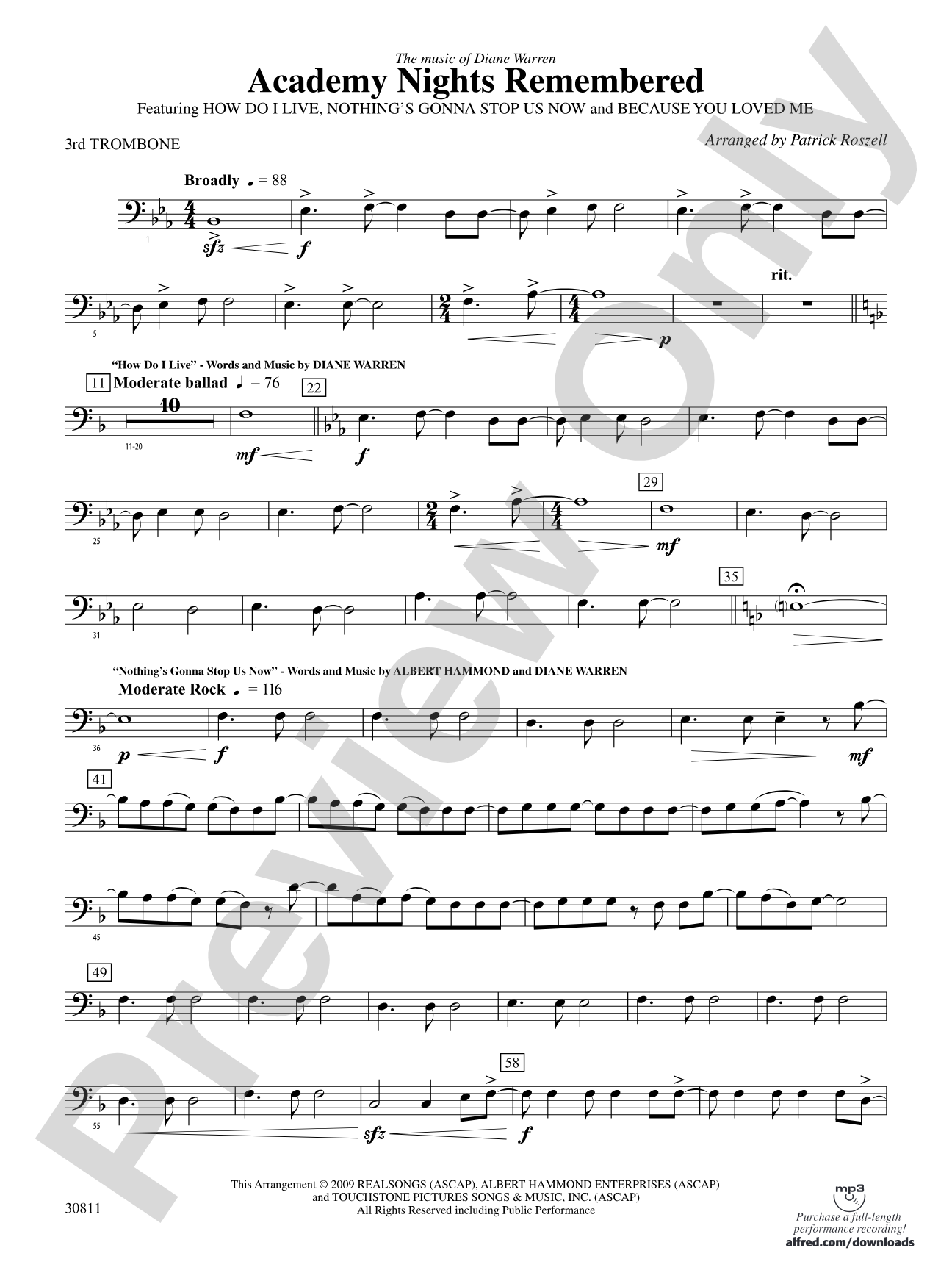

Academy Nights Remembered (The Music of Diane Warren): 3rd Trombone
Featuring: How Do I Live / Nothing's Gonna Stop Us Now / Because You Love Me
[Diane Warren] / arr. Patrick Roszell
Grade: 3 (Medium Easy)
Item: 00-PC-0015729_TN3
$5.99
Pickup currently not available
Description
From the opening music right through the end of the awards, this very musical medley has your audience right there! Featuring "How Do I Live," "Nothings Gonna Stop Us Now," and "Because You Love Me," the medley concludes with all the grandeur from the awards broadcast. All composed by award winner Diane Warren, this medley is sure to bring the house down! (5:26)


Don't just read it, hear it, play along with it, and watch your students grow with it. In MakeMusic Cloud, Academy Nights Remembered (The Music of Diane Warren): 3rd Trombone comes alive with professional accompaniment, adjustable tempo, and built-in practice tools that turn solo practice into real progress.
Open in the Player
Jump straight in and assign it today.
Start Your Free Trial
Open this title and explore the full library in minutes.
Sample Audio
1
Audio File
--:--
0:00
0:00
Sample Video
No sample videos found.
Additional Details
Series:
Pop Concert Band
Publisher:
Alfred Music
Page Count:
258
SKU:
00-PC-0015729_TN3
More about this title
About the Composer: Diane Warren
Diane Warren stands among the most prolific songwriters in contemporary music, with an unmatched track record of crafting hits across film, television, and popular music. Her compositions have earned multiple Grammy nominations and Academy Award recognition, making her one of the few songwriters to achieve sustained success across decades and multiple genres. Warren's gift for melody and emotional directness translates powerfully to concert settings, where her songs retain their accessibility while offering substantial musical substance for ensemble performance.
Why we love this
Patrick Roszell's arrangement captures the cinematic sweep of an awards broadcast while keeping the ensemble engaged throughout a substantial medley. The Grade 3 scoring balances accessibility with musicality, allowing strong execution from developing bands without sacrificing the grandeur and emotional arc that made these songs resonate with audiences. Programming this gives your band a contemporary repertoire piece that audiences genuinely recognize and enjoy, creating that rare moment when your concert connects with listeners beyond the school community.
What to expect
This medley brings the sophisticated production values and emotional drama of an awards ceremony directly into your concert hall. The arrangement honors the sweeping, cinematic quality of the original songs while building toward a climactic finish that leaves audiences energized and satisfied.
Who it's for
Concert band directors looking for contemporary repertoire that engages both performers and audiences with recognizable, emotionally resonant material. This works well for ensembles at the Grade 3 level seeking something substantial beyond traditional classical programming while remaining accessible to developing players.
How to get the most out of it
- Shape the transitions between songs deliberately. Each medley section needs a distinct character and tempo relationship, so establish clear sectional boundaries in rehearsal rather than letting the piece drift from one song to the next.
- Balance the melody against the harmonic texture in the accompaniment parts. The woodwind and brass lines need definition so the main themes remain singable and clear, even in the fuller sections.
- Reserve energy for the final section. The conclusion promises awards-broadcast grandeur, which means earlier sections should sit in a comfortable dynamic range that allows for genuine crescendo and impact at the end.
- Lock the rhythmic foundation in the low reeds and brass early. Popular music idioms demand rhythmic precision, particularly in the accompanying parts, so secure that foundation before refining the outer voices.
How to use it
Program this as a concert closer or anchor your pop-focused concert around it. The recognizable material and substantial runtime (5:26) make it strong enough to stand alone or to provide contrast and contemporary flavor when paired with classical or jazz selections. It works particularly well for spring concerts, pops nights, or community events where you want to showcase your band's musicality while acknowledging contemporary musical tastes.
Skills your students will build
- Sustaining legit phrasing in popular music idioms
- Balancing solo lines against ensemble accompaniment
- Executing smooth transitions between contrasting sections
- Building dynamic contrast and narrative arc across an extended medley
- Responding to film and media repertoire with appropriate style and weight