
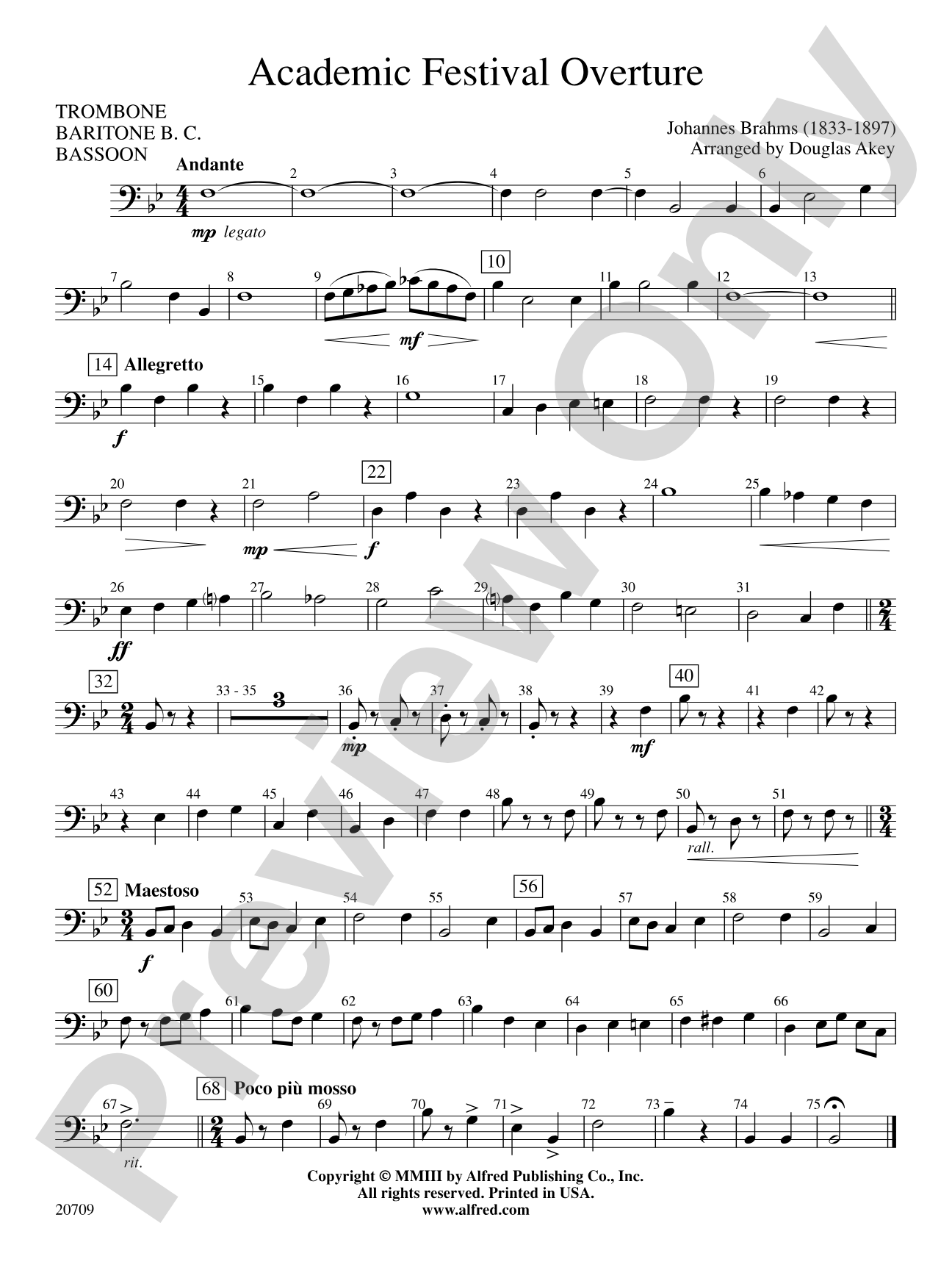

Academic Festival Overture: 1st Trombone
By Johannes Brahms / arr. Douglas Akey
Grade: 1 (Very Easy)
Item: 00-PC-0000445_TN1
$3.00
Pickup currently not available
Description
Brahms's Academic Festival Overture was composed in the summer of 1880 for the conferment of his own honorary doctorate of philosophy degree by Breslau University. The piece is based on a number of student songs that would have been familiar to those in attendance at the time. The themes derived from four of those songs have been used in this arrangement for young band and are presented in the same order in which they appear in Brahms's original. Careful attention to the written dynamics and articulations will aid your students in creating an authentic performance of this transcription. A perfect choice for young bands at festival.


Don't just read it, hear it, play along with it, and watch your students grow with it. In MakeMusic Cloud, Academic Festival Overture: 1st Trombone comes alive with professional accompaniment, adjustable tempo, and built-in practice tools that turn solo practice into real progress.
Open in the Player
Jump straight in and assign it today.
Start Your Free Trial
Open this title and explore the full library in minutes.
Sample Audio
1
Audio File
--:--
0:00
0:00
Sample Video
No sample videos found.
Additional Details
Series:
Alfred Debut Series
Publisher:
Alfred Music
Page Count:
118
SKU:
00-PC-0000445_TN1
More about this title
About the Composer: Johannes Brahms
Johannes Brahms (1833–1897) stands among the most significant composers of the Romantic era, bridging the classical forms of the 18th century with the expressive language of his own time. His works span symphonies, concertos, chamber music, and vocal music; they are marked by rigorous craftsmanship, memorable melody, and emotional depth. Brahms spent much of his career in Vienna, where he became a towering figure in the musical life of the city and a beloved mentor to younger composers.
The Academic Festival Overture, written when Brahms was at the height of his powers, reflects both his academic rigor and his warmth. Composed to celebrate his own honorary doctorate from the University of Breslau, the piece draws on student songs familiar to the university community. Rather than creating something lofty or distant, Brahms wove together these folk melodies into a work that is both sophisticated and approachable, making it an ideal gateway to the masterworks for young musicians.
Why we love this
This arrangement opens the Academic Festival Overture to young bands without sacrificing the piece's character or architectural logic. Douglas Akey's Grade 1 transcription preserves the original's emotional arc and four distinctive student song melodies while distributing the parts accessibly across your ensemble. Young musicians get to experience a genuine Brahms masterwork, not a simplified imitation, and gain confidence tackling repertoire that sounds mature and substantial.
What to expect
The Academic Festival Overture carries warmth and celebration without sentimentality. Each student song unfolds with its own character, from straightforward and jaunty to wistful and lyrical, creating a sense of gathering and remembrance. The piece builds gradually from intimate moments to a triumphant conclusion that leaves audiences energized and players proud of what they've accomplished.
Who it's for
Young concert bands at Grades 1–2 who are ready to tackle a work with genuine musical substance and historical significance. Students preparing for festival or concert performance will benefit from Akey's thoughtful handling of the original orchestration and clear part writing. This arrangement welcomes musicians who have solid fundamentals but may be encountering Brahms for the first time.
How to get the most out of it
- Shape each student song melody with clear phrasing and consistent vibrato in the woodwind and brass soloists; these tunes deserve the respect you'd give a Brahms symphony.
- Honor every written dynamic marking and articulation as Akey has adapted them from the original score. The contrast between marcato and legato passages is essential to the work's character.
- Balance the ensemble carefully when melodies pass between sections; Brahms rarely gives the tune to just one instrument, so blend and transparency matter as much as individual voice quality.
- Allow the piece to breathe at structural turning points. This is not a march; it unfolds with reflection and purpose, so resist the urge to rush transitions between the four songs.
How to use it
Open a concert or festival set with this piece to establish sophistication and set an ambitious tone for the performance ahead. Its moderate length and uplifting conclusion make it an excellent closer as well, particularly when paired with lighter contemporary works that show contrast. Directors often program the Academic Festival Overture as a capstone to a year's worth of growth, giving students a tangible measure of how far they've come.
Skills your students will build
- Balancing melody across sections in a multi-thematic structure
- Responding to dynamic shaping and articulation as compositional narrative
- Ensemble blend and transparency when doubling and passing voices
- Sustaining musical line and phrasing over longer formal structures
- Performing Romantic-era repertoire with stylistic awareness