
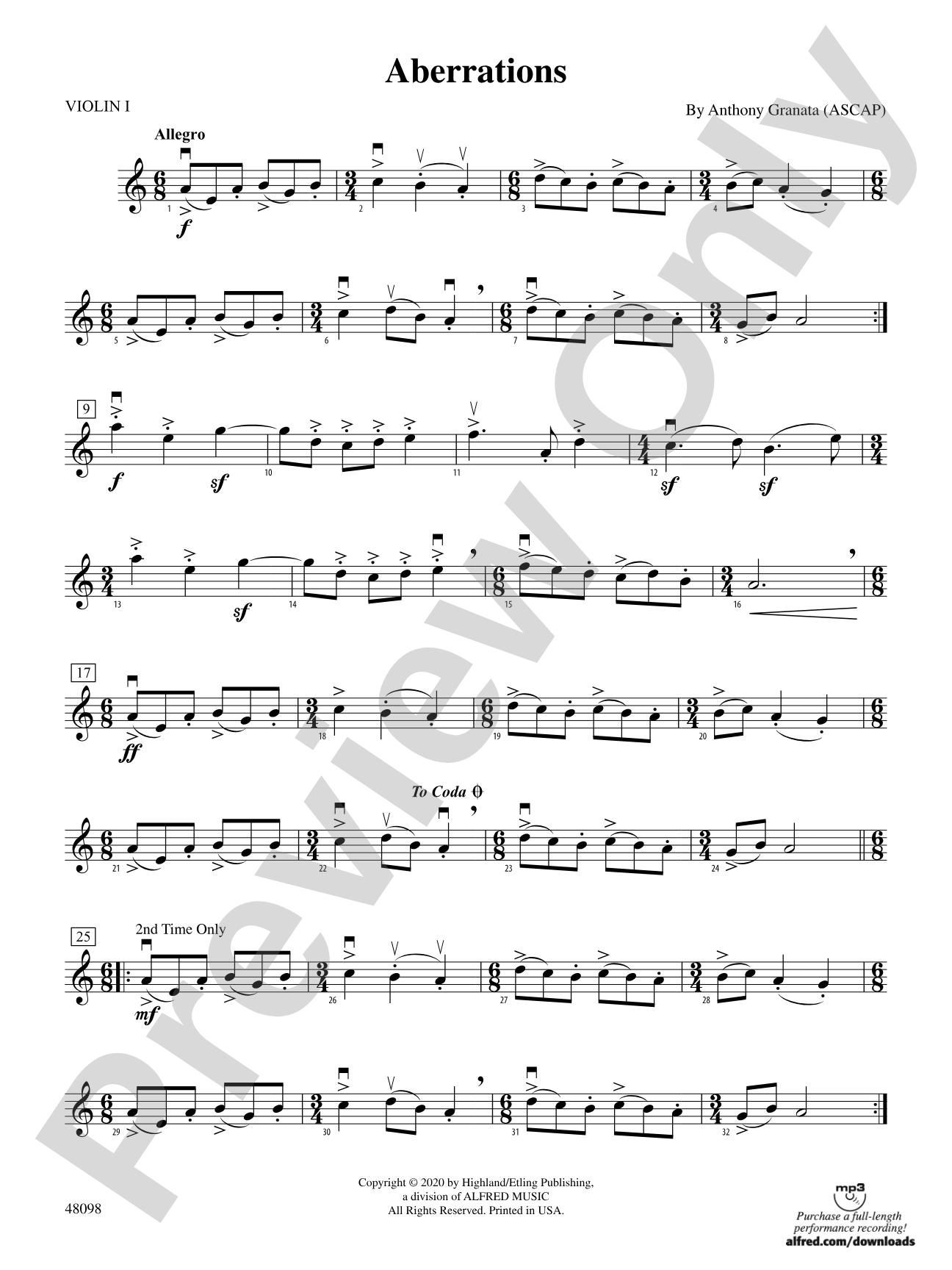

Aberrations: 1st Violin
By Anthony Granata
Grade: 3
Item: 00-PC-0018533_VN1
$3.00
Pickup currently not available
Description
Aberrations by Anthony Granata is an exciting contemporary work with constant deviation of time signature, rhythmic intensity, modern harmonies, and variety of counterpoint. The title refers to the frequent changes of the time signature, requiring musicians to move in and out of 6/8, 3/4, and 4/4. The double fugue and abundance of contrapuntal interplay make this a thrilling and challenging piece for your advanced orchestras. Students will love the driving accented A minor motif, the layered rich legato countermelodies, and the forceful coda. (2:45) This title is available in MakeMusic Cloud.


Don't just read it, hear it, play along with it, and watch your students grow with it. In MakeMusic Cloud, Aberrations: 1st Violin comes alive with professional accompaniment, adjustable tempo, and built-in practice tools that turn solo practice into real progress.
Open in the Player
Jump straight in and assign it today.
Start Your Free Trial
Open this title and explore the full library in minutes.
Sample Audio
1
Audio File
--:--
0:00
0:00
Sample Video
Additional Details
Series:
Highland/Etling String Orchestra
Publisher:
Alfred Music
Page Count:
124
SKU:
00-PC-0018533_VN1
More about this title
About the Composer: Anthony Granata

Anthony Granata is a Connecticut-based composer and string educator who draws directly from his classroom experience. A violist and Western Connecticut State University graduate, he has taught orchestra, band, and chorus across elementary, middle, and high school levels, with deep roots in the Norwalk public schools where he first learned violin and viola.
Granata began composing at age twelve and returned to writing music intentionally to help his young string players navigate advanced musical concepts. He currently teaches middle school orchestra in Westport, Connecticut, while pursuing a degree in school administration. His work reflects genuine advocacy for public school music programs and a commitment to creating repertoire that challenges and engages developing musicians.
Why we love this
Aberrations solves a real challenge for advanced string directors: finding contemporary work that demands technical and musical maturity without sacrificing student engagement. The constant metric shifts feel organic rather than gimmicky, and the double fugue structure rewards serious preparation while the accented minor motif gives students an immediately satisfying payoff.
What to expect
Aberrations pulses with restless energy, constantly shifting ground beneath the listener's feet through its meter changes while maintaining relentless forward motion. The interweaving melodic lines create richness and dialogue, and the driving final section resolves the piece's formal tensions into a forceful, satisfying conclusion.
Who it's for
Advanced string orchestras and upper-level high school ensembles ready for metric complexity and contrapuntal density. This work demands secure rhythmic reading, individual musicianship, and willingness to sit with contemporary harmonic language.
How to get the most out of it
- Mark the time signature changes clearly in each part and conduct with precision during transitions; students need visual confirmation when moving between 6/8, 3/4, and 4/4.
- Isolate the contrapuntal sections in sectional rehearsals, assigning each voice its own melodic identity so players understand their role in the layered texture.
- Balance the legato countermelodies by asking those voices to sing through their parts first, establishing phrasing and bow distribution before adding rhythmic complexity.
- Bring the coda to full intensity by rehearsing the accented A minor material with the ensemble standing; the physical engagement helps drive the energy you need in those final measures.
How to use it
Program this as the anchor of a contemporary strings concert or as a contest/festival showcase piece that demonstrates your orchestra's technical command and interpretive maturity. At just under three minutes, it pairs well with a longer Classical work or Romantic concerto, offering contrast in both idiom and era.
Skills your students will build
- Reading and executing frequent time signature changes (6/8, 3/4, 4/4) without losing pulse
- Maintaining individual melodic lines within dense contrapuntal textures
- Understanding double fugue structure and voice independence
- Sustaining legato phrasing across metric modulations
- Responding to detailed articulation and dynamic markings in contemporary notation