
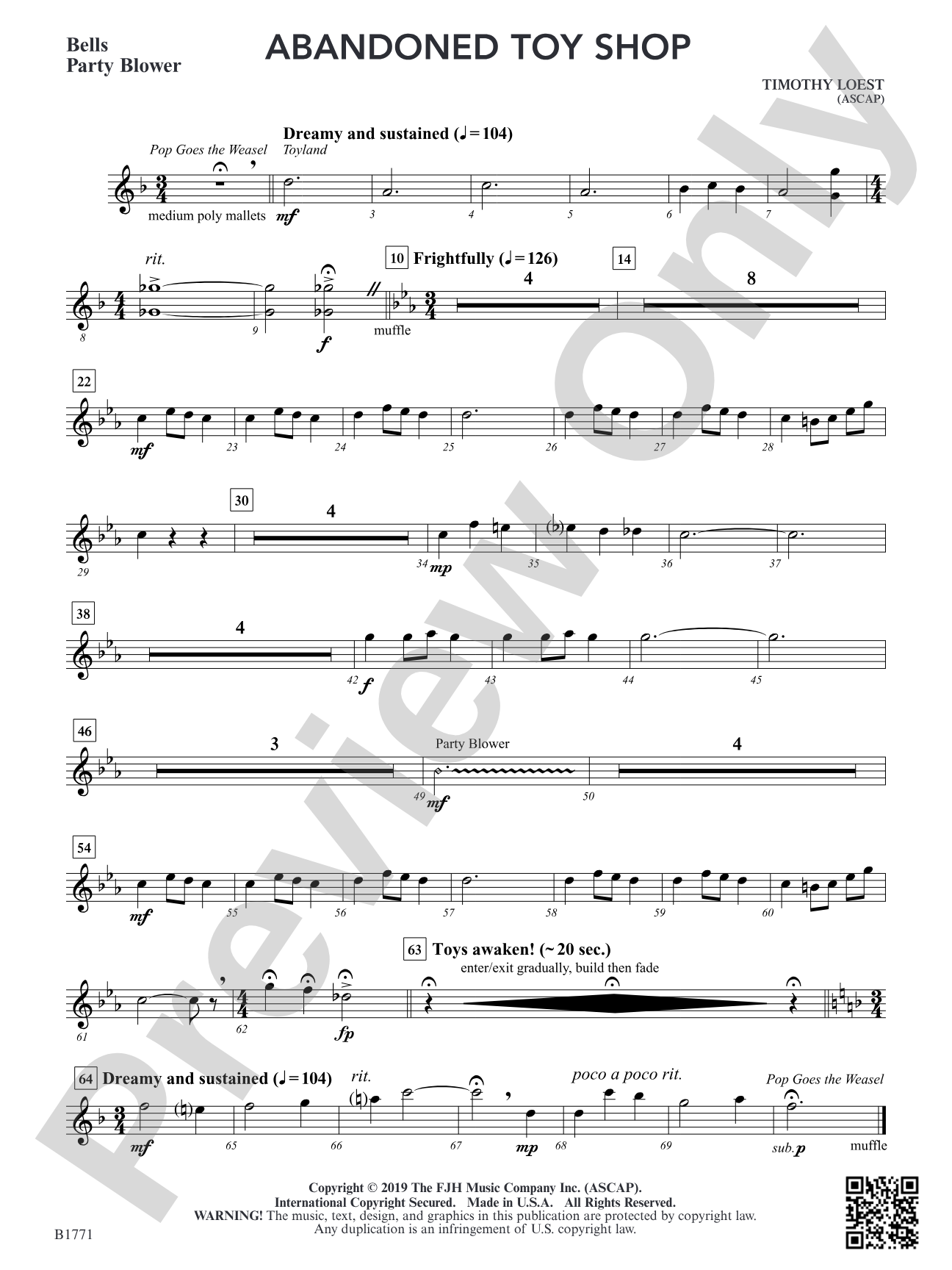

Abandoned Toy Shop: Bells
By Timothy Loest
Grade: 1
Item: 98-PC-DB1771_B
$7.00
Pickup currently not available
Description
Orphaned toys come to life in this eerie tour of an abandoned toy store. The work opens and closes with Victor Herbert’s dreamlike Toyland as a Jack-in-the-box plays Pop Goes the Weasel. A wealth of toy sounds make their appearance among diminished chords, tri-tones, and the Dies Irae, which surrounds an aleatoric section featuring a whole host of noisy toys. Highly accessible, extremely creative, and definitely memorable!


Don't just read it, hear it, play along with it, and watch your students grow with it. In MakeMusic Cloud, Abandoned Toy Shop: Bells comes alive with professional accompaniment, adjustable tempo, and built-in practice tools that turn solo practice into real progress.
Open in the Player
Jump straight in and assign it today.
Start Your Free Trial
Open this title and explore the full library in minutes.
Sample Audio
1
Audio File
--:--
0:00
0:00
Sample Video
Additional Details
Series:
FJH Beginning Band
Publisher:
The FJH Music Company, Inc.
SKU:
98-PC-DB1771_B
More about this title
About the Composer: Timothy Loest

Timothy Loest has spent over three decades in the classroom developing a compositional voice that balances accessibility with genuine musicality. His works for young band are performed internationally, and his influence extends beyond composition; he has contributed to several widely adopted band methods, including Measures of Success and the Beyond series, while also founding Fanfare Music Press in 2022 to publish high-quality band literature. His compositions have appeared on major network television programs including The Tonight Show Starring Jimmy Fallon and Good Morning America, and in 2017 he received the Illinois Grade School Music Association's Cloyd Myers Memorial Award for Excellence in Music Education.
Loest earned his Bachelor of Music Education from Illinois State University and his Master of Music from Northwestern University. He taught for his entire career at F.E. Peacock Middle School in Itasca, Illinois, and holds memberships in ASCAP and the Illinois Grade School Music Association. His willingness to accept commissions demonstrates his continued investment in creating music that serves the educational and artistic needs of young musicians.
Why we love this
This piece delivers exactly what Grade 1 students crave: a narrative arc with theatrical flair and genuine musical substance. Loest threads recognizable melodies (Toyland, Pop Goes the Weasel) through unsettling harmonic terrain, creating a score that teaches harmonic color and aleatoric techniques while keeping students engaged with the unfolding story of abandoned toys coming to life.
What to expect
Eerie and whimsical in equal measure, as if you're walking through a dusty toy store where the toys have begun to stir. The dreamlike opening pulls you in gently, but as the diminished chords and tritones accumulate alongside the scratches and squeaks of animated toys, the piece tilts toward the unsettling, anchored by the Dies Irae's distant tolling. By the end, when Toyland returns, you're not quite sure if the toys have settled back into stillness or are simply waiting.
Who it's for
This score is ideal for Grade 1 concert bands ready to tackle something conceptually ambitious without overwhelming instrumental demands. It works beautifully for groups preparing contest and festival submissions, since the piece combines accessibility with creativity and gives students a narrative to invest in beyond basic technique.
How to get the most out of it
- Let the Jack-in-the-box mechanism (Pop Goes the Weasel excerpts) become a recurring character students recognize; clear attacks and precise rhythm at the repeating moments will make this device memorable for the audience.
- Build the aleatoric toy section gradually in rehearsal; students need to understand what controlled chaos sounds like before attempting it together, so workshop this section separately before integrating it into the full score.
- Balance the eerie elements (diminished chords, tritones, Dies Irae) against the playful toy sounds so neither overwhelms; the contrast between menacing and whimsical is what makes this arrangement work.
- Use the Dies Irae passages as teaching moments for understanding how classical musical references can add weight and sophistication to a Grade 1 arrangement.
How to use it
Program this early in a concert to set a distinctive mood and give the audience a reason to lean in; its novelty appeal makes it a strong opener that still demonstrates serious musicianship. It pairs well on a festival or contest program with more traditional Grade 1 selections, since it shows range and interpretive depth without requiring unusual instrumental demands.
Skills your students will build
- Harmonic color and dissonance (diminished chords, tritones, Dies Irae context)
- Controlled execution of aleatoric and graphic notation passages
- Recognition of classical musical quotations and their expressive use in arrangement
- Ensemble cohesion during complex rhythmic and textural changes
- Articulation and tonal control for characterization (toy sounds versus melodic material)