
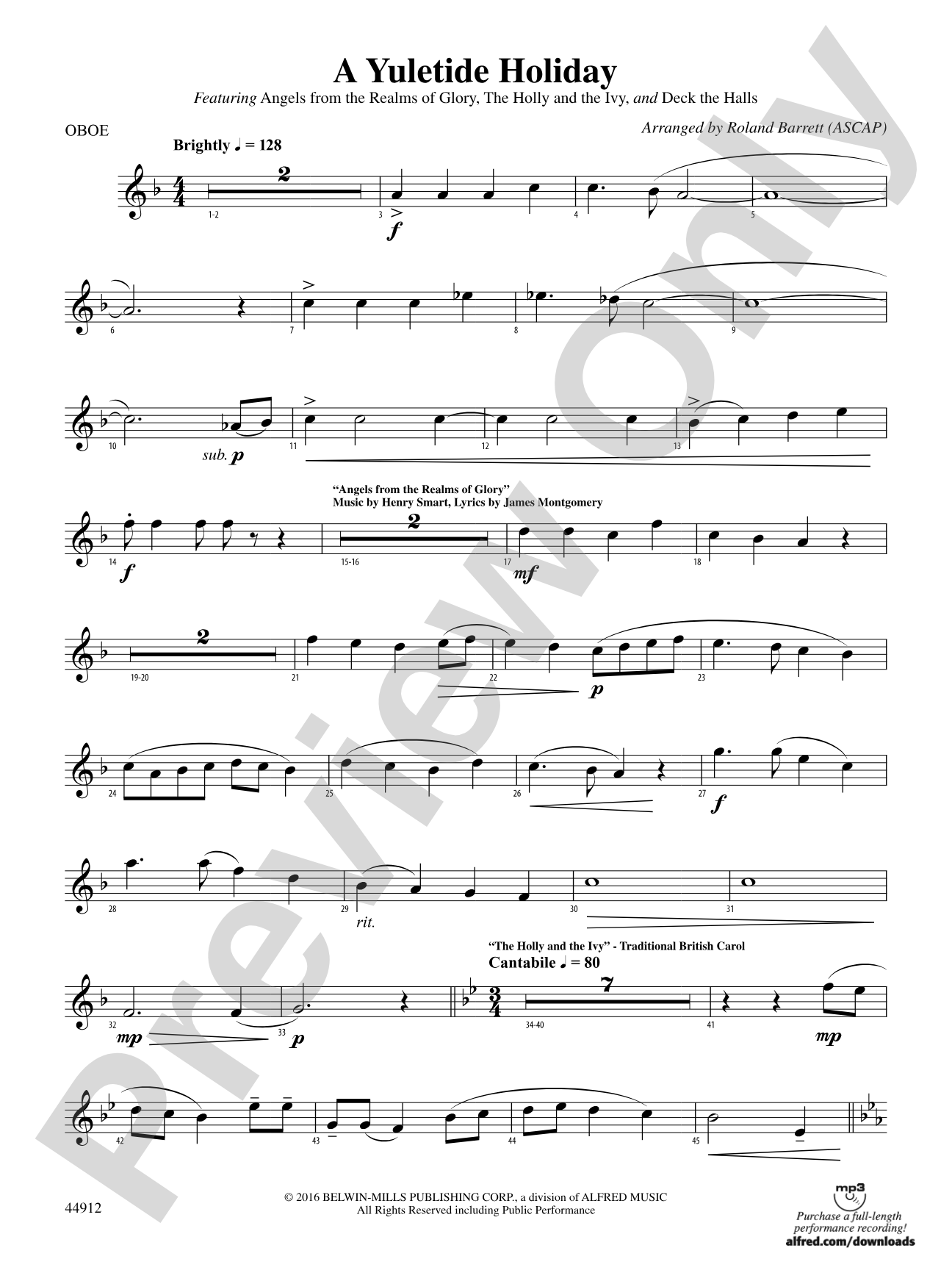

A Yuletide Holiday: Oboe
Featuring: Angels from the Realms of Glory / The Holly and the Ivy / Deck the Halls
Various / arr. Roland Barrett
Grade: 2 (Easy)
Item: 00-PC-0017403_O1
$3.00
Pickup currently not available
Description
Featuring the well-known Yuletide favorites "Angels from the Realms of Glory," "The Holly and the Ivy," and "Deck the Halls," this festive medley captures the spirit of the season for students and audiences alike. Each carol has roots from the United Kingdom and is charismatically scored, showcasing each section of your band with a wide variety of textures and tempo. Musically compelling! (3:00)


Don't just read it, hear it, play along with it, and watch your students grow with it. In MakeMusic Cloud, A Yuletide Holiday: Oboe comes alive with professional accompaniment, adjustable tempo, and built-in practice tools that turn solo practice into real progress.
Open in the Player
Jump straight in and assign it today.
Start Your Free Trial
Open this title and explore the full library in minutes.
Sample Audio
1
Audio File
--:--
0:00
0:00
Sample Video
Additional Details
Series:
Belwin Young Band
Publisher:
Alfred Music
Page Count:
256
SKU:
00-PC-0017403_O1
More about this title
About the Arranger: Roland Barrett

Roland Barrett has shaped multiple generations of student musicians through his work at the University of Oklahoma, where he joined the music theory and composition faculty in 2001. His career spans decades as both an educator and prolific arranger, with over two hundred published works for symphonic and marching bands, as well as chamber ensembles. His compositions and arrangements have earned recognition from the Dallas Wind Symphony, numerous All-State and All-District Honor Bands, and national platforms including NPR, the Midwest Band & Orchestra Convention, and the International Trumpet Guild.
Beyond the classroom, Barrett continues to arrange music for the Pride of Oklahoma marching band and has received multiple ASCAPlus awards for his creative output. His focus on twentieth-century composition and theory informs arrangements that balance accessibility with musical substance, making his work particularly valuable for student ensembles seeking repertoire that challenges without overwhelming.
Why we love this
Barrett's arrangement reveals what makes these three carols endure: he distributes the melodic material across your entire band, ensuring every section carries the tune at some point and stays actively engaged throughout. The variety of textures and tempo shifts within three minutes prevents any single carol from wearing thin, and Grade 2 scoring means your students can execute the musical intentions without technical firefighting.
What to expect
Three beloved British carols unfold with warmth and gentle sophistication. The arrangement breathes between sections, allowing each tune to establish its own character while the orchestration reinforces the festive, communal spirit these melodies carry.
Who it's for
Directors programming a winter concert need reliable, musically substantial repertoire that audiences recognize and students can prepare quickly. This medley works equally well as a concert opener or closer and requires no soloists or special instrumentation beyond a standard concert band.
How to get the most out of it
- Balance the melody against harmonic support by asking your woodwinds and brass to listen for weight; with three tunes stacked across three minutes, clarity of line matters more than volume.
- Mark the tempo transitions between carols clearly on your score and parts so the band can anticipate the shift rather than react to it.
- Identify which sections carry the main tune in each carol during your first read-through; this focuses rehearsal time on the sections that need precision first.
How to use it
Position this medley as your winter concert anchor; its three-minute span and familiar melodies give audiences a moment of genuine connection. Pair it with a contrasting non-holiday piece to round out your programming and showcase the band's range.
Skills your students will build
- Playing within a multi-voice texture while maintaining awareness of the primary melody
- Executing rhythmic precision across multiple key and tempo changes
- Balancing individual part responsibility with ensemble blend
- Responding to conductor tempo and style changes between sections