
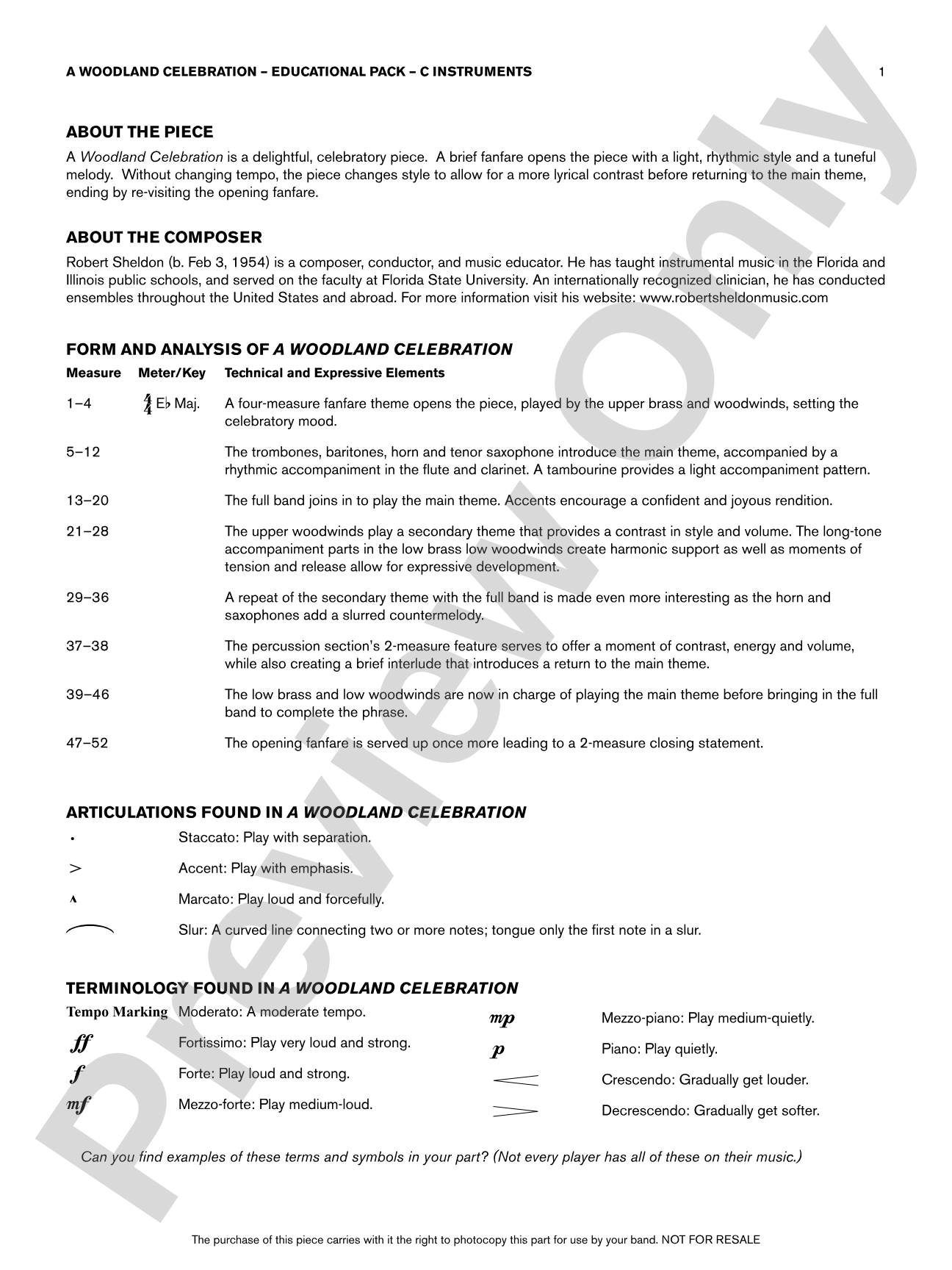

A Woodland Celebration: C Educational Pack
By Robert Sheldon
Grade: 1 (Easy)
Item: 00-PC-0018664_C_EDPAK
$3.00
Pickup currently not available
Description
Perfect for opening or closing a concert for first-year band students, A Woodland Celebration by Robert Sheldon lends a light rhythmic style to a tuneful melody. This piece is easily playable as soon as young students can play a concert B-flat scale and learn the note concert A-flat. Second clarinet does not go over the break, and second trumpet and horn also have limited ranges.
A Woodland Celebration was commissioned by the Smallwood Drive School Band, Amherst, New York (Angela Antersol, Director) with appreciation for the generosity of the Smallwood PTA in celebration and recognition of the National School of Character Award presented to the school in 2019.
A Woodland Celebration correlates to Book 1, Level 5 of Sound Innovations for Concert Band. (1:45)


A Woodland Celebration was commissioned by the Smallwood Drive School Band, Amherst, New York (Angela Antersol, Director) with appreciation for the generosity of the Smallwood PTA in celebration and recognition of the National School of Character Award presented to the school in 2019.
A Woodland Celebration correlates to Book 1, Level 5 of Sound Innovations for Concert Band. (1:45)
Don't just read it, hear it, play along with it, and watch your students grow with it. In MakeMusic Cloud, A Woodland Celebration: C Educational Pack comes alive with professional accompaniment, adjustable tempo, and built-in practice tools that turn solo practice into real progress.
Open in the Player
Jump straight in and assign it today.
Start Your Free Trial
Open this title and explore the full library in minutes.
Sample Audio
1
Audio File
--:--
0:00
0:00
Sample Video
Additional Details
Series:
Sound Innovations for Concert Band
Publisher:
Alfred Music
Page Count:
85
SKU:
00-PC-0018664_C_EDPAK
More about this title
About the Composer: Robert Sheldon

Robert Sheldon stands among the most widely performed composers in wind band repertoire today. His works appear on festival and contest programs across the globe, and he has received major recognition from the American School Band Director's Association, Phi Beta Mu, and ASCAP. Beyond composing, Sheldon serves as lead author of Sound Innovations for Concert Band and maintains an active schedule as guest conductor for All-State and regional honor bands.
His conducting and clinician work spans the United States and international venues including Japan, Canada, Italy, Germany, Australia, and China. Sheldon has led performances of his compositions at Carnegie Hall, Orchestra Hall in Chicago, Boston Symphony Hall, the Sydney Opera House, and the Kennedy Center for the Performing Arts. VanderCook College of Music awarded him an honorary doctorate in 2020.
Why we love this
This piece nails the opening number for first-year students without overextending young players. The accessible range and straightforward rhythmic profile let new musicians experience success on stage while a genuinely pleasant melody ensures audiences stay engaged rather than endure a confidence-builder.
What to expect
A stroll through a bright woodland with dappled sunlight breaking through the trees. The rhythmic vitality feels like movement and light discovery rather than heavy marching, with a tuneful backbone that sits contentedly in the ears.
Who it's for
First-year band students who have mastered the concert B-flat scale and can read concert A-flat comfortably. The limited range requirements for second clarinet, second trumpet, and horn make this accessible to players still developing their technique.
How to get the most out of it
- Keep the pulse steady throughout. The light rhythmic style relies on consistent tempo to stay buoyant; any hesitation flattens the character.
- Balance the melody between clarinet and trumpet so neither swallows the other. Young players often overplay their exposed lines.
- Bring out the harmonic colors by asking each section to voice with warmth rather than just playing notes. Even Grade 1 students respond to this cue.
- Shape phrases with slight flexibility in tempo rather than rigid metronomic playing. The woodsy character invites gentle breathing room between ideas.
How to use it
Open a concert with this to set a welcoming tone before more challenging repertoire, or close a program on a high note of accomplishment. At just 1:45, it also pairs well with other Grade 1 selections for a cohesive opening set that showcases the ensemble's abilities without fatigue.
Skills your students will build
- Reading concert pitch transposition (B-flat to concert pitch)
- Sustaining steady rhythmic pulse with ensemble precision
- Balancing melody and harmony within a four-part texture
- Phrasing and dynamic shaping at an early stage
- Playing within a limited range while maintaining tone quality