
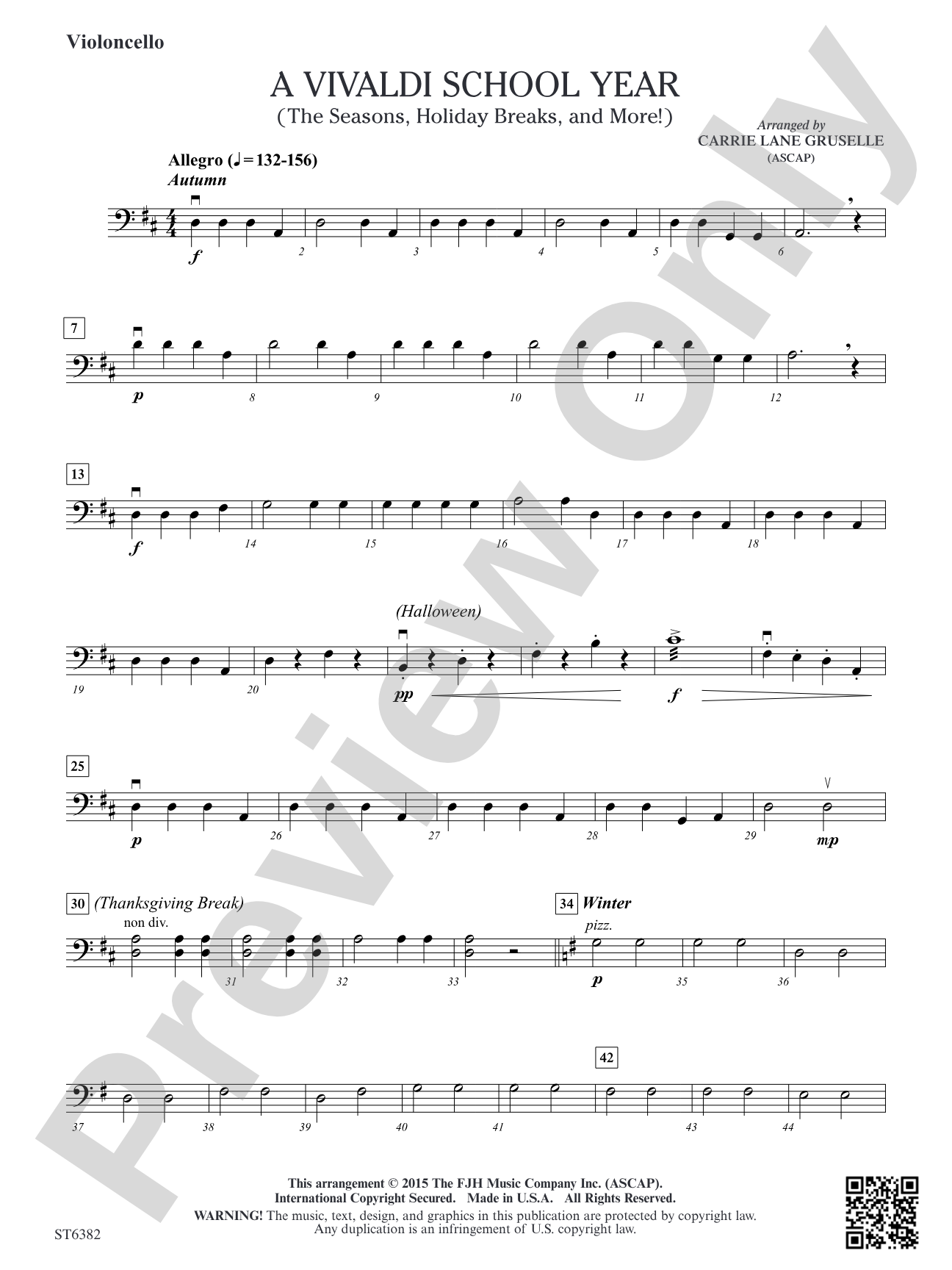

A Vivaldi School Year: Violoncello
Arranged by Carrie Lane Gruselle
Grade: 1.5
Item: 98-PC-DST6382_VC1
$7.00
Pickup currently not available
Description
This remarkably clever arrangement introduces orchestras to each movement of Vivaldi's The Four Seasons as the work follows students through the school year. included are fun themes representing Thanksgiving, Winter break, Spring break (in Hawaii!) and graduation! Hilarious, yet extremely educational and musical. Great Baroque bowing practice sprinkled with seasonal fun!


A Vivaldi School Year: Violoncello isn't in MakeMusic Cloud just yet...but it could be. Let us know you'd like to see it, and you'll help shape what comes next. In the meantime, start a free trial and dive into thousands of interactive titles your students can play along with today.
Request This Title
Tell us you want it.
Start Your Free Trial
Explore everything that's ready to play right now.
Sample Audio
1
Audio File
--:--
0:00
0:00
Sample Video
No sample videos found.
Additional Details
Series:
FJH Beginning Strings
Publisher:
The FJH Music Company, Inc.
SKU:
98-PC-DST6382_VC1
More about this title
About the Arranger: Carrie Lane Gruselle

Carrie Lane Gruselle earned her Bachelor of Music Education from the University of Wisconsin–Eau Claire and continued her studies at the University of Wisconsin–Stevens Point, where she completed a Master's degree with an emphasis in Suzuki pedagogy. She has taught elementary and middle school strings in the Appleton Area School District while also serving as cello instructor for the Lawrence University Arts Academy in Appleton, Wisconsin.
Why we love this
Gruselle captures what makes Vivaldi's Four Seasons universally engaging for young players while anchoring the music to their actual lives. By mapping each season to school milestones (Thanksgiving, winter break, spring break in Hawaii, graduation), she transforms a Baroque masterwork into something students recognize as theirs. The arrangement respects the original's harmonic and melodic content while keeping the technical demands accessible for early orchestras, and the seasonal humor never undermines the legitimate pedagogical value of the piece.
What to expect
Familiar yet fresh. Vivaldi's distinctive melodic shapes and harmonic language come through clearly, giving students authentic contact with Baroque style, but Gruselle's orchestration and clever thematic additions keep the experience playful rather than reverential. The Hawaii section offers a genuinely delightful surprise, while the graduation ending carries real emotional weight appropriate to its context.
Who it's for
String orchestras at the early intermediate level who are ready to tackle a recognizable classical masterwork but need a version that accounts for limited technique and building ensemble skills. Directors looking for a piece that builds genuine excitement about concert programming will find students respond strongly to the seasonal themes and relatable concert context.
How to get the most out of it
- Establish the Baroque articulation style early in rehearsal by isolating the opening phrases and clarifying which notes receive slight separation. Use the score to model the exact detached but flowing character before sectionals dive into parts.
- Balance the dialogue between violin sections carefully, especially in passages where melodies trade between first and second violins. Young players often lock into unison; remind them that inner voices shape the melody just as much as the top line.
- Pay attention to the special effects marking for the Hawaii section. Gruselle writes specific performance instructions here that students will find surprising and fun; rehearse those moments so they land with clarity and humor.
- Emphasize the bow control in the faster figurations, where short strokes must stay light and connected. This is authentic baroque technique wrapped in a piece students are excited to play.
How to use it
Program the movements across the school year as seasonal touchstones, performing each movement at its corresponding concert (fall concert features Autumn and Thanksgiving, winter concert includes Winter, spring concert showcases Spring and Hawaii, and the graduation movement closes the final concert). Alternatively, perform all four movements on a single concert to give young orchestras their first experience with a multi-movement masterwork structure.
Skills your students will build
- Baroque bowing patterns and articulation (separation, legato connections, bow distribution)
- Reading and responding to tempo markings and character indications
- Balancing transparent texture with ensemble blend (dialogue between violin parts, inner voice independence)
- Managing moderate rhythmic variety without complex meter changes
- Sustaining musical line through longer phrases while maintaining rhythmic precision