
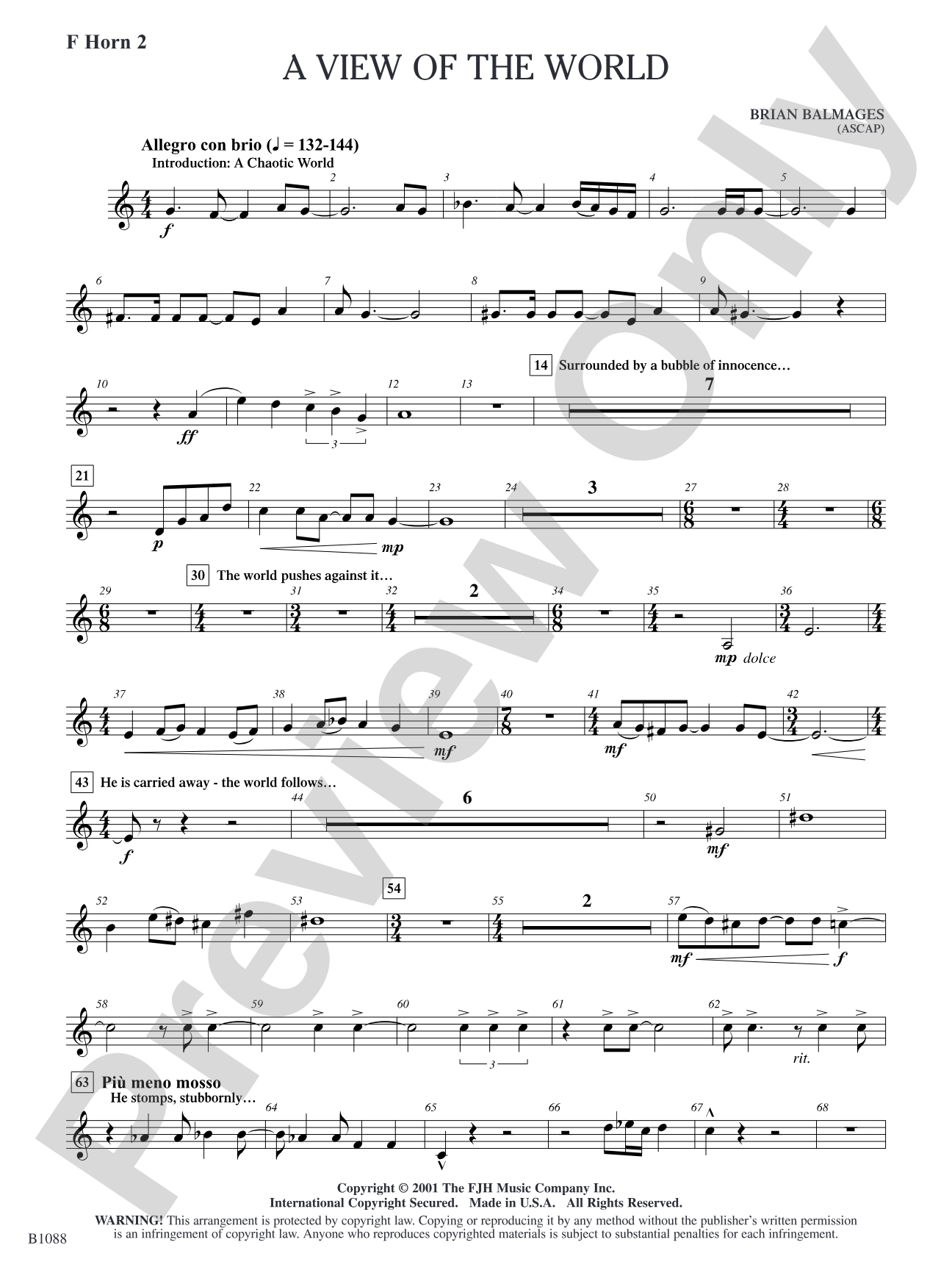

A View of the World: F Horn 2
By Brian Balmages
Grade: 5
Item: 98-PC-DB1088_H2
$7.00
Pickup currently not available
Description
This substantive single-movement work explores a view of the world through the eyes of a child. Captions appear in both the score and parts to indicate each emotional episode as this extensive and powerful work unfolds through many transformations in texture and style. Skillfully conceived and written for the mature band, this is an excellent festival choice. (10:45)


A View of the World: F Horn 2 isn't in MakeMusic Cloud just yet...but it could be. Let us know you'd like to see it, and you'll help shape what comes next. In the meantime, start a free trial and dive into thousands of interactive titles your students can play along with today.
Request This Title
Tell us you want it.
Start Your Free Trial
Explore everything that's ready to play right now.
Sample Audio
1
Audio File
--:--
0:00
0:00
Sample Video
No sample videos found.
Additional Details
Series:
FJH Concert Band
Publisher:
The FJH Music Company, Inc.
SKU:
98-PC-DB1088_H2
More about this title
About the Composer: Brian Balmages

Brian Balmages has built a rare career moving fluidly across orchestral, band, and chamber music contexts, earning commissions and performances from professional ensembles, universities, and K-12 programs alike. His work has appeared on stages from Carnegie Hall to the Sydney Opera House, and he received the A. Austin Harding Award from the American School Band Directors Association along with the 2020 NBA William D. Revelli Composition Contest prize for Love and Light. A member of the American Bandmasters Association, Balmages holds the inaugural James Madison University Distinguished Alumni Award and has conducted all-state ensembles, university groups, and professional orchestras across the United States, Australia, Italy, and beyond.
Balmages currently serves as Director of MakeMusic Publications and Digital Education for Alfred and MakeMusic, a role that reflects his deep investment in music education at every level. His music was performed during the 2013 Presidential Inaugural Prayer Service and he maintains active guest conducting relationships with major conferences including the Midwest Clinic and Western International Band Clinic.
Why we love this
A View of the World succeeds because it treats emotional storytelling with musical sophistication rather than sentimentality. The captioned episodes give your band a narrative arc to follow without forcing the narrative into the music, and the constant textural and stylistic shifts demand genuine interpretive maturity from players and conductors alike. For a festival program, this work stands out precisely because it asks substantial things of a mature ensemble without resorting to excessive technical display.
What to expect
A child's perspective on the world unfolds as a series of discoveries: moments of wonder alternate with confusion, clarity shifts into surprise. The music doesn't lecture or simplify; it honors the genuine complexity of how a young mind experiences things, moving through different textures and emotional colors with the fluidity of actual thought.
Who it's for
Grade 5 bands with mature musical sensibilities and a festival season on the calendar. You need an ensemble capable of sustaining focus over nearly eleven minutes and responding to fine textural distinctions, not necessarily one with advanced technical chops.
How to get the most out of it
- Study the captions alongside the score before rehearsals begin; they frame each emotional shift and help your ensemble understand why the texture or style is changing, not just playing what's in front of them.
- Balance the extensive transformations by identifying two or three key moments where the emotional temperature shifts most dramatically, then rehearse those transitions with particular care.
- Give your soloists (if featured) space to breathe; the writing often uses individual voices to signal emotional turns, so resist the urge to over-blend in these moments.
- Let the 10:45 length breathe in your rehearsals without rushing; rushing dilutes the accumulated weight of the emotional journey.
How to use it
Place this as a centerpiece concert work rather than an opener, where the audience has settled in and your band can command full attention for the work's full arc. The single-movement structure and emotional weight make it a natural finale to a concert side, leaving a strong final impression without demanding a complete tonal reset.
Skills your students will build
- Sustaining focus and ensemble cohesion across extended single-movement forms
- Interpreting emotional and textural cues through captions without relying on program notes alone
- Responding to frequent shifts in texture, instrumentation, and musical character
- Balancing individual voice independence with collective ensemble sound
- Controlling dynamics and tone color across a wide emotional spectrum