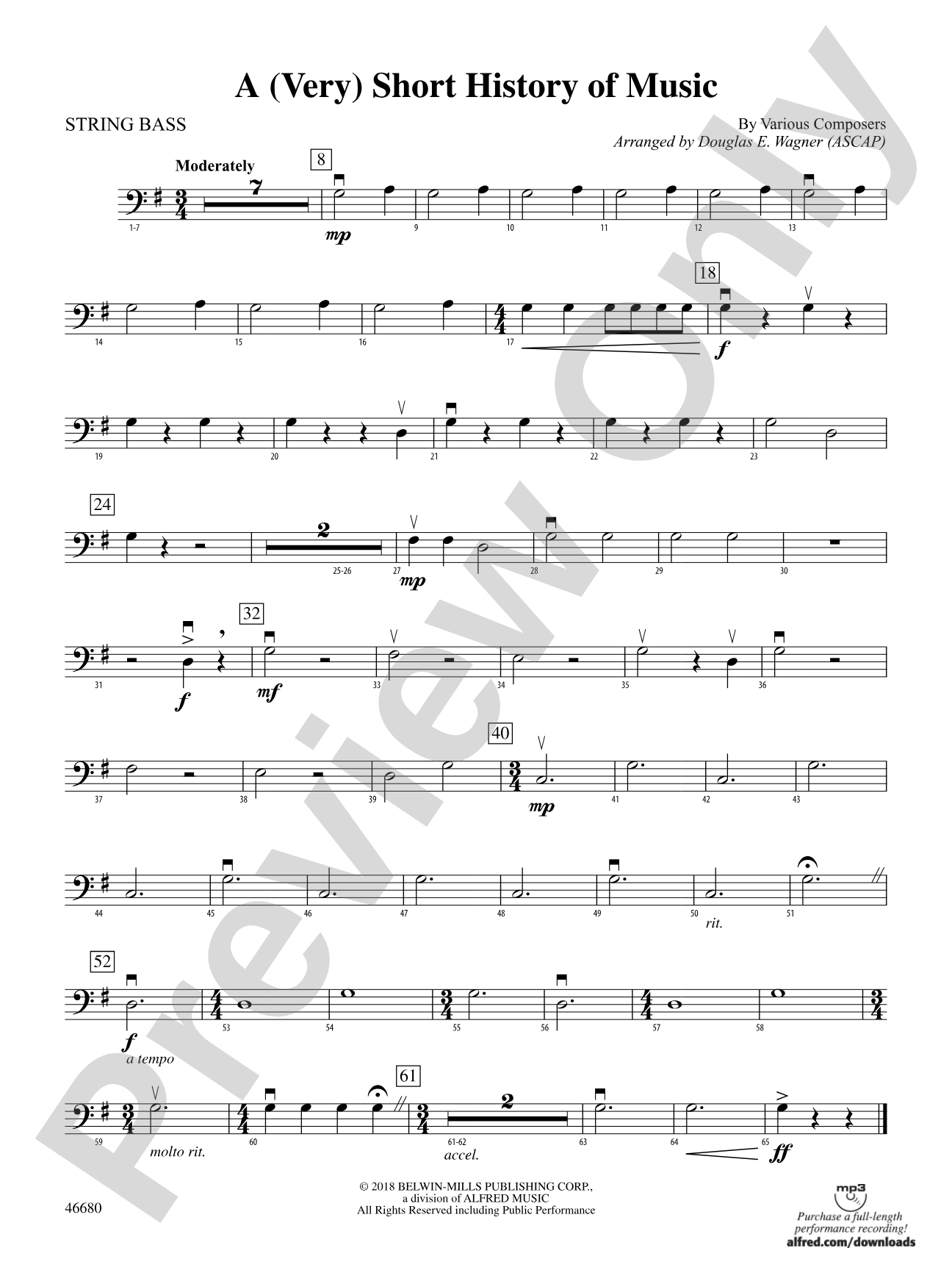
A (Very) Short History of Music: String Bass Sheet Music Preview

A (Very) Short History of Music: String Bass

Various / arr. Douglas E. Wagner

Grade: 1

Item: 00-PC-0017818_SB

Digital Download
$5.99
Description
"A (Very) Short History of Music" is an amazing grade 1 medley of a representative example from each major period of Western music using mostly half and quarter notes. Seamlessly presented by Douglas E. Wagner, players and audiences alike will experience approximately ten centuries of music history in two and a half minutes. This title is available in MakeMusic Cloud.

Don't just read it, hear it, play along with it, and watch your students grow with it. In MakeMusic Cloud, A (Very) Short History of Music: String Bass comes alive with professional accompaniment, adjustable tempo, and built-in practice tools that turn solo practice into real progress.

Sample Audio
0:00
0:00
Sample Video
Additional Details
Series: Belwin Beginning String Orchestra
Publisher: Alfred Music
Page Count: 72
SKU: 00-PC-0017818_SB

More about this title

About the Arranger: Douglas E. Wagner

Douglas E. Wagner

Douglas E. Wagner earned his undergraduate and graduate degrees in music from Butler University and spent three decades as a high school music educator and administrator in his native Chicago before dedicating himself fully to composition and arrangement. Since 1973, he has created more than 3,500 published works across choirs, concert bands, orchestras, handbells, organ, piano, and voice, with global performances reaching millions of listeners through concert halls, broadcasts, and recordings.

Why we love this

This medley accomplishes something genuinely rare at Grade 1: it teaches music history through immediate musical experience rather than explanation. The seamless transitions between periods keep young players engaged while their audiences gain a tangible sense of ten centuries of compositional voices, all in under three minutes. It's the kind of programming piece that works equally well as an opening number or a concert closer because it genuinely delights both student musicians and listeners.

What to expect

A musical postcard collection that moves briskly from one landscape to another, each glimpse distinct yet connected. The mostly half and quarter note writing keeps the piece grounded and playable while the shifting harmonic language and melodic gestures transport listeners across centuries in what feels like a single breath.

Who it's for

String orchestras at the Grade 1 level looking for a piece that entertains audiences while building young players' awareness of musical style and history. Directors seeking concert programming that feels substantive without overwhelming early learners will find this medley both musically rewarding and pedagogically honest.

How to get the most out of it

  • Highlight the character shifts between periods by adjusting articulation and tone color without changing tempo; let the music itself signal the transitions rather than adding ritardandos.
  • Balance the parts so that melodic lines sing clearly through each section; Grade 1 scores often distribute the tune across multiple voices, so careful rehearsal of who has the primary line prevents muddy texture.
  • Conduct with clear, confident preparation gestures to keep the ensemble unified through quick style changes; younger orchestras gain confidence when they see exactly where each section begins.

How to use it

Open a concert with this piece to set an educational and engaging tone, or use it as a bridge between classical and contemporary repertoire on the same program. Its brevity and direct appeal make it ideal for school assemblies, pep performances, or as a complement to a social studies unit on cultural history.

Skills your students will build

  • Recognizing and performing stylistic characteristics across four major periods of Western music
  • Maintaining ensemble cohesion through rapid stylistic transitions
  • Reading and executing mostly quarter and half note rhythms with accuracy
  • Responding to subtle conducting cues that signal musical character changes

You May Also Like