
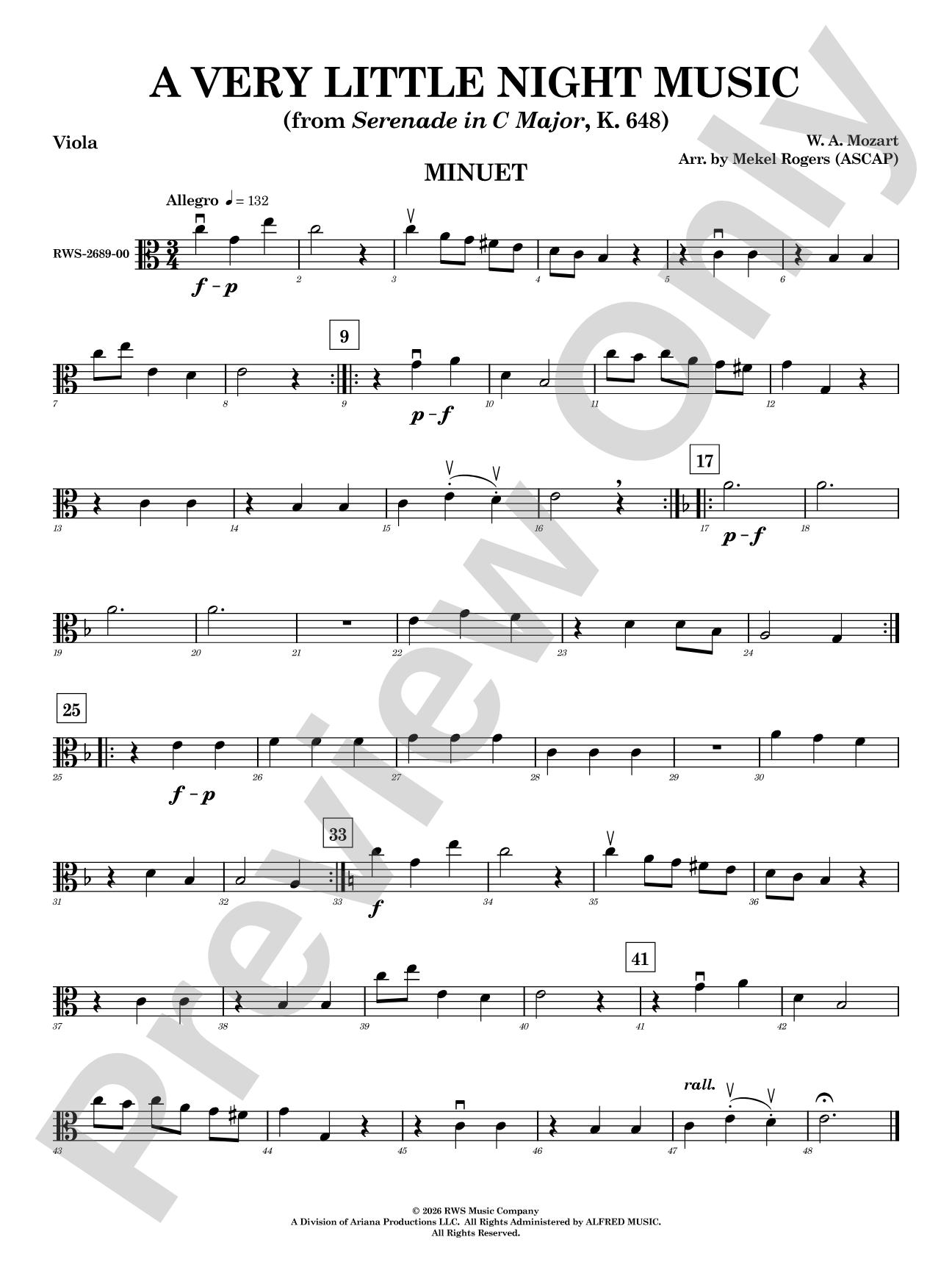

A Very Little Night Music: Viola
(from Serenade in C Major, K.648)
W. A. Mozart / arr. Mekel Rogers
Grade: 2.5
Item: 98-PC-0000063_VA1
$3.00
Pickup currently not available
Description
A newly discovered piece by Mozart? Yes! A Very Little Night Music is the first arrangement for young string orchestra of this composition, written when the composer was approximately 10–12 years old. The last two movements of the serenade (the minuet and finale) are thoughtfully arranged for young players, providing a perfect opportunity to introduce students to a "new" work by the Classical master.


A Very Little Night Music: Viola isn't in MakeMusic Cloud just yet...but it could be. Let us know you'd like to see it, and you'll help shape what comes next. In the meantime, start a free trial and dive into thousands of interactive titles your students can play along with today.
Request This Title
Tell us you want it.
Start Your Free Trial
Explore everything that's ready to play right now.
Sample Audio
1
Audio File
--:--
0:00
0:00
Sample Video
Additional Details
Series:
RWS - Developing Strings
Publisher:
RWS Music Company
SKU:
98-PC-0000063_VA1
More about this title
About the Composer: W. A. Mozart
Wolfgang Amadeus Mozart (1756–1791) was composing substantial works before most children learn to read music fluently. His prodigious output across every genre reflects not just innate talent but relentless compositional discipline, a habit formed in childhood under his father Leopold's exacting tutelage. The pieces Mozart wrote in his early years reveal the same structural clarity and melodic gift that define his mature masterworks, making them invaluable windows into how musical thinking develops.
For educators, Mozart's juvenile compositions offer something rare: music written by a child composer that never condescends to young players. Even when arranged for accessible ensembles, these works maintain the harmonic sophistication and formal logic that made Mozart essential to the Classical tradition. Teaching his music connects students directly to a figure who shaped Western music history.
Why we love this
Mekel Rogers has seized a genuine opportunity here: this minuet and finale arrangement introduces students to music they've likely never encountered, even in Mozart survey courses. The Grade 2.5 level manages real Classical phrasing without overwhelming young string players, making it accessible enough for solid middle-school ensembles while maintaining enough musical substance to reward careful rehearsal.
What to expect
Mozart at his most elegant and economical. The minuet glides with courtly grace, its transparent textures letting every voice breathe. The finale sparkles with momentum and wit, the kind of piece where clarity of ensemble sound becomes its own reward.
Who it's for
Young string orchestras ready to expand beyond familiar arrangements into repertoire that expands their sense of what "Mozart" can mean. Conductors seeking contest or festival material that combines accessibility with genuine musical substance will find this particularly valuable.
How to get the most out of it
- Shape the minuet's phrases with period-appropriate articulation; avoid heavy bowing on downbeats, allowing the Classical clarity to emerge naturally.
- Lock the ensemble pulse before rehearsing the finale's faster passages; rhythmic precision in young orchestras often improves dramatically when players feel genuine confidence in the beat.
- Balance the string sections carefully in the minuet so the melodic line sings without drowning the harmonic foundation in the lower voices.
- Experiment with the repeat structure as a pedagogical tool; having the ensemble discuss which repeats to observe (and why) deepens their understanding of Mozart's formal thinking.
How to use it
Program this alongside other classical miniatures to show students how composers across centuries approached shorter forms. Its familiarity factor (it is Mozart, after all) makes it an excellent choice for family concerts or pops programs, while the musical integrity keeps it engaging for more traditional classical concerts.
Skills your students will build
- Classical phrasing and period articulation
- Ensemble balance across string sections
- Reading and executing repeat structures thoughtfully
- Understanding minuet form and finale structure
- Sustaining intonation in longer melodic lines at moderate tempo