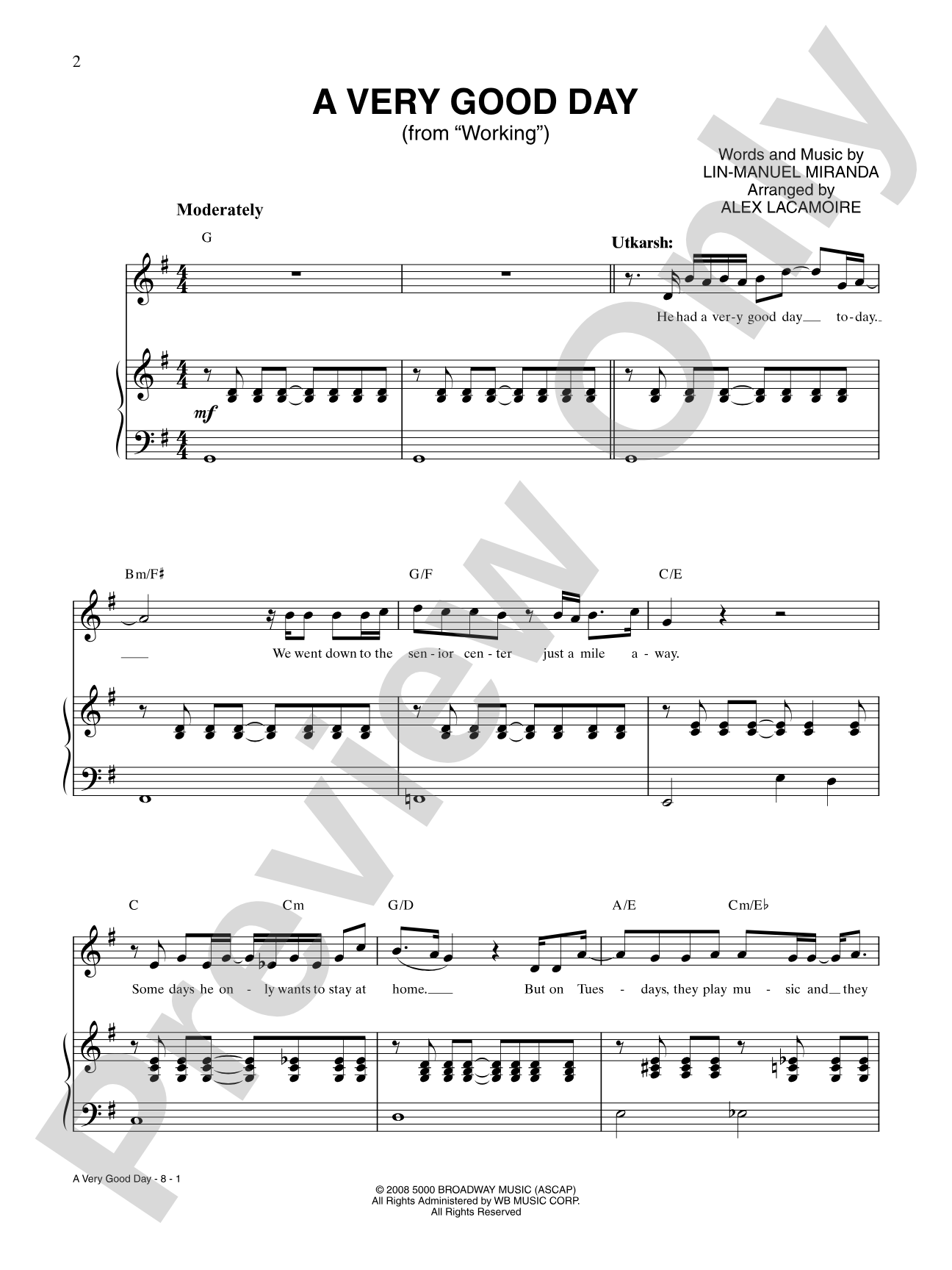
A Very Good Day (from "Working"): Piano/Vocal/Chords Digital Sheet Music

A Very Good Day (from "Working"): Piano/Vocal/Chords Digital Sheet Music

Lin-Manuel Miranda, Alex Lacamoire

Item: 00-PS-0015118

Digital Download
$3.99
Description

A Very Good Day (from "Working"): Piano/Vocal/Chords Digital Sheet Music isn't in MakeMusic Cloud just yet...but it could be. Let us know you'd like to see it, and you'll help shape what comes next. In the meantime, start a free trial and dive into thousands of interactive titles your students can play along with today.

Sample Audio
No sample audio found.
Sample Video
Additional Details
SKU: 00-PS-0015118

More about this title

About the Arranger: Alex Lacamoire

Alex Lacamoire is a composer and orchestrator whose work spans Broadway, film, and concert music. He is best known for his orchestrations and arrangements of contemporary musical theater, bringing sophisticated harmonic language and accessible instrumental writing to both stage and educational contexts.

Why we love this

This arrangement distills the emotional core of the song into a singable, pianistically idiomatic setting that works equally well for audition prep, recital programming, or classroom performance. The chord changes are clear enough for singers to feel supported by an accompanist but interesting enough to keep pianists engaged.

What to expect

Warm and conversational, with an understated optimism that captures quiet moments of reflection. The song invites intimacy between singer and pianist, creating space for genuine emotional connection rather than spectacle.

Who it's for

Singers preparing audition material, young performers building recital repertoire, and pianists working with vocalists in lessons or rehearsals. This arrangement is accessible enough for intermediate singers and pianists but offers room for artistic interpretation at more advanced levels.

How to get the most out of it

  • Balance the vocal line so it sits naturally above the piano without requiring the singer to push; the accompaniment should breathe with the vocalist rather than compete.
  • Pay attention to phrase lengths and where the song needs air; resist the urge to rush through quieter moments, as they anchor the emotional arc.
  • Use the chord symbols to explore voicing options at the piano; experiment with inversions and rhythmic comping that complements your singer's interpretation.

How to use it

Include this as a contemporary musical theater selection in a solo recital or cabaret-style performance, or program it alongside other Sondheim selections to build thematic coherence. It pairs well with both traditional art song and contemporary pop arrangements in mixed recitals.

Skills your students will build

  • Interpreting musical theater text and subtext
  • Coordinating with an accompanist and responding to piano voicings
  • Managing the emotional arc of a reflective song without oversinging
  • Reading chord symbols and understanding functional harmony in contemporary musical theater

You May Also Like