
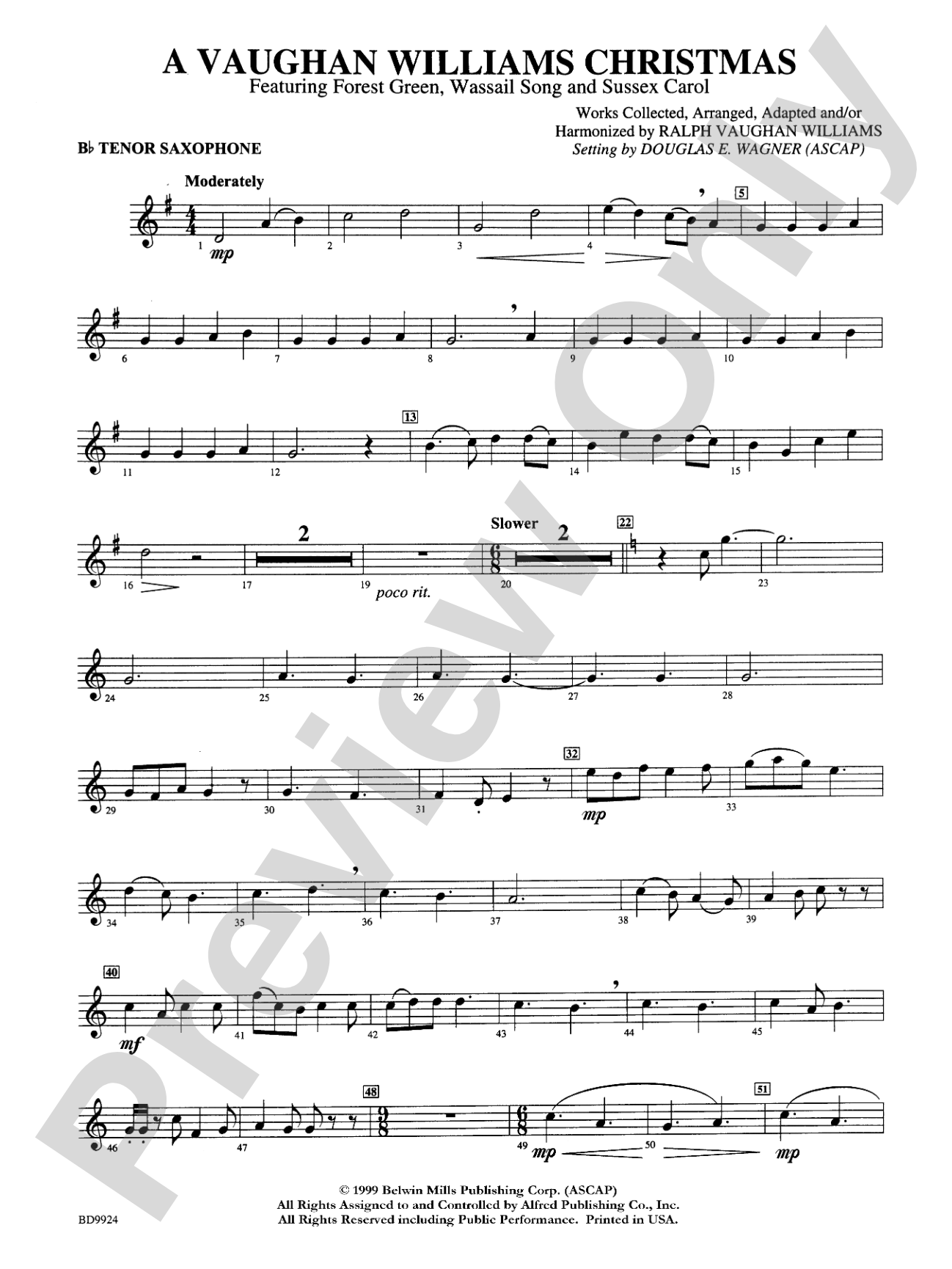

A Vaughan Williams Christmas: B-flat Tenor Saxophone
Featuring: Forest Green / Wassail Song / Sussex Carol
Works collected, arranged, adapted and/or harmonized by Ralph Vaughan Williams / setting by Douglas E. Wagner
Grade: 3 (Medium Easy)
Item: 00-PC-0002097_TX1
$3.00
Pickup currently not available
Description
A giant among composers, Ralph Vaughan Williams has contributed to the literature for concert band music that is standard repertoire throughout the world. Here are works from other genres that were collected, arranged, adapted, and/or harmonized by Vaughan Williams: "Forest Green (O Little Town of Bethlehem)" (from the first edition of the English Hymnal, 1906), "Wassail Song" (the fifth of Five English Folk Songs, 1913), and "Sussex Carol" (the second of Eight English Carols, 1919). These are the works of a master in a stunning new setting by Douglas Wagner. (4:24)


Don't just read it, hear it, play along with it, and watch your students grow with it. In MakeMusic Cloud, A Vaughan Williams Christmas: B-flat Tenor Saxophone comes alive with professional accompaniment, adjustable tempo, and built-in practice tools that turn solo practice into real progress.
Open in the Player
Jump straight in and assign it today.
Start Your Free Trial
Open this title and explore the full library in minutes.
Sample Audio
1
Audio File
--:--
0:00
0:00
Sample Video
No sample videos found.
Additional Details
Series:
Belwin Concert Band
Publisher:
Alfred Music
Page Count:
212
SKU:
00-PC-0002097_TX1
More about this title
About the Arranger: Douglas E. Wagner

Douglas E. Wagner brings three decades of high school music direction into his prolific compositional practice. Educated at Butler University, he has published over 3,500 works across concert band, choir, orchestra, handbell ensemble, and solo instrumental and vocal genres since 1973.
Wagner's music circulates globally, with performances reaching concert halls, broadcasts, and educational ensembles on multiple continents. Well over seventeen million copies of his compositions have found their way into rehearsal rooms and performance venues worldwide. He resides in Indianapolis with his wife, Sandy.
Why we love this
Wagner's treatment of these three Vaughan Williams works honors the original hymnic and folk sources while creating something genuinely fresh for concert band. The Grade 3 scoring makes this accessible without sacrificing the depth and sophistication audiences expect from masterwork arrangements, and the 4-minute-24-second duration holds strong presence on a full concert program without overwhelming rehearsal resources.
What to expect
These three carols breathe with a quiet dignity and warmth rooted in English folk tradition. Wagner's concert band scoring preserves the hymnic character of the originals while opening them to fuller orchestration, creating something that feels both familiar and newly discovered.
Who it's for
Directors programming a winter concert need substantial but elegant arrangements of holiday material. This is ideal for bands working at the Grade 3 level who want to perform authentic Vaughan Williams alongside recognizable carols, and for ensembles seeking concert repertoire with genuine musical substance rather than holiday filler.
How to get the most out of it
- Balance the melodic line across sections carefully; these carols thrive on clarity rather than blend, so ensure the primary voice emerges distinctly from the accompaniment texture.
- Shape the phrasing through breath and release rather than dynamic swells; these hymnic tunes respond best to architectural control and straightforward musical architecture.
- Attend to the harmonic language underneath the melodies. Wagner's arrangements sit in that early-20th-century idiom where chromatic voice leading and modal colorings require precision intonation from the middle voices.
- Let the recorded accompaniment anchor your tempo, but use rehearsal to instill the shape and intention of each carol so the ensemble owns the phrasing independently.
How to use it
Position this arrangement as an anchor for your winter concert or as a standalone suite that concludes a program with substance. The three-movement structure and unified compositional voice make it work especially well in the second half of a concert, where it can settle the audience without dropping energy.
Skills your students will build
- Balance in homophonic texture with multiple melodic strands
- Phrasing and breathing control in hymnic settings
- Intonation within chromatic and modal harmonic movement
- Stylistic understanding of early-20th-century English choral writing