
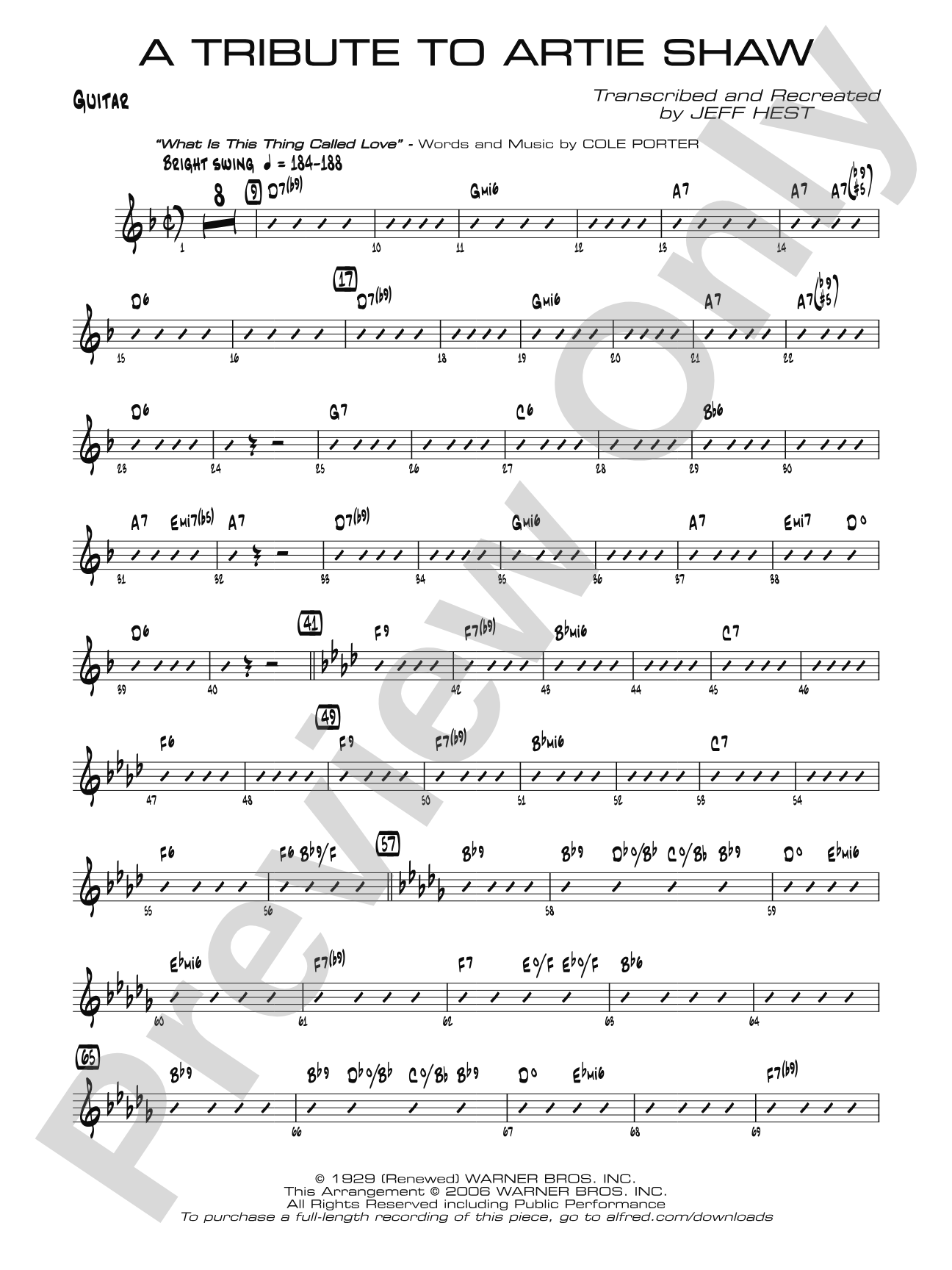

A Tribute to Artie Shaw: Guitar
Music by Cole Porter and Sigmund Romberg / arr. Jeff Hest
Grade: 4 (Medium Advanced / Difficult)
Item: 00-PC-0017112_G
$3.00
Pickup currently not available
Description
Here is a re-creation and transcription of three classic hits made famous by the late, great clarinetist Artie Shaw. Arranger Jeff Hest has gone the extra mile to provide an accurate transcription of "What Is This Thing Called Love," Softly as in a Morning Sunrise," and "Begin the Beguine." To keep this chart accessible, the solo clarinet part is playable by a competent clarinetist. An optional baritone sax part is included. A wonderful arrangement!


Don't just read it, hear it, play along with it, and watch your students grow with it. In MakeMusic Cloud, A Tribute to Artie Shaw: Guitar comes alive with professional accompaniment, adjustable tempo, and built-in practice tools that turn solo practice into real progress.
Open in the Player
Jump straight in and assign it today.
Start Your Free Trial
Open this title and explore the full library in minutes.
Sample Audio
1
Audio File
--:--
0:00
0:00
Sample Video
No sample videos found.
Additional Details
Series:
Premier Jazz Series
Publisher:
Alfred Music
Page Count:
90
SKU:
00-PC-0017112_G
More about this title
About the Composer: Cole Porter
Cole Porter (1891-1964) composed some of the twentieth century's most sophisticated popular songs, blending witty lyrics with harmonically adventurous melodies that challenged jazz musicians and audiences alike. His influence on jazz repertoire runs deep; musicians from Duke Ellington to contemporary ensemble arrangers continue to mine his catalog for its harmonic richness and melodic elegance.
Why we love this
Jeff Hest's transcriptions capture the essence of Artie Shaw's interpretations without overcomplicating them for your ensemble. The clarinet solo part sits comfortably for a capable player, and the inclusion of an optional baritone sax part gives you flexibility in your instrumentation. Programming these three standards together creates a cohesive set that lets your students experience the sophistication of American songwriting alongside authentic jazz interpretation.
What to expect
These arrangements embody the elegance and swing sophistication that defined Shaw's career. The pieces unfold with jazz sensibility and harmonic depth; the clarinet sings over rich ensemble textures while maintaining the lyrical quality these standards deserve. You'll hear the craft in both the original compositions and Hest's reimagining of them.
Who it's for
Jazz ensemble directors programming at the Grade 4 level who want to include repertoire with real harmonic substance and historical weight. This is ideal for ensembles with a competent lead clarinetist and a rhythm section ready to support sophisticated changes. The set works equally well for festival preparation or concert programming.
How to get the most out of it
- Study recordings of Artie Shaw's original interpretations to understand the phrasing and rhythmic nuance these melodies demand; the printed page alone won't capture the swing feel and articulation choices that made them iconic.
- Balance the clarinet soloist prominently but not aggressively; these are elegant standards that benefit from conversational interplay between the solo voice and the ensemble.
- Treat the rhythm section as the foundation for the entire arrangement; lock the comping and timekeeping before the horns enter, since the harmonic sophistication relies on clean, steady foundation.
- Use the three-tune package as a chance to explore different feels within the jazz standard tradition; each piece has distinct character and requires adjustment in articulation and tempo interpretation.
How to use it
Present all three pieces as a curated set that showcases American standards and the jazz tradition together, offering your audience a coherent concert block rather than scattered selections. This package also works well as a centerpiece for a concert exploring how jazz musicians reimagine popular song, paired with film music or vocal standards if your program includes singers.
Skills your students will build
- Interpreting jazz articulation and phrasing from written notation
- Accompanying a jazz soloist with dynamic control and rhythmic independence
- Reading and performing harmonically complex chord changes
- Building ensemble cohesion across multiple sustained pieces with similar style
- Understanding historical arrangements and how transcription preserves artistic intent