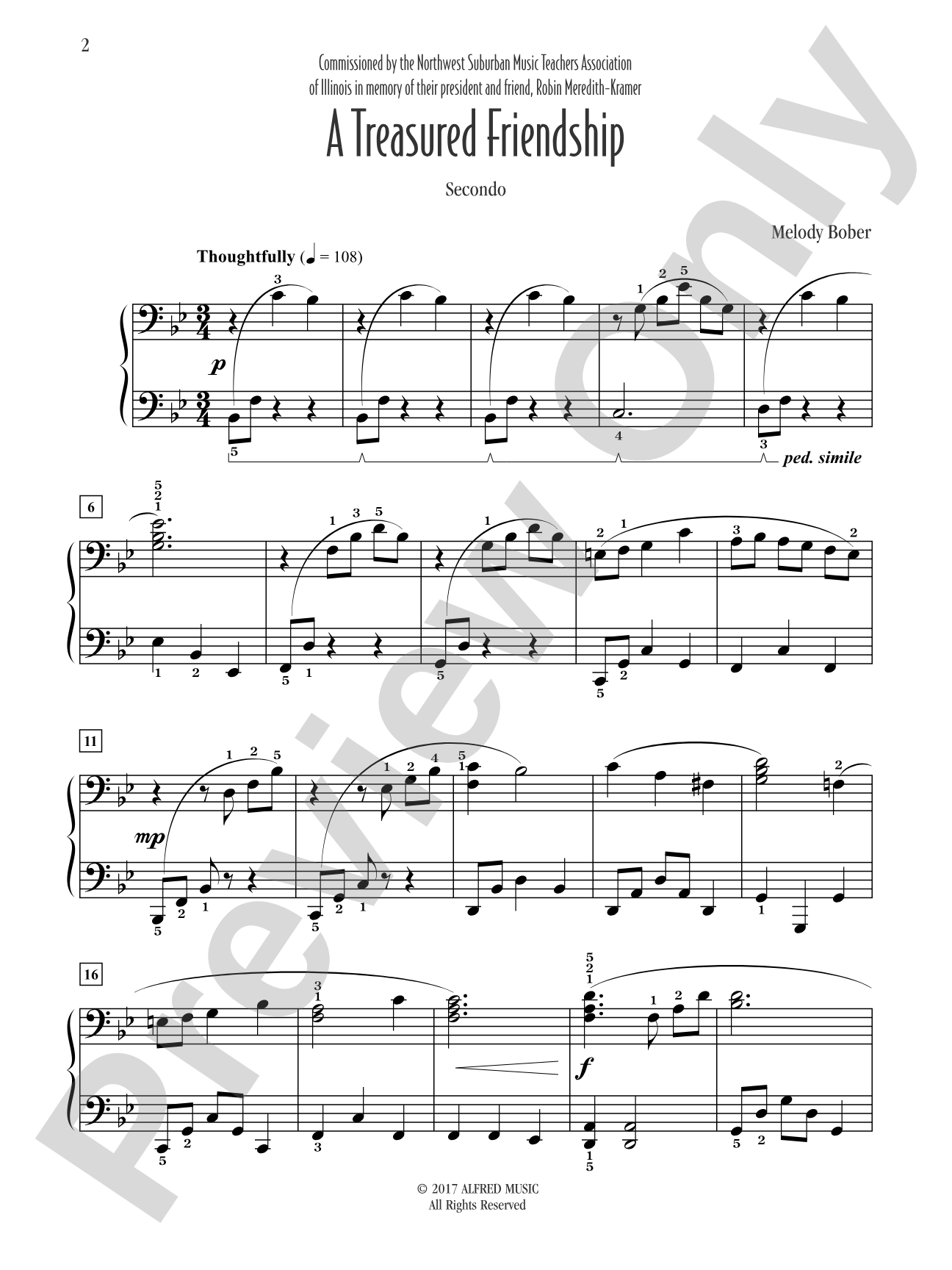
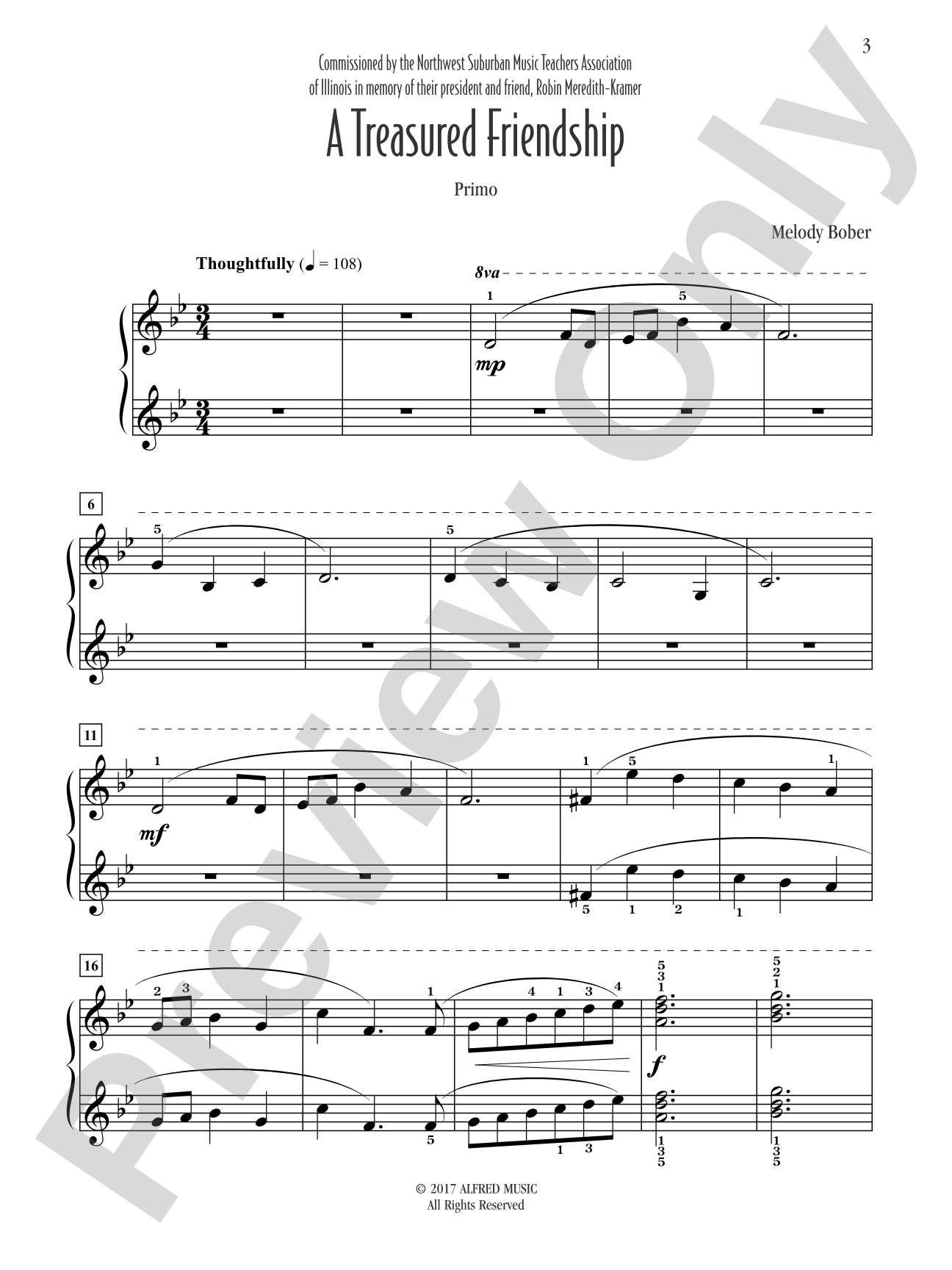
A Treasured Friendship - Piano Duet (1 Piano, 4 Hands) Sheet Music Preview

A Treasured Friendship - Piano Duet (1 Piano, 4 Hands): Piano Duets & Four Hands

By Melody Bober

Level: Intermediate

Item: 00-PB-0000679

Digital Download
$5.99
Description
This beautiful duet celebrates the treasure of friendship through music. Filled with lush harmonies and lyrical melodic lines, it journeys through several keys (B-flat, G, and C major) as it builds to a high point, followed by a gentle conclusion. Both parts are equal in difficulty and share the lovely melody, providing an excellent vehicle for working on balance and voicing. Anyone who has a best friend will love playing this duet, which was commissioned by the Northwest Suburban Music Teachers Association of Illinois in memory of one of their members. A Federation Festivals 2020-2024 selection.

A Treasured Friendship - Piano Duet (1 Piano, 4 Hands): Piano Duets & Four Hands isn't in MakeMusic Cloud just yet...but it could be. Let us know you'd like to see it, and you'll help shape what comes next. In the meantime, start a free trial and dive into thousands of interactive titles your students can play along with today.

Sample Audio
No sample audio found.
Sample Video
Additional Details
Series: The Alfred Duet Series
Publisher: Alfred Music
Page Count: 12
SKU: 00-PB-0000679

More about this title

About the Composer: Melody Bober

Melody Bober

Melody Bober holds degrees in music education from the University of Illinois and in piano performance from Minnesota State University, Moorhead. Her teachers, Joel Shapiro and Andrew Froelich on piano, Mary Hoffman in music education, and Tony Caramia in jazz, shaped her distinctive voice as both performer and composer.

Bober's career spans private studio teaching, two decades in public schools, university instruction, and active work as a church pianist and director. She has become a sought-after clinician at regional and national conferences, known for writing pieces that deepen students' musical understanding while keeping them engaged. She teaches and composes in Minnesota.

Why we love this

The equal parts and shared melody create genuine collaboration rather than hierarchy, making this ideal for students who are just beginning to explore duet playing. Bober's modulations through B-flat, G, and C major give the piece harmonic interest without sacrificing accessibility, and the emotional core, a tribute to friendship and loss, resonates with students beyond the notes on the page.

What to expect

Warmth and affection unfold gradually through lush harmonies, then build with increasing brightness as the piece moves through its tonal centers. The arc culminates in a moment of genuine beauty before settling into a tender, reflective close that feels earned rather than hurried.

Who it's for

Intermediate pianists preparing duets for recital or festival play, especially those ready to share equally demanding material with a partner. It speaks directly to students with meaningful friendships and gives them a way to express that bond through music.

How to get the most out of it

  • Balance the melody between primo and secondo by having both players voice their line with equal weight through the middle section; resist the urge to let one hand dominate.
  • Map the key centers in rehearsal so both players understand where each modulation arrives and why it matters to the architecture of the piece.
  • Shape the climactic passage together by agreeing on a slight tempo flexibility and dynamic peak; this prevents either hand from pushing ahead or dragging.
  • Use the gentle conclusion to practice releasing tension deliberately, allowing the final measures to breathe rather than rushing toward the end.

How to use it

Place this on a recital between more technically demanding pieces to showcase musical maturity and ensemble sensitivity, or program it as part of a larger student showcase featuring duet work. Its commissioning story makes it especially fitting for spring festivals or occasions celebrating community and mentorship.

Skills your students will build

  • Ensemble balance and voicing across two equal piano parts
  • Modulation between three major keys (B-flat, G, and C)
  • Collaborative tempo and dynamic shaping in duet context
  • Phrase architecture and the relationship between climax and resolution
  • Part independence while maintaining unified musical intent

You May Also Like