
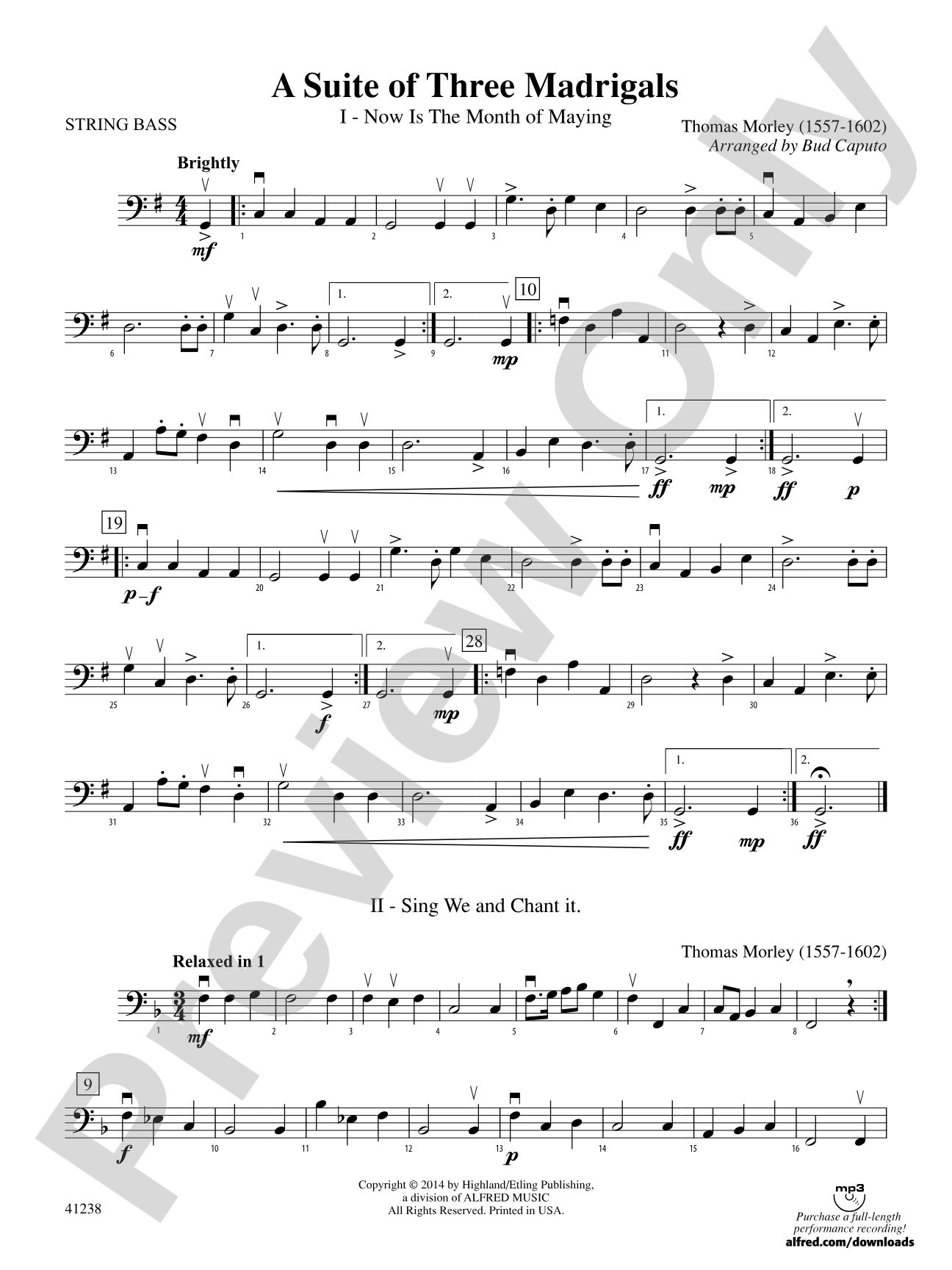

A Suite of Three Madrigals: String Bass
By Thomas Morley and John Farmer / arr. Bud Caputo
Grade: 3
Item: 00-PC-0016361_SB
$5.99
Pickup currently not available
Description
In keeping with the efforts of developing a curriculum that fosters Comprehensive Musicianship, this string orchestra arrangement of three of the most popular Renaissance madrigals, will provide your students with a peak into this period of music history that is frequently overlooked. "Now Is the Month of Maying," "Sing We and Chant It," both by Thomas Morley, and "Fair Phyllis," by John Farmer, are basic choral repertoire found in most high school and college full SATB and madrigal ensembles. The string ensemble may perform the arrangement alone with the added Renaissance style percussion. Or, better yet, why not enhance the performance by adding an SATB chorus thereby sharing the stage with your school's most advanced choral ensemble? (5:00) This title is available in MakeMusic Cloud.


Don't just read it, hear it, play along with it, and watch your students grow with it. In MakeMusic Cloud, A Suite of Three Madrigals: String Bass comes alive with professional accompaniment, adjustable tempo, and built-in practice tools that turn solo practice into real progress.
Open in the Player
Jump straight in and assign it today.
Start Your Free Trial
Open this title and explore the full library in minutes.
Sample Audio
1
Audio File
--:--
0:00
0:00
Sample Video
No sample videos found.
Additional Details
Series:
Highland/Etling String Orchestra
Publisher:
Alfred Music
Page Count:
148
SKU:
00-PC-0016361_SB
More about this title
About the Composer: Thomas Morley
Thomas Morley (1557-1602) was England's most prolific madrigal composer and a central figure in the English Renaissance. His output shaped the development of secular vocal music in the late 16th century, and his compositions remain staples of choral literature. Morley also published "A Plaine and Easie Introduction to Practicall Musicke" (1597), one of the earliest music theory textbooks in English, which documented compositional practices of his era and remains a valuable resource for understanding Renaissance counterpoint and performance.
Why we love this
This arrangement opens a direct pathway to Renaissance style and compositional technique without requiring full madrigal ensemble resources. The option to perform it with or without chorus gives you programming flexibility, and pairing it with your advanced singers creates a genuinely collaborative performance that students will remember. The madrigals themselves are melodically accessible and harmonically clear, making them ideal for building string players' understanding of historical context alongside contemporary technique.
What to expect
These madrigals radiate the clarity and grace of Renaissance counterpoint while remaining transparent enough for young string players to hear and respond to each other. The three-piece format offers contrasts in mood and character, from dance-like energy to intimate expression, giving the ensemble a satisfying arc that feels both historically informed and musically complete.
Who it's for
String orchestras at the high school and early college level looking to develop musicianship through historical repertoire. Directors seeking a bridge between strictly contemporary string writing and the pedagogical richness of early music.
How to get the most out of it
- Balance the three pieces across the five-minute arc by attending to the character shifts; use Renaissance style percussion sparingly to clarify phrase structure rather than driving pulse.
- If combining with your SATB chorus, establish which ensemble leads each madrigal in rehearsal so parts blend rather than compete; clarity of text matters even in instrumental sections.
- Shape phrases according to text declamation patterns (breathe where singers would), even though the strings are playing without words.
- Tune intervals with care in the Renaissance sonority; wider vibrato and modern vibrato habits will muddy the period sound Caputo's arrangement implies.
How to use it
Program this as a concert centerpiece that showcases string technique while teaching ensemble awareness; the optional chorus collaboration transforms it into a cross-curricular feature between instrumental and vocal departments. It works particularly well in a spring concert focused on music history, or as a contest entry for festival settings that value pedagogical substance and artistic merit.
Skills your students will build
- Reading and performing Renaissance counterpoint with clear part independence
- Adapting vibrato and tone color to match early music style
- Listening across parts to maintain harmonic balance in polyphonic texture
- Understanding madrigal form and phrase structure rooted in text painting
- Collaborating between string and choral ensembles when performing combined arrangement