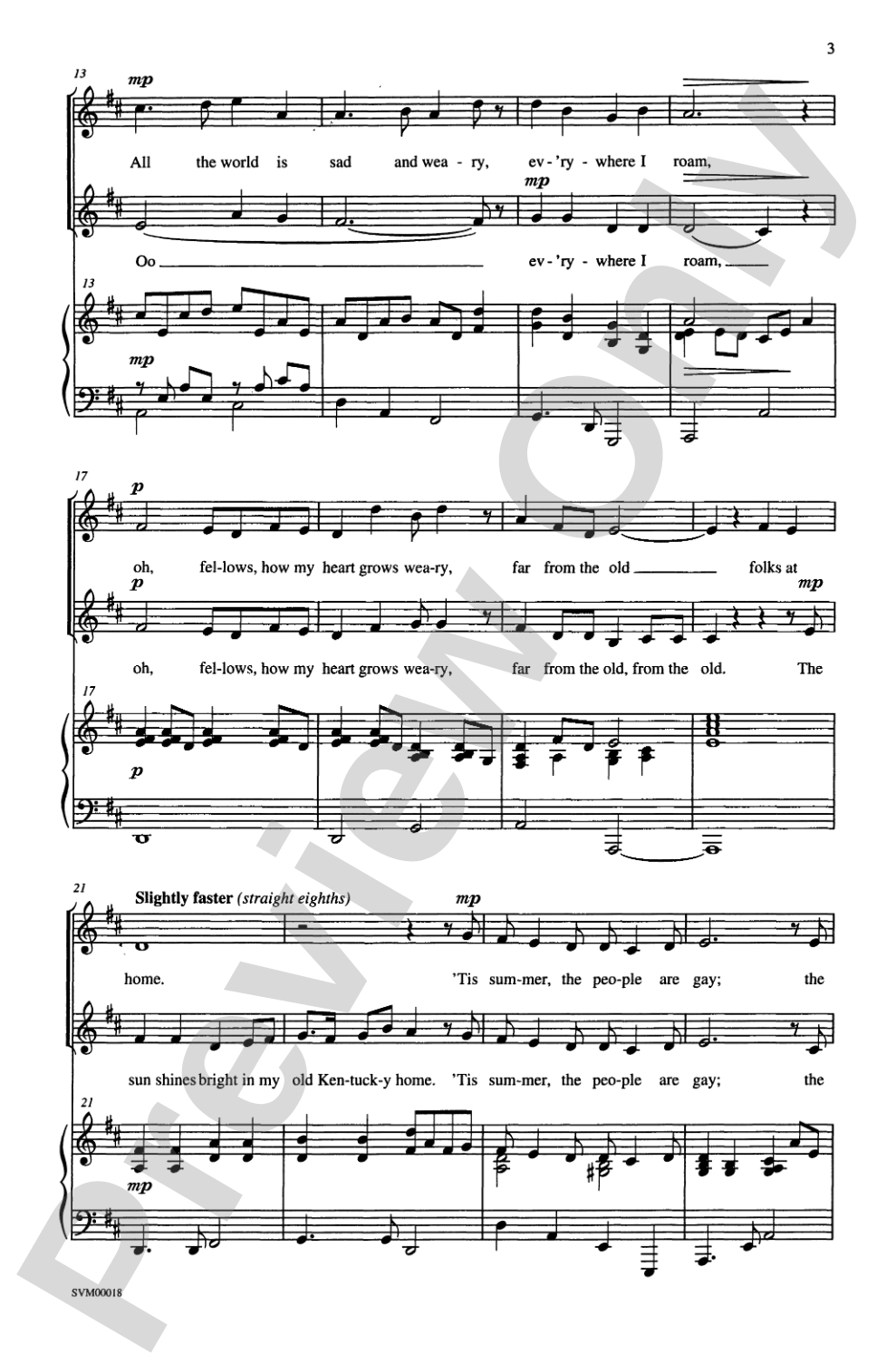
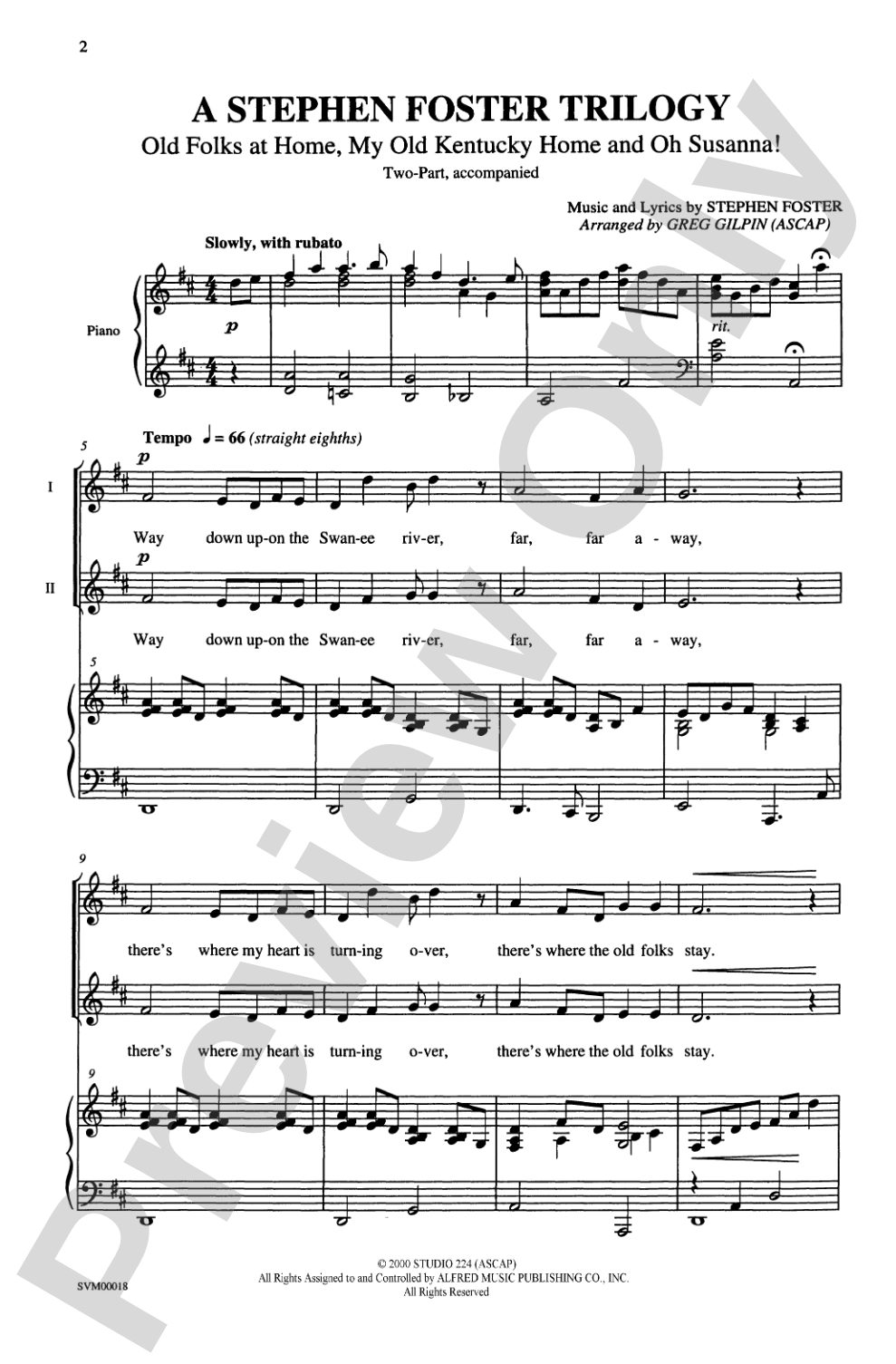
A Stephen Foster Trilogy Sheet Music Preview

A Stephen Foster Trilogy: 2-Part Choral Octavo

The Old Folks at Home / My Old Kentucky Home / Oh Susanna!

Music and lyrics by Stephen Foster / arr. Greg Gilpin

Item: 00-PO-0005318

Digital Download
$2.25

Minimum order quantity: 20 copies

Description
The winning combination of Stephen Foster's text and Greg Gilpin's musical creativity bring these three short pieces to the top of the "must-do" list. "The Old Folks at Home," "My Old Kentucky Home," and "Oh Susanna" are the traditional Southern American folk songs, beautifully voiced for choral presentation.

A Stephen Foster Trilogy: 2-Part Choral Octavo isn't in MakeMusic Cloud just yet...but it could be. Let us know you'd like to see it, and you'll help shape what comes next. In the meantime, start a free trial and dive into thousands of interactive titles your students can play along with today.

Sample Audio
No sample audio found.
Sample Video
Additional Details
Series: Alfred Archive Edition: Studio PR Catalog
Publisher: Alfred Music
Page Count: 8
SKU: 00-PO-0005318

More about this title

About the Composer: Stephen Foster

Stephen Foster (1826-1864) stands as America's first great songwriter, crafting melodies that became the soundtrack of the nineteenth century. His gift lay in writing simple, deeply singable tunes paired with lyrics that captured the spirit of everyday American life. Foster's output included over two hundred songs, many of which remain fixtures in the choral and folk music repertoires, celebrated for their accessibility and emotional directness.

Why we love this

Greg Gilpin's arrangements preserve the melodic essence that made these Foster classics enduring while providing practical 2-part voicing that works across mixed-age and mixed-ability choirs. The straightforward harmonic language and folk authenticity mean your singers connect immediately to the music without getting bogged down in complexity. Programming three beloved American standards in one octavo gives you flexibility to use them together as a thematic set or separately throughout the year.

What to expect

These arrangements evoke the warmth of American parlor singing and the resilience embedded in folk tradition. Singing them feels both intimate and communal, drawing listeners into moments of nostalgia and reflection that span generations.

Who it's for

This octavo serves choir directors working with singers in middle school through early high school, community choirs, or church choirs seeking authentic American repertoire. The 2-part voicing makes it accessible for groups without advanced harmonic reading skills while the Foster melodies ensure artistic substance and historical significance.

How to get the most out of it

  • Encourage singers to shape the phrases with natural speech rhythms rather than metronomic precision; these melodies thrive on gentle rubato and conversational phrasing.
  • Balance the two parts carefully in rehearsal so neither voice overshadows the harmony; the folk character depends on both lines singing with equal presence.
  • Consider the cultural weight these melodies carry in American history and discuss the context with your singers before rehearsal to build interpretive awareness.
  • Layer recorded accompaniments gradually during rehearsal rather than relying on them from the start; singers will internalize the melody more securely when they build independence first.

How to use it

Weave these three pieces across a season's programming rather than clustering them into one concert; "The Old Folks at Home" suits a spring pops program, while "My Old Kentucky Home" works beautifully in a patriotic or Americana-themed concert. You might also open a holiday or end-of-year concert with all three as a tribute to American musical heritage.

Skills your students will build

  • Singing in parallel harmony with consistent blend and balance
  • Interpreting American folk traditions and understanding their cultural context
  • Sustaining legit vocal tone through simple, folk-based melodic contours
  • Reading and performing text with natural phrasing rather than mechanical rhythm

You May Also Like