
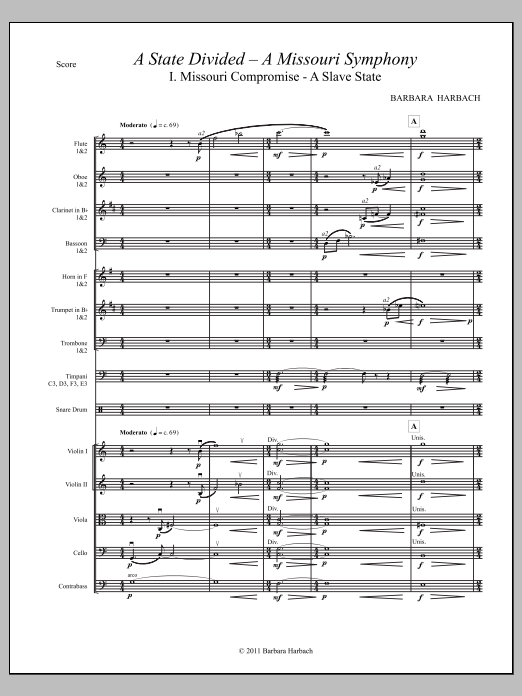

A State Divided - a Missouri Symphony: Full Orchestra Conductor Score & Parts
By Barbara Harbach
Item: 35-PK00291468
$28.25
Pickup currently not available
Buy Extra Parts (Digital PDF Download)
Parts Added to Cart!
Description
A State Divided - Missouri Symphony for Orchestra is in three movements, each representing Missouri's involvement in the Civil War and filled with newly composed folk tunes and spirituals, rhythmic excitement, martial music and soaring melodies. I. Missouri Compromise - a slave state was initially settled by slave-holding Southerners coming up the Mississippi and Missouri rivers. II. Skirmish at Island Mound - African-American regiment, a Union victory was notable as the first known engagement of an African-American regiment during the Civil War. III. The Battle of Westport - the battle that saved Missouri was one of the Civil War's largest battles west of the Mississippi and the Union victory dashed Confederate hopes of occupying Missouri, and the battle has been called "The Gettysburg of the West." Duration: 14:00


A State Divided - a Missouri Symphony: Full Orchestra Conductor Score & Parts isn't in MakeMusic Cloud just yet...but it could be. Let us know you'd like to see it, and you'll help shape what comes next. In the meantime, start a free trial and dive into thousands of interactive titles your students can play along with today.
Request This Title
Tell us you want it.
Start Your Free Trial
Explore everything that's ready to play right now.
Sample Audio
No sample audio found.
Sample Video
No sample videos found.
Additional Details
Publisher:
Hal Leonard
SKU:
35-PK00291468
More about this title
About the Composer: Barbara Harbach
Barbara Harbach is a composer whose work bridges concert music and educational programming with equal sophistication. Her compositions often draw on American history and folk materials, creating narratives that engage both musicians and audiences in meaningful cultural storytelling.
Why we love this
A State Divided tackles significant American history through three interconnected movements that never feel didactic. The combination of original folk melodies, spirituals, and period-appropriate musical language creates a score that educates while maintaining genuine dramatic arc and musical substance throughout.
What to expect
The score unfolds like a living historical document, moving from the contemplative weight of the Missouri Compromise through urgent, energetic conflict toward decisive, sweeping resolution. Newly composed folk idioms blend with spiritual traditions to create music that feels both grounded in its period and freshly composed.
Who it's for
This work suits orchestras seeking substantive American repertoire that serves educational and concert programming simultaneously. It engages high school and college ensembles capable of handling the full orchestral palette while remaining accessible to musicians developing their craft.
How to get the most out of it
- Balance the folk and spiritual melodies in Movement I so they sing through the accompanying textures; these themes anchor the entire work and deserve clarity without aggressive dynamics.
- The rhythmic intensity of Movement II demands precise ensemble work, particularly in the percussion and low brass. Establish your tempo markings early and hold the ensemble accountable to consistent articulation across sections.
- Build momentum through Movement III by carefully controlling the dynamic trajectory. The battle movement's climactic passages need room to breathe before the final arrival, not aggressive pushing from the start.
How to use it
Program this as a centerpiece for concerts exploring American history and identity, pairing it with other works examining the Civil War era or folk traditions. The three-movement structure also works as a thoughtful closer to a concert program, offering narrative completeness and sufficient duration to make a substantial artistic statement.
Skills your students will build
- Sustaining lyrical lines while maintaining harmonic clarity in thick orchestral textures
- Ensemble precision in rhythmically complex sections featuring multiple meter and syncopation
- Interpreting period-appropriate articulation and phrasing within a newly composed work
- Balancing folk melodic material against more sophisticated harmonic settings
- Coordinating large ensemble dynamics to support long-form narrative structure across fourteen minutes