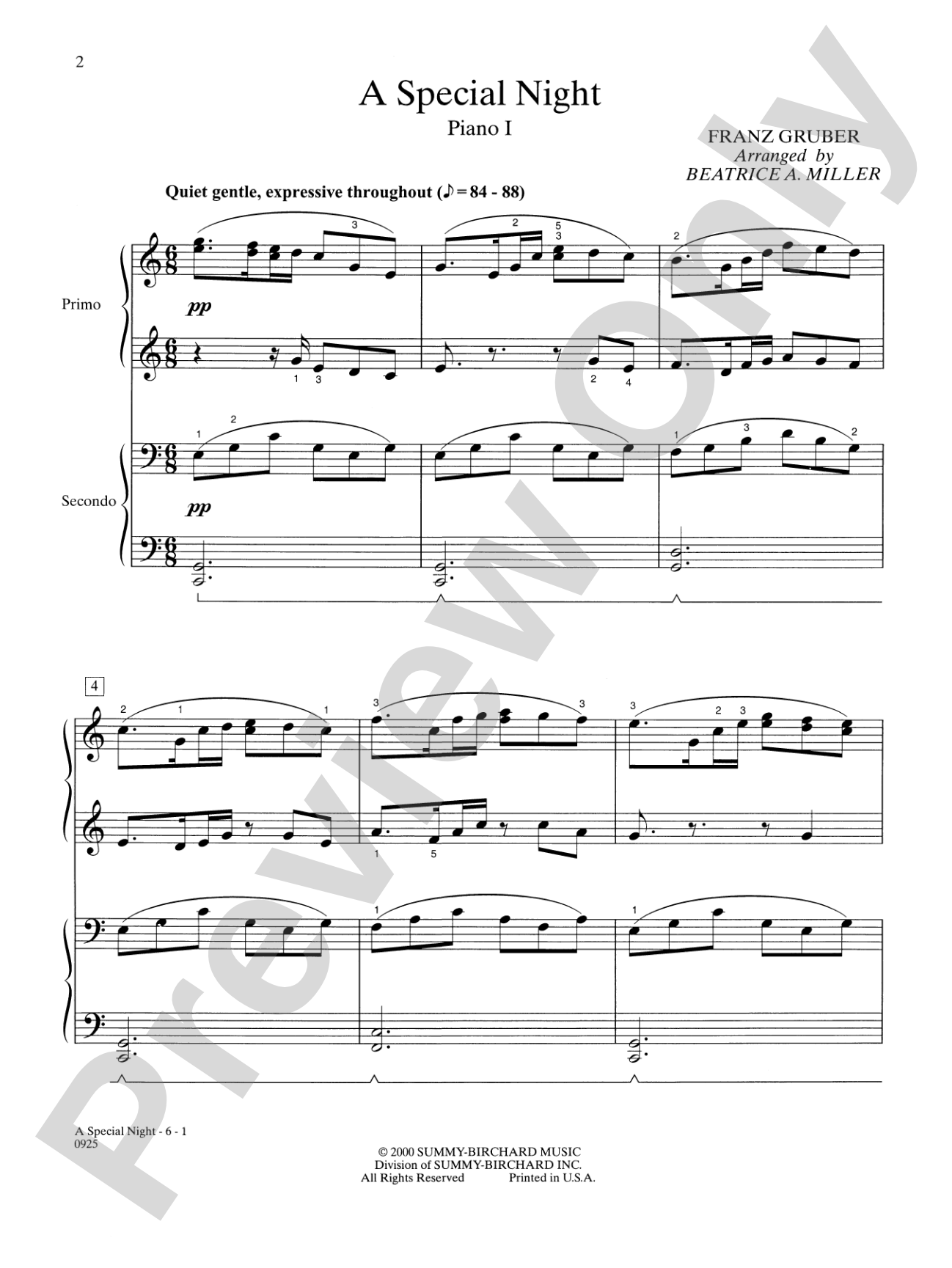
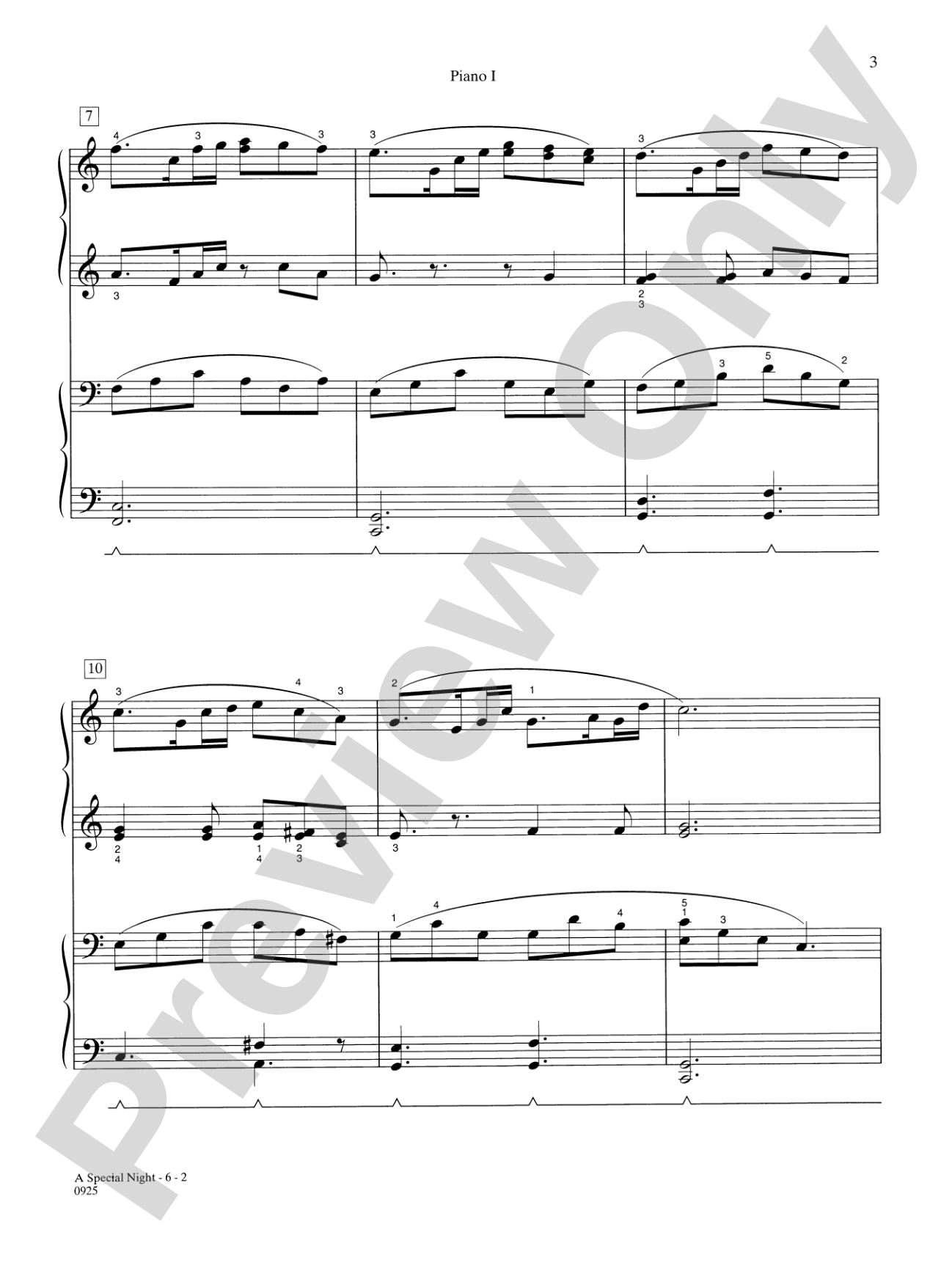
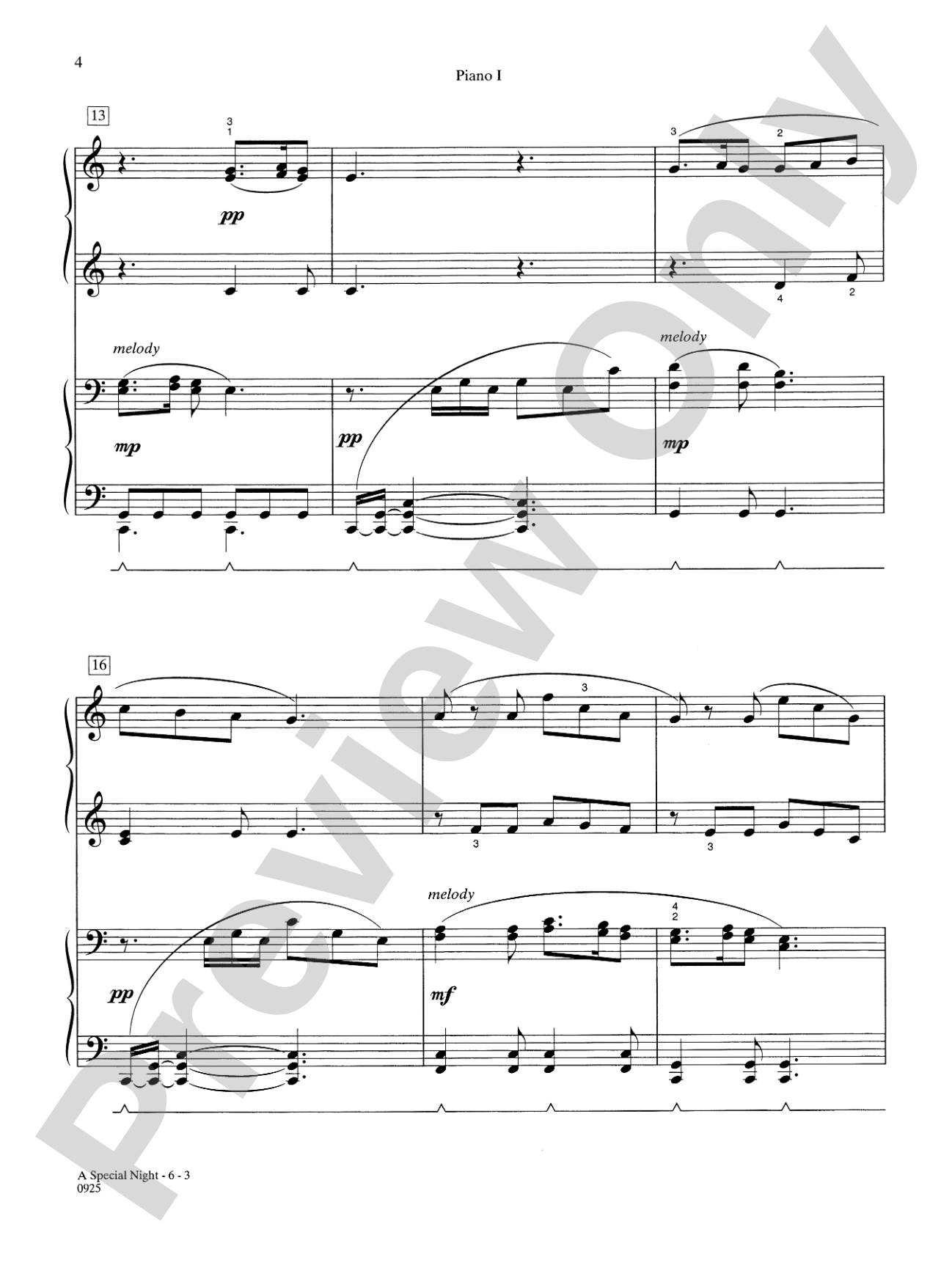
A Special Night: An Arrangement of Silent Night - Piano Quartet (2 Pianos, 8 Hands): Piano
An Arrangement of Silent Night
Arranged by Beatrice A. Miller
Level: Intermediate
Item: 00-PB-0000696
Pickup currently not available
Related Items
A Special Night: Piano Quartet (2 Pianos, 8 Hands) Sheet (2 copies included) |
$6.99
|
View |
Description
A Special Night: An Arrangement of Silent Night - Piano Quartet (2 Pianos, 8 Hands): Piano isn't in MakeMusic Cloud just yet...but it could be. Let us know you'd like to see it, and you'll help shape what comes next. In the meantime, start a free trial and dive into thousands of interactive titles your students can play along with today.
Tell us you want it.
Explore everything that's ready to play right now.
Sample Audio
Sample Video
Additional Details
More about this title
About the Arranger: Beatrice A. Miller

Beatrice A. Miller grew up in Detroit, Michigan, where her father's role as a Lutheran pastor and choir director made sacred music central to family life. Evening hymn singing shaped her lifelong passion for religious repertoire; a family legend recounts how her infant musical babbling mirrored the cadence of hymns, sparking her brothers' enthusiasm for singing alongside her.
Miller earned her Master's degree in music composition from Northwestern University and spent decades teaching piano, directing choirs, and serving as a church organist in Corvallis, Oregon. After retiring from teaching in 1979, she devoted herself fully to composing and began publishing in 1987. The Oregon Music Teacher's Association honored her as Composer of the Year in 1997.
Why we love this
Miller's arrangement transforms a beloved hymn into a sophisticated four-hand conversation across two pianos, giving intermediate pianists the rare chance to explore real ensemble interplay without requiring advanced technical facility. The shifting melody assignments and layered textures keep all four performers engaged and musically present, making this a genuinely collaborative experience rather than a hierarchical setup. Its selection for the Federation Festivals 2024-2028 roster confirms its appeal for advancing students seeking meaningful holiday programming.
What to expect
This arrangement radiates warmth without sentimentality. As four hands weave around each other across two keyboards, the familiar melody feels simultaneously intimate and expansive, creating a sense of gathering and shared musical devotion. The flowing countermelodies and shifting textures give the hymn breathing room, letting listeners experience its timeless message through fresh harmonic and textural layers.
Who it's for
Intermediate pianists who have developed ensemble awareness and can maintain independence within a group texture will thrive with this arrangement. It suits advanced high school students, college musicians in piano proficiency sequences, and adult amateur ensembles eager to perform collaboratively during the holiday season.
How to get the most out of it
- Balance the melody line carefully when it passes between pianists. Slight dynamic adjustments prevent the tune from disappearing into accompaniment figuration, especially when lower voices carry the primary theme.
- Establish the tempo and harmonic grounding at the outset; having both pianists lock into the same pulse prevents the countermelody and accompaniment layers from losing their way through the variations.
- Rehearse the hand-crossing passages independently if they occur in your arrangement. Two pianists sharing one keyboard requires absolute clarity about spatial territory.
- Shape the variations dynamically to reflect the narrative arc. Each new treatment of the melody invites a slightly different color; use volume, pedaling, and touch to tell that story rather than repeating the same musical voice.
How to use it
Program this as a centerpiece for a winter concert, positioning it where its gentle sophistication offers respite between more virtuosic or energetic pieces. It works equally well as a recital finale for a group of intermediate pianists or as a special feature within a larger holiday concert that mixes solo and ensemble repertoire.
Skills your students will build
- Listening and responding to other pianists' musical lines in real time
- Maintaining rhythmic independence while supporting ensemble cohesion
- Shaping melodic lines and countermelody with dynamic control and phrase awareness
- Managing shared keyboard space or coordinating hand placement across two instruments
- Interpreting variations on a familiar tune through textural and harmonic contrast