
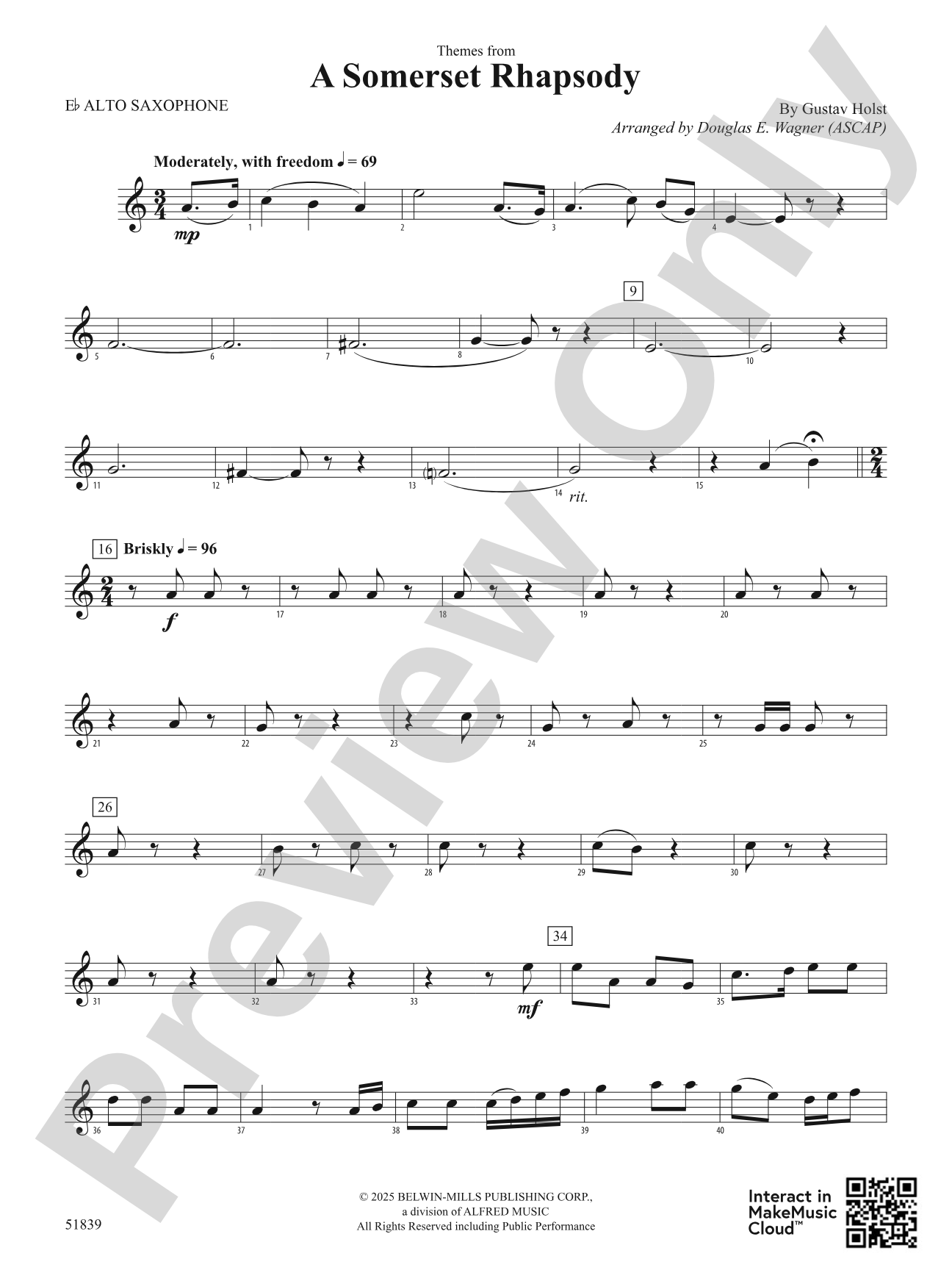

A Somerset Rhapsody: E-flat Alto Saxophone
By Gustav Holst / arr. Douglas E. Wagner
Grade: 2
Item: 00-PC-0019523_AX1
$5.99
Pickup currently not available
Description
Written at the peak of the early 20th century period of intense folk music interest in Great Britain, A Somerset Rhapsody draws upon tunes collected by Cecil Sharp (to whom the work is dedicated) in his travels throughout that area of exceptional natural beauty in Southwest England. Holst chose three of these folk songs that are seamlessly presented in this arrangement: the pensive "Sheep Shearing Song," the bold "High Germany," and the doleful "The True Lover's Farewell." Penned in 1906, A Somerset Rhapsody displays definite hints of the iconic First Suite in E-flat (1909) and Second Suite in F (1911) for military band soon to come. This arrangemment by Douglas E. Wagner, is an excellent way to introduce your students to the music of Holst. (2:50)


Discover MakeMusic Cloud: thousands of interactive titles your students can play along with today.
Sample Audio
1
Audio File
--:--
0:00
0:00
Sample Video
Additional Details
Series:
Belwin Young Band
Publisher:
Alfred Music
SKU:
00-PC-0019523_AX1
More about this title
About the Composer: Gustav Holst
Gustav Holst (1874-1934) revolutionized British band music through his deep respect for folk tradition and his gift for orchestration. His two suites for military band, composed in 1909 and 1911, became foundational repertoire for the genre and remain standards in concert band literature today. Holst's approach to folk material was never merely decorative; he understood that these melodies carried the cultural weight of ordinary people's lives, and he treated them with both reverence and imagination.
Beyond his band works, Holst composed prolifically across genres, including the orchestral suite The Planets, which secured his international reputation. Yet his band music reveals something equally important: his belief that serious compositional craft belonged in every ensemble, at every level. His legacy shaped how generations of composers and educators approached folk material, community music-making, and the relationship between accessibility and artistic integrity.
Why we love this
Wagner's arrangement captures the essence of Holst's folk sensibility while remaining genuinely playable for young ensembles. Three distinct melodies allow your band to experience authentic thematic development and textural variety without excessive technical demands, making this an ideal gateway to both Holst and the concert band canon. The work proves that Grade 2 repertoire can be musically substantial.
What to expect
A Somerset Rhapsody unfolds like a journey through the English countryside, stopping to listen at three different moments. The opening's gentle introspection gives way to vigorous energy, then settles into a bittersweet farewell. Throughout, Holst's orchestration shimmers with color and intention, despite the Grade 2 scoring.
Who it's for
Concert bands at the Grade 2 level and programs seeking substantial masterwork repertoire without overwhelming technical demands. This arrangement works equally well for festival programming and concert contexts where directors want to build students' understanding of British band tradition and folk-based composition.
How to get the most out of it
- Shape each folk tune as a self-contained song rather than as musical background. The phrasing should breathe naturally, allowing the lyrical character of 'Sheep Shearing Song' and 'The True Lover's Farewell' to emerge clearly.
- Balance the three tunes so that each registers as a distinct personality. 'High Germany' demands boldness, but it should not overshadow the quieter songs; use dynamic contrast to establish these relationships.
- Attend carefully to the transitions between melodies. Wagner's arranging hand shows particularly in how smoothly one tune yields to the next; clean releases and confident entries will honor that craftsmanship.
- Let the ensemble discover why Holst dedicated this work to Cecil Sharp by researching the folk songs themselves. Hearing the original melodies strengthens interpretive choices and builds genuine connection to the material.
How to use it
Program this as a centerpiece in a concert exploring folk music across cultures, or use it as your band's festival selection to introduce adjudicators to Holst's approach to orchestration and melody. Pairing it with a contrasting modern work or a lighter march reinforces the emotional weight without exhausting your ensemble or audience.
Skills your students will build
- Phrasing longer melodic lines with direction and shape
- Balancing independent voices within a folk-song texture
- Understanding how arrangers adapt existing material for new ensembles
- Listening critically to historical context and composer intent
- Transitioning smoothly between contrasting musical ideas