A Simple Song at Sunrise (from "Florida Suite"): Oboe Sheet Music Preview

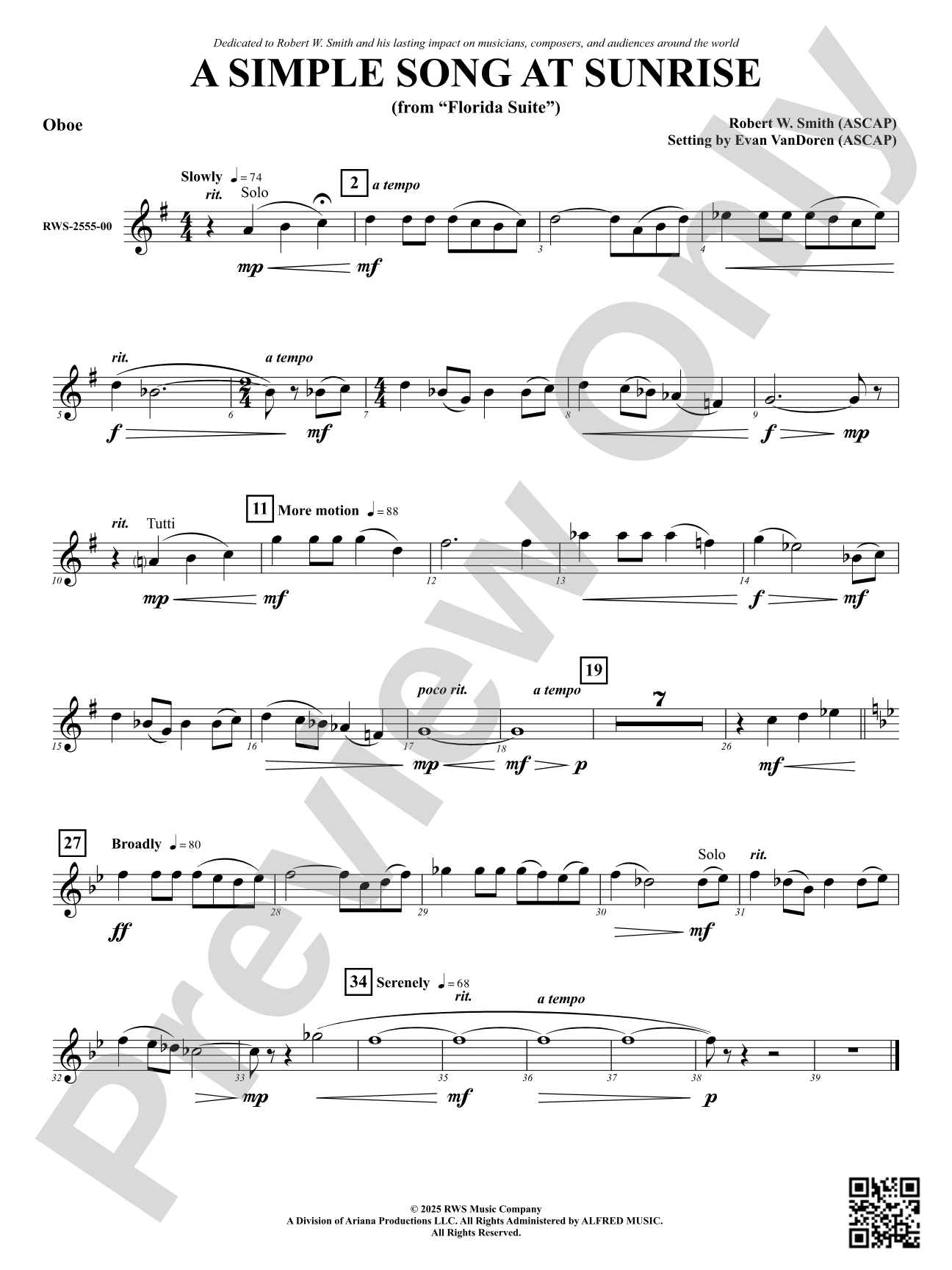
A Simple Song at Sunrise (from "Florida Suite"): Oboe

(from "Florida Suite")

By Robert W. Smith / Setting by Evan VanDoren

Grade: 3

Item: 98-PC-RWS2555_O1

Digital Download
$3.99
Description
A Simple Song at Sunrise, composed for DCI's first-ever show featuring all original music, is now available for your concert band. This ballad from "A Florida Suite," Robert W. Smith's masterwork has captivated audiences for decades and will do the same for yours. Envisioned as a sunrise over a Florida beach, Evan VanDoren's beautifully orchestrated concert band setting truly honors the legacy of the original composer.

A Simple Song at Sunrise (from "Florida Suite"): Oboe isn't in MakeMusic Cloud just yet...but it could be. Let us know you'd like to see it, and you'll help shape what comes next. In the meantime, start a free trial and dive into thousands of interactive titles your students can play along with today.

Sample Audio
0:00
0:00
Sample Video
Additional Details
Series: RWS - Concert Band
Publisher: RWS Music Company
SKU: 98-PC-RWS2555_O1

More about this title

About the Composer: Robert W. Smith

Robert W. Smith

Robert W. Smith stands among America's most performed composers for concert band and orchestra, with over 400 published works to his credit. His education at Troy State University and the University of Miami grounded him in both composition and music pedagogy, disciplines evident in every score he writes. Smith's orchestral works, including his symphonies The Divine Comedy and The Odyssey, have traveled globally and become repertoire staples from North America to Asia and Europe.

Beyond the concert hall, Smith's music has reached millions through television broadcasts, Olympic ceremonies, and landmark public events including the Macy's Thanksgiving Day Parade and Opening Day at Dodger Stadium. As a conductor and clinician, he has worked directly with ensembles across the United States, Canada, Japan, Australia, and Europe, continuously shaping how his music is performed and understood.

Why we love this

A sunrise ballad that captures genuine poetry without sacrificing accessibility: VanDoren's orchestration brings out the lyrical warmth Smith composed while keeping the Grade 3 range playable and engaging for developing ensembles. This is the kind of concert piece that reminds audiences why they came to hear a band in the first place.

What to expect

Dawn light spreading across still water; the orchestration unfolds gradually, each instrument coming in as if the sun were painting the landscape layer by layer. The harmonic language feels timeless and peaceful, never saccharine, with moments of gentle luminosity that catch the ear without demanding attention.

Who it's for

Concert bands working at Grade 3 level who want repertoire that demonstrates musical maturity and emotional depth. This piece rewards bands ready to move beyond technical exercises into genuine song interpretation while remaining well within their technical range.

How to get the most out of it

  • Shape the opening phrase to breathe naturally; treat sustained passages as one long vocal line rather than static harmony, with the low brass anchoring but never pushing ahead of the melody.
  • Balance the woodwind colors carefully during the middle section where internal voices emerge; Smith often writes pretty harmony that disappears if the principal voices dominate.
  • Let the final cadence settle without rushing; the piece's power lies in its simplicity, so resist the urge to add dramatic weight where restraint serves better.

How to use it

Program this as a centerpiece to a concert that needs both contrast and substance, especially when surrounded by march or fast-paced contemporary pieces. It works particularly well as the second or third selection, after audiences have settled, and before energy shifts back up; also fitting for spring concerts where the imagery feels seasonal and right.

Skills your students will build

  • Sustained phrasing and line continuity across full phrases without breaking for breath
  • Balancing transparent harmonic color, particularly keeping inner voices audible without forcing
  • Ensemble balance in homophonic textures where different sections carry equal musical weight
  • Interpretation of expressive dynamics in a piece that relies on subtlety rather than contrast

You May Also Like