
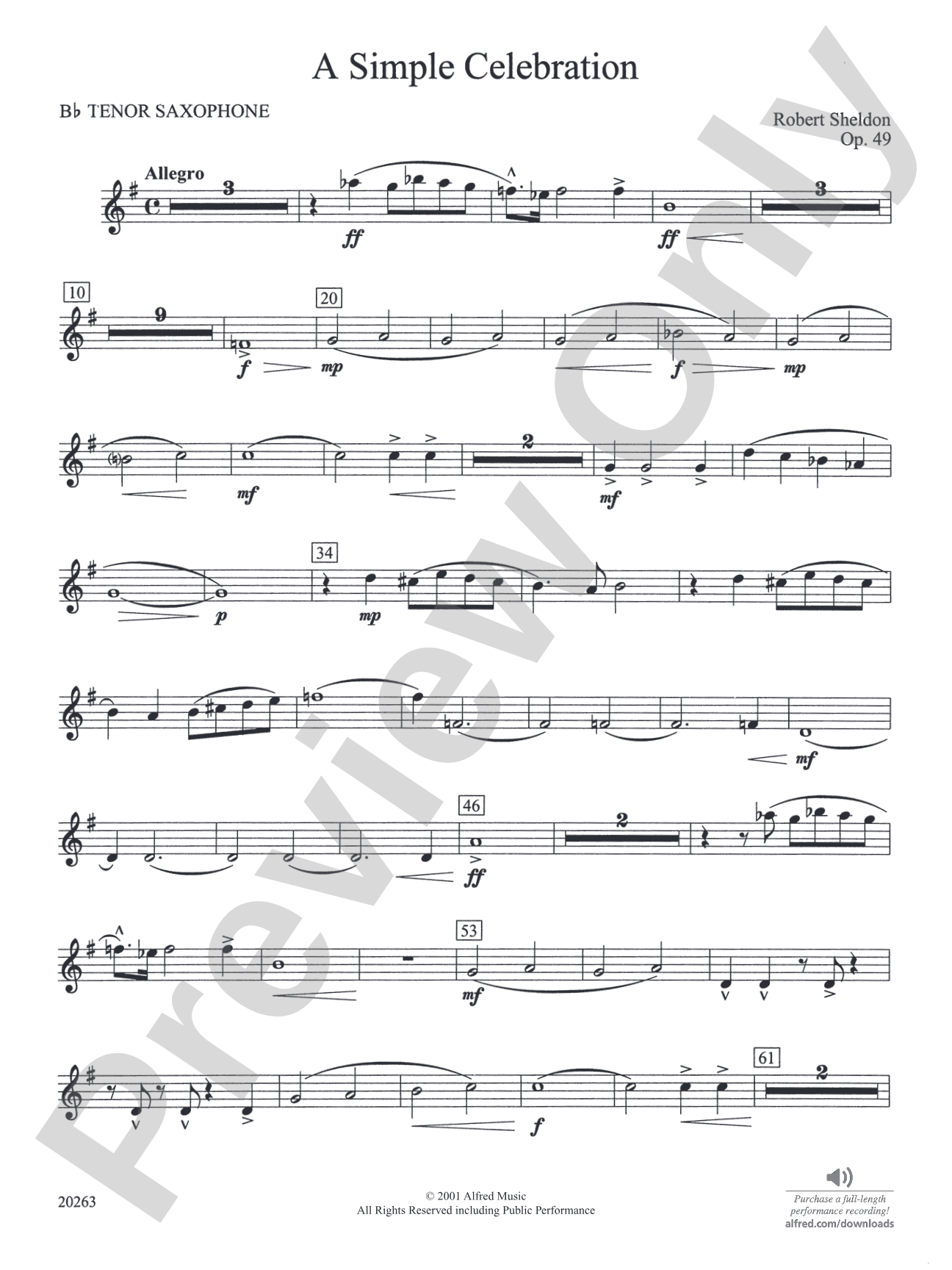

A Simple Celebration: B-flat Tenor Saxophone
Music by Robert Sheldon
Grade: 4 (Medium Difficult)
Item: 00-PC-0018746_TX1
$3.00
Pickup currently not available
Description
Energetic themes, colorful orchestration, vocal textures and playful rhythms make A Simple Celebration attractive for concert or contest. Many opportunities for expressive playing are found throughout the solo passages, the introspective transitions, and plaintive "Andante" section. The return of the opening theme provides a fast-paced development, leading to a rhythm puzzle that finds its solution in the triumphal conclusion. A sure winner!


A Simple Celebration: B-flat Tenor Saxophone isn't in MakeMusic Cloud just yet...but it could be. Let us know you'd like to see it, and you'll help shape what comes next. In the meantime, start a free trial and dive into thousands of interactive titles your students can play along with today.
Request This Title
Tell us you want it.
Start Your Free Trial
Explore everything that's ready to play right now.
Sample Audio
1
Audio File
--:--
0:00
0:00
Sample Video
No sample videos found.
Additional Details
Series:
Alfred Concert Band
Publisher:
Alfred Music
Page Count:
3
SKU:
00-PC-0018746_TX1
More about this title
About the Composer: Robert Sheldon

Robert Sheldon stands among the most widely performed composers of wind band music in the world. His works appear regularly on concert and contest schedules internationally, and his catalog reflects decades of commissions and new publications. He served as lead author for Sound Innovations for Concert Band and has received recognition from the American School Band Director's Association, Phi Beta Mu, and the American Society of Composers, Authors and Publishers.
Sheldon maintains an active schedule as both guest conductor and clinician, leading All-State and Regional Honor Bands while presenting at universities and state music education conferences across North America and internationally, including appearances in Japan, Canada, Italy, Germany, Australia, and China. His works have been performed at Carnegie Hall, Symphony Hall in Boston, Orchestra Hall in Chicago, the Sydney Opera House, and the Kennedy Center for the Performing Arts. He received an honorary doctorate from VanderCook College of Music in 2020.
Why we love this
Sheldon knows how to write for the Grade 4 band without talking down to it. The piece delivers genuine musical substance through energetic themes and smart orchestration while keeping the technical demands manageable for most ensembles. It works equally well in concert or contest settings, and the balance of rhythmic playfulness with introspective moments gives your musicians something real to interpret.
What to expect
A Simple Celebration opens with infectious energy and colorful brass and woodwind textures that immediately engage the listener. The piece shifts gently into quieter, more reflective terrain before returning to its opening material with renewed momentum, building to a triumphal finish that feels genuinely earned.
Who it's for
Concert bands at the Grade 4 level looking for repertoire that balances musical sophistication with accessible instrumentation. This works for ensembles preparing for concert performances or festival competition, and it's substantial enough to anchor a program without overwhelming newer or developing bands.
How to get the most out of it
- Shape the solo passages with careful attention to phrasing. These moments reward expressive playing and give your soloists a chance to shine; let them breathe and shape their lines with intention.
- The transitions require clarity from the full ensemble. Support the introspective sections with a lighter texture and controlled dynamics so the shift in mood registers clearly with the audience.
- Approach the rhythm puzzle deliberately during rehearsals. Break it down rhythmically before combining it with the full instrumentation; once your students own the figure, the solution will land with impact.
- Build momentum into the final section. The fast-paced development and triumphal conclusion need forward motion and dynamic contrast to feel earned rather than rushed.
How to use it
Place this piece as a concert opener or early second-half selection where its energy and optimism can anchor your program. The structure and pacing make it an ideal festival selection for Grade 4 bands seeking a competitive piece that also works as compelling concert repertoire.
Skills your students will build
- Balancing ensemble color through strategic orchestration and articulation choices
- Shaping solo passages with musical intent and expressive control
- Reading and executing rhythmic complexity (the rhythm puzzle) at tempo
- Interpreting contrasting sections (fast, introspective, and triumphal) with appropriate textural and dynamic shifts
- Maintaining rhythmic precision during fast-paced development passages