
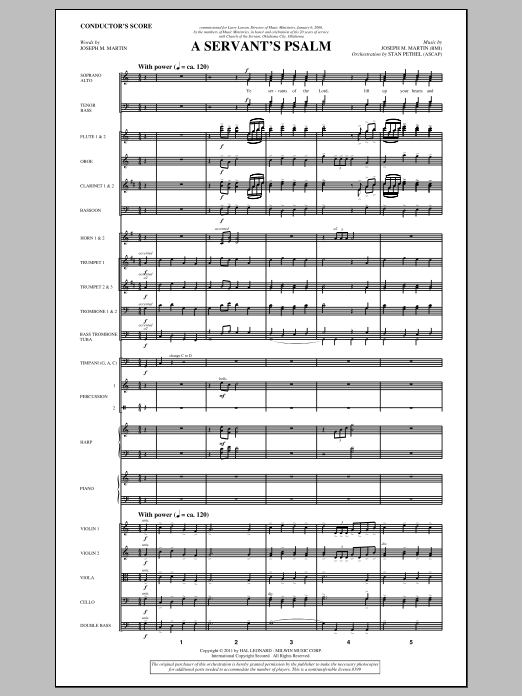

A Servant's Psalm: Choral Instrumental Pak
By Joseph M. Martin
Item: 35-PK00205735
$75.00
Pickup currently not available
Buy Extra Parts (Digital PDF Download)
Parts Added to Cart!
Description
For choirs seeking a challenge, this anthem offers scope and power. Thick divided chords offer a sonorous depth to the timbre of the anthem, and the mixed meter characteristics of the rhythmic writing delivers a festive energy worthy of the finest ensembles. The final section springs forth with a rustic abandon concluding with antiphonal pyrotechnics that takes the anthem to dizzying heights!


A Servant's Psalm: Choral Instrumental Pak isn't in MakeMusic Cloud just yet...but it could be. Let us know you'd like to see it, and you'll help shape what comes next. In the meantime, start a free trial and dive into thousands of interactive titles your students can play along with today.
Request This Title
Tell us you want it.
Start Your Free Trial
Explore everything that's ready to play right now.
Sample Audio
No sample audio found.
Sample Video
No sample videos found.
Additional Details
Publisher:
Hal Leonard
SKU:
35-PK00205735
More about this title
About the Composer: Joseph M. Martin

Joseph M. Martin studied piano performance at Furman University and earned his master's degree from the University of Texas at Austin, where he taught in the Piano Pedagogy Department for five years. His career has spanned both concert halls and sacred spaces; he won the Nina Plant Wideman Competition and performed as a featured soloist with orchestras across the United States and Mexico, including a nationally broadcast recital from Ex-convento del Carman in Guadalajara.
Martin's compositions have found audiences in unexpected places, from Carnegie Hall to the Mel Tillis Theatre to countless worship services across North America. While he maintains an active performance schedule, his focus has increasingly turned toward church music and conferences for church musicians. He resides in Austin, Texas with his family.
Why we love this
Martin writes for the ensemble that exists in your actual rehearsal space, not some imaginary supergroup. The divided voicing creates genuine harmonic richness without becoming muddy, and the rhythmic challenges energize rather than overwhelm singers who are ready for something substantial. The final section's antiphonal writing gives you a concrete moment of spectacle that feels earned, not forced.
What to expect
Robust and assured, like a structure built from stone rather than wood. The divided chords create a warm, full-bodied sonority that feels generous and expansive, while the mixed meter elements inject genuine sparkle and forward momentum. When the antiphonal exchanges arrive near the end, there is an almost raucous joy that feels like it might tip into chaos but stays just in control.
Who it's for
Choirs with solid musicianship who want to tackle demanding harmonic writing and rhythmic complexity without leaving their singers feeling defeated. The piece rewards preparation and ensemble maturity, making it ideal for groups working toward a significant concert moment or festival performance.
How to get the most out of it
- Prepare the rhythmic shifts by isolating the mixed meter sections in sectional rehearsals before putting them in context with other voices. Singers internalize the pulse much faster when they can feel how their line sits against a steady beat.
- Balance the thick divided chords by thinking toward the soprano line rather than letting basses anchor everything down. The sonority depends on all parts sitting in the same dynamic world.
- Shape the antiphonal finale by allowing genuine space and silence between the exchanges rather than rushing to fill time. The power comes from clean releases and fresh attacks.
- Record a rehearsal run-through and listen for clarity in the middle voices, where doubled harmony can obscure rather than enhance. One listen often reveals where you need to thin texture or adjust balances.
How to use it
This works beautifully as a centerpiece for a concert built around sacred choral music, giving you a piece substantial enough to anchor a first half and showcase your choir's technical capabilities. It pairs well with older or simpler settings of the same text, or alongside other contemporary sacred works that share its harmonic depth.
Skills your students will build
- Reading and executing mixed meter changes (shifting between adjacent measures of different beat counts)
- Balancing divided voicing to achieve blend rather than mud
- Sustaining ensemble cohesion during rhythmic complexity
- Shaping antiphonal sections with precise articulation and clear releases
- Singing divided harmony parts with independent musical confidence