
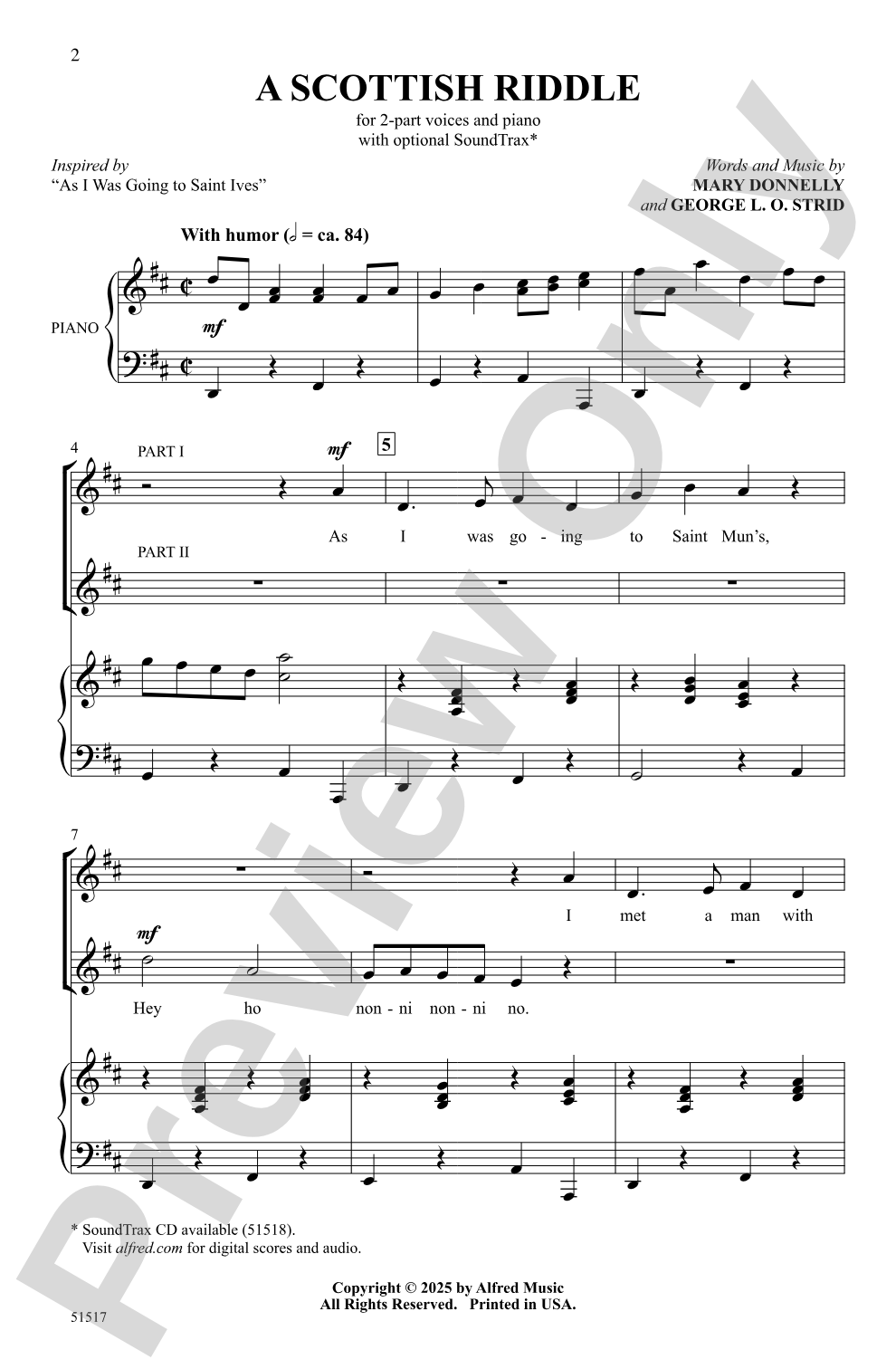
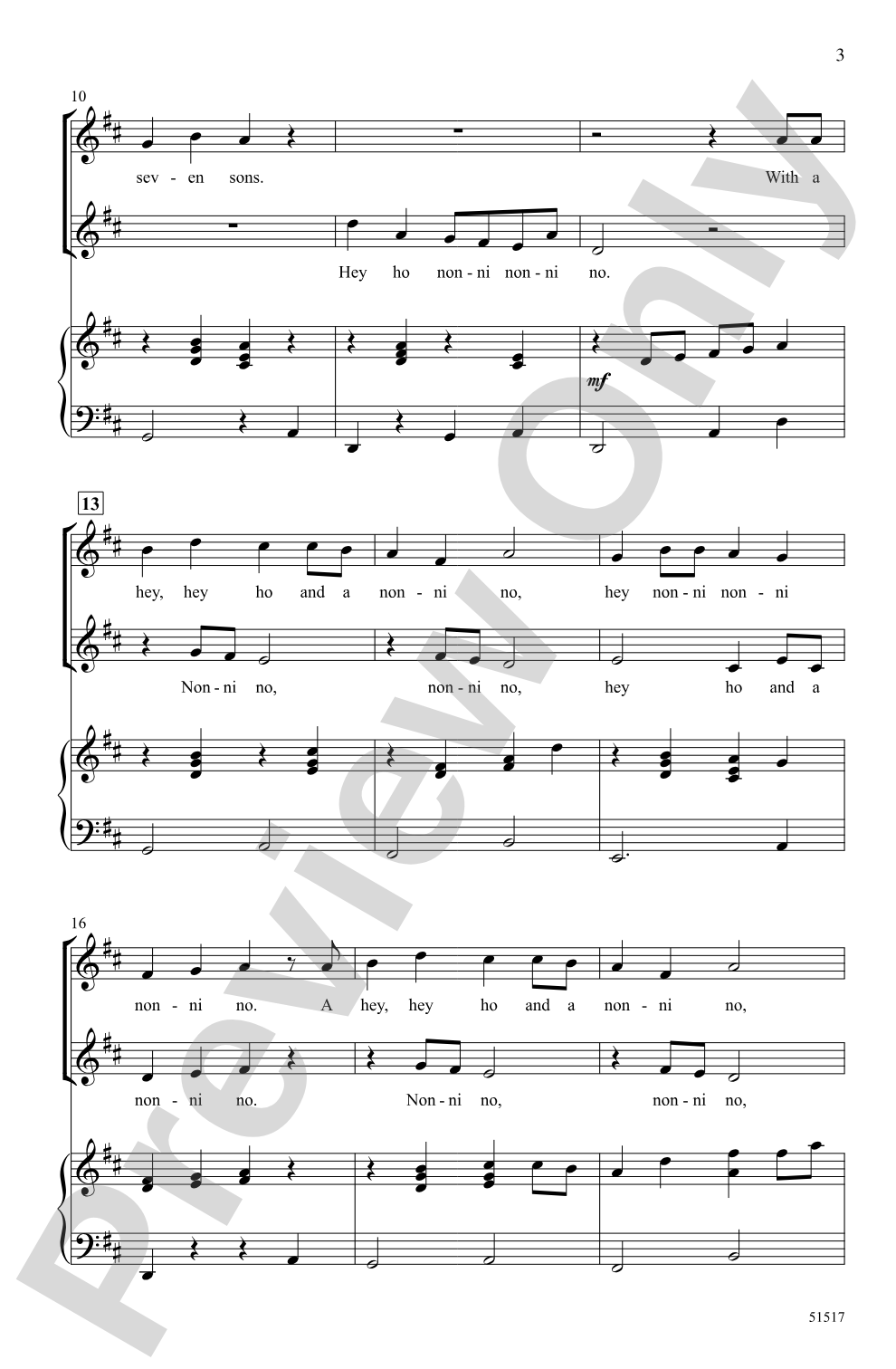

A Scottish Riddle: 2-Part Choral Octavo
Words and music by Mary Donnelly and George L. O. Strid
Item: 00-PO-0007473
$2.30
Minimum order quantity: 20 copies
Pickup currently not available
Description
"Oh good heavens, so many sevens!" You don't need a calculator to enjoy this humorous piece, inspired by a nursery rhyme. Featuring independent voice parts and back-and-forth singing, this number-crunching novelty travels swiftly through different keys and tempos for dramatic effect. And even if you lose count along the way, on the last page, the riddle is solved!


A Scottish Riddle: 2-Part Choral Octavo isn't in MakeMusic Cloud just yet...but it could be. Let us know you'd like to see it, and you'll help shape what comes next. In the meantime, start a free trial and dive into thousands of interactive titles your students can play along with today.
Request This Title
Tell us you want it.
Start Your Free Trial
Explore everything that's ready to play right now.
Sample Audio
1
Audio File
--:--
0:00
0:00
Sample Video
Additional Details
Series:
Alfred Choral Designs
Publisher:
Alfred Music
Page Count:
12
SKU:
00-PO-0007473
More about this title
About the Composer: Mary Donnelly

Mary Donnelly grew up in Reno, Nevada, and studied English and French at the University of Nevada, Reno. While still an undergraduate, she organized two children's choruses, an experience that inspired her to pursue music education. She earned her Master's Degree in Education from Lesley College in Cambridge, Massachusetts, where she focused on arts integration across the curriculum.
Donnelly taught general music and choir in elementary and middle schools throughout the Washoe County School District for three decades before retiring. In 1985, she began collaborating with George Strid on a musical for Reading Week, launching a partnership that has produced over two hundred songs and twenty-five musicals. She holds membership in ACDA, NEA, and ASCAP.
Why we love this
A Scottish Riddle stands out for its genuine humor and structural playfulness. The piece doesn't simply tell a joke; it builds the comedy through shifting keys and tempos, keeping singers and audiences engaged with unexpected musical turns that land the punchline on the final page.
What to expect
There's a playful, tongue-in-cheek energy throughout, with the constant references to numbers creating a quirky rhythm that propels the piece forward. The shifting keys and tempos keep everyone slightly on their toes, building momentum toward the reveal on the final page where everything clicks into place.
Who it's for
This piece works well for 2-part choirs at the middle school and early high school levels, including mixed voice sections and treble choirs seeking accessible repertoire with genuine entertainment value. It appeals to singers who enjoy novelty material and audiences who appreciate humor that doesn't sacrifice musical craftsmanship.
How to get the most out of it
- Maintain crisp articulation on the number-filled text to keep the humor landing clearly; syllabic clarity prevents the riddle from becoming muddled.
- Practice the key and tempo changes as marked transitions rather than stumbles; treat each shift as a deliberate musical device that intensifies the comedic effect.
- Use the recorded accompaniment to lock in ensemble confidence, especially through the rhythmic interplay of the back-and-forth sections.
How to use it
Program this as a concert opener or lighter moment between more serious selections. Its novelty character and quick pacing make it ideal for family concerts, school assemblies, or any program needing an engaging piece that entertains without requiring solemn interpretive work from your singers.
Skills your students will build
- Reading and performing rapid key changes
- Executing tempo changes accurately and musically
- Singing independent 2-part lines with clear voice independence
- Delivering text rhythmically and intelligibly in novelty material
- Responding to dynamic musical contrasts for comedic timing