A Salute To Richard Rodgers (arr. Ted Ricketts) Sheet Music Preview

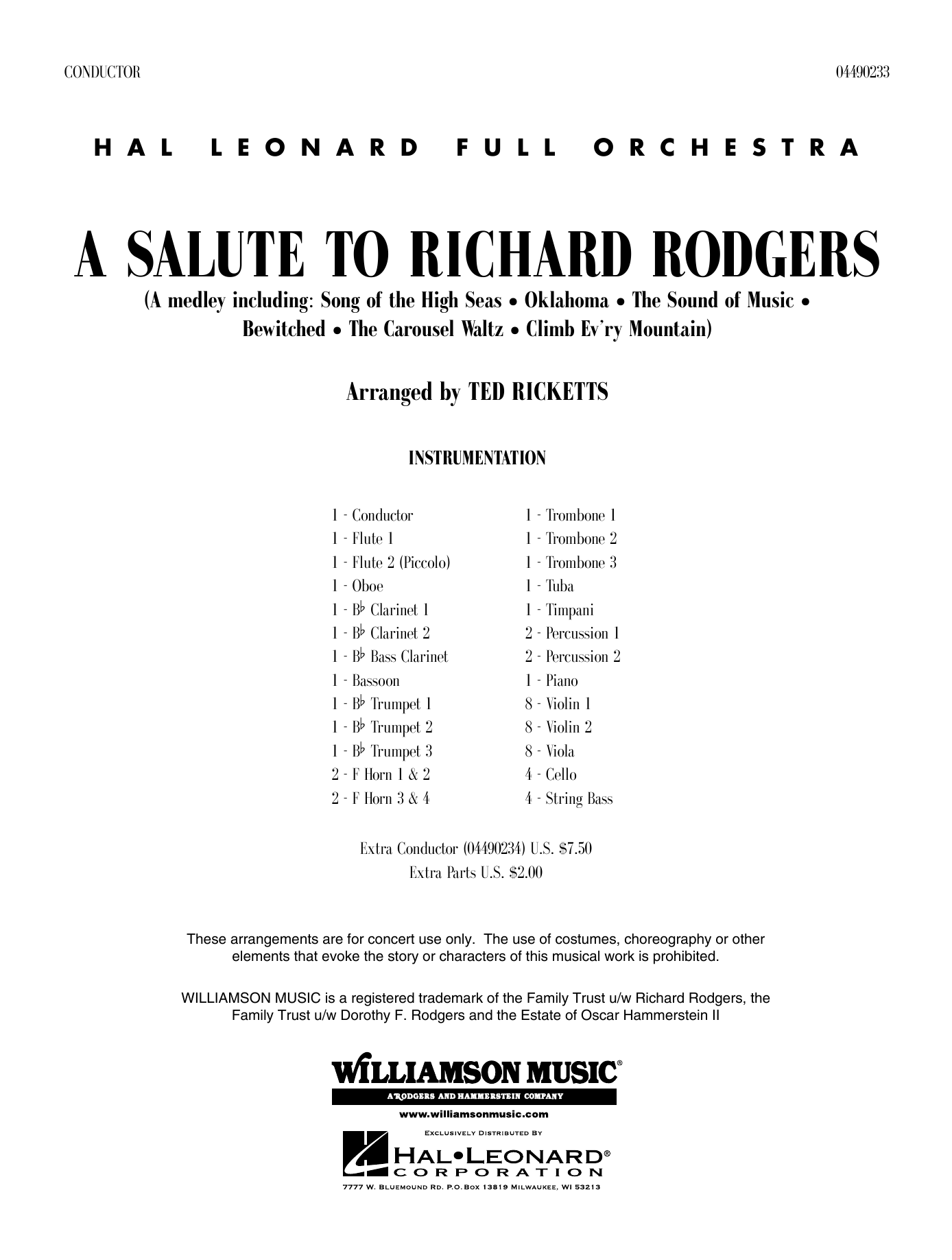
A Salute To Richard Rodgers (arr. Ted Ricketts): Full Orchestra Conductor Score & Parts

By Richard Rodgers / Arranged by Ted Ricketts

Grade: 4

Item: 35-PK01461177

Digital Download
$85.00

One moment…

Description
Best-known for his innovations in musical theater, celebrated American composer Richard Rodgers would have been 100 years old in the year 2002. This adventurous work includes a varied cross-section of his compositions from the collaborations with Lorenz Hart and Oscar Hammerstein II to his Emmy award-winning film score Victory At Sea. Includes: Song of the High Seas, Oklahoma, The Sound of Music, Bewitched, The Carousel Waltz and Climb Ev'ry Mountain. A marvelous tribute to one of the masters of melody.

A Salute To Richard Rodgers (arr. Ted Ricketts): Full Orchestra Conductor Score & Parts isn't in MakeMusic Cloud just yet...but it could be. Let us know you'd like to see it, and you'll help shape what comes next. In the meantime, start a free trial and dive into thousands of interactive titles your students can play along with today.

Sample Audio
No sample audio found.
Sample Video
Additional Details
Publisher: Hal Leonard
SKU: 35-PK01461177

More about this title

About the Composer: Richard Rodgers

Richard Rodgers stands as one of America's most prolific and influential composers, having shaped popular music across multiple media for nearly seven decades. His partnership with lyricist Oscar Hammerstein II produced some of the most enduring works in musical theater, including Oklahoma! and The Sound of Music, while his earlier collaboration with Lorenz Hart yielded sophisticated jazz-influenced standards. Beyond Broadway, Rodgers composed the score for the acclaimed television series Victory At Sea, demonstrating his versatility and earning him an Emmy Award.

Why we love this

Rodgers' melodies are instantly recognizable and emotionally direct, making this arrangement a vehicle for teaching how memorable songwriting translates across orchestral textures. The medley format allows your ensemble to experience the arc of an entire concert within a single piece, building confidence and momentum through familiar material. Ted Ricketts' orchestration preserves the melodic clarity that made these songs popular while giving every section meaningful work.

What to expect

A journey through decades of American songwriting, from the optimism and wide-open landscapes of Oklahoma to the majestic Alpine sweep of The Sound of Music, with maritime adventure and romantic sophistication woven between. The familiar melodies carry emotional weight that transcends the arrangement itself, inviting audiences into a celebration of craft and accessibility.

Who it's for

Orchestras at the Grade 4 level looking to program recognizable, audience-friendly repertoire that maintains musical substance. Student musicians benefit from playing material they already know, which allows them to focus on ensemble balance and stylistic execution rather than decoding unfamiliar harmonic language.

How to get the most out of it

  • Balance the soloists and featured sections against the full orchestra sound. These melodies thrive on clarity, so avoid letting accompaniment textures bury the tune.
  • Attend to the style shifts between selections. Oklahoma demands a different character than The Sound of Music; use rehearsal time to nail the transitions and let each section breathe in its own idiom.
  • The Carousel Waltz requires steady, flowing momentum. Resist the urge to linger; keep the pulse dancing to let the 3/4 meter sing naturally.
  • Lean into the Victory At Sea march sections with rhythmic precision. The naval character of that material rewards crisp articulation and confident ensemble alignment.

How to use it

Position this as a centerpiece in a pops concert or spring program where audience engagement matters. It also serves well as a concert finale, offering crowd-pleasing material that leaves listeners humming as they leave. Consider pairing it with one serious work earlier in the program to balance a lighter second half.

Skills your students will build

  • Identifying and balancing melody against accompaniment across varied orchestrations
  • Executing style-specific articulation and phrasing across musical theater idioms
  • Navigating tempo and meter changes between contrasting selections within a medley format
  • Sustaining ensemble cohesion through longer programmatic structures
  • Reading and responding to frequent solo and sectional features

You May Also Like