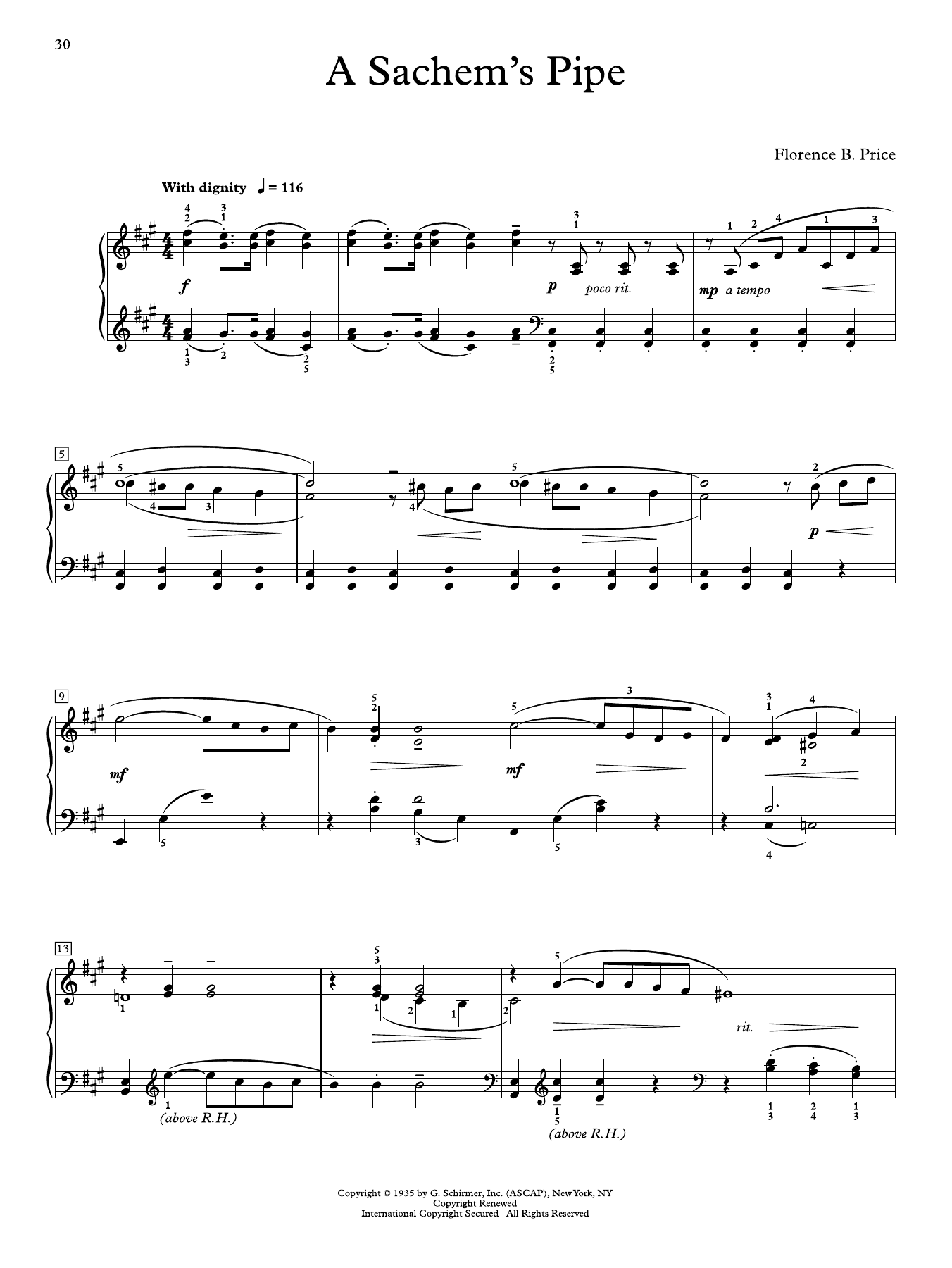
A Sachem's Pipe Sheet Music Preview

A Sachem's Pipe: Educational Piano

As performed by Florence Price

Item: 35-DS01838574

Digital Download
$4.99
Description

Discover MakeMusic Cloud: thousands of interactive titles your students can play along with today.

Sample Audio
No sample audio found.
Sample Video
Additional Details
Publisher: Hal Leonard
Page Count: 2
SKU: 35-DS01838574

More about this title

About the Artist: Florence Price

Florence Price (1887–1953) was the first African American woman to have a symphony performed by a major American orchestra. A composer of remarkable range, she wrote across genres including symphonies, concertos, chamber works, and solo piano pieces, drawing deeply from African American spirituals, folk traditions, and European classical forms. Her educational works remain vital resources for teaching students the full scope of American concert music history.

Why we love this

Price's piano miniatures bring authenticity and cultural depth to the student repertoire without sacrificing musical interest. This piece sits at that productive intersection where pedagogical clarity meets genuine artistry, giving your students something real to interpret rather than another technical exercise.

What to expect

A reflective, intimate work that weaves melodic simplicity with underlying harmonic sophistication. The title evokes Native American tradition, and the piece carries a lyrical, contemplative quality that rewards thoughtful interpretation.

Who it's for

Students exploring solo repertoire beyond the standard European canon will find this piece accessible without being patronizing. It works well for intermediate pianists ready to engage with meaningful American concert music.

How to get the most out of it

  • Anchor the piece's rhythmic character by feeling the pulse of the accompaniment pattern; don't let the melody float free from the harmonic foundation beneath it.
  • Listen carefully to how Price balances folk-song simplicity in the melodic line against slightly more sophisticated harmonic movement. Resist over-romanticizing; clarity serves the music better than expressive excess.
  • If dynamic markings are sparse, use phrase shape and harmonic changes as your guide for subtle shading rather than waiting for explicit directions.

How to use it

Include this in a recital program exploring American composers or in a thematic concert examining cultural musical traditions and their treatment by concert composers. It also serves as an excellent repertoire choice for students preparing audition or festival programs focused on diversifying the standard piano canon.

Skills your students will build

  • Balancing melody and accompaniment texture
  • Interpreting pieces with minimal performance directives
  • Understanding American concert music and African American compositional traditions
  • Phrasing and shaping in miniature forms

You May Also Like