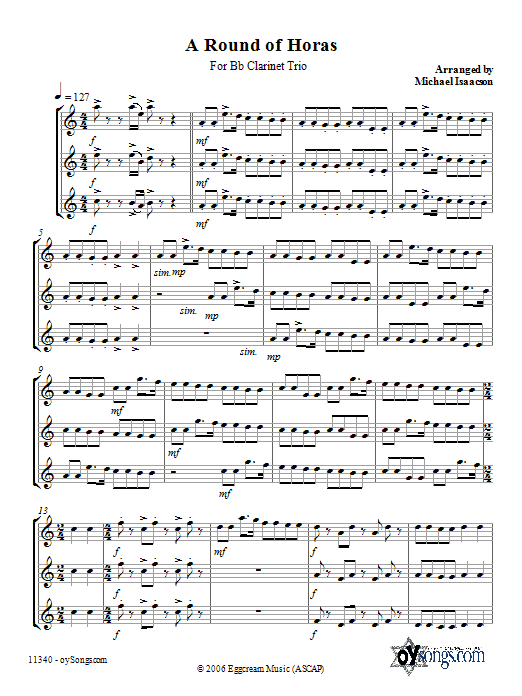
A Round of Horas Sheet Music Preview

A Round of Horas: Lead Sheet / Fake Book

Arranged by Michael Isaacson

Item: 35-DS00090137

Digital Download
$3.99
Description

A Round of Horas: Lead Sheet / Fake Book isn't in MakeMusic Cloud just yet...but it could be. Let us know you'd like to see it, and you'll help shape what comes next. In the meantime, start a free trial and dive into thousands of interactive titles your students can play along with today.

Sample Audio
No sample audio found.
Sample Video
Additional Details
Publisher: Hal Leonard
Page Count: 5
SKU: 35-DS00090137

More about this title

About the Arranger: Michael Isaacson

Michael Isaacson is a composer and arranger whose work centers on Jewish musical traditions and their role in contemporary performance. His arrangements bring cultural specificity to standard educational and performance contexts, treating traditional material with both scholarly respect and practical musicality.

Why we love this

Isaacson's collection gives you authentic hora melodies in lead sheet format, which means your ensemble has real flexibility in how to interpret and perform them. Whether you're building a cultural studies unit, planning a world music concert, or looking for material that connects singers and pianists in genuine dialogue, these arrangements work across skill levels and ensemble configurations.

What to expect

Warm, circle-dance energy that feels both celebratory and grounded in tradition. The lead sheet format gives the music room to breathe and invites personal musicality from both singer and accompanist, creating performances that feel lived-in rather than merely rendered.

Who it's for

Pianists and singers looking to perform or study traditional Jewish music in a format that encourages arranging and interpretation. This resource works equally well for music history classes examining cultural repertoire, choral ensembles seeking thematic programming, or applied studio teachers exploring world music traditions with students.

How to get the most out of it

  • Treat the melody line as conversational rather than strictly metronomic; hora rhythms breathe and shift with the dancers' movement, so let your pianist follow the singer's phrasing.
  • Balance lyrical warmth against rhythmic clarity when accompanying; the steady pulse underneath should support, not drive, the vocal line.
  • Explore dynamic shaping across repeated sections; small shifts in texture or touch prevent the form from feeling static through multiple iterations.

How to use it

Create a thematic evening exploring dance music across cultures, pairing these horas with Spanish folk songs, Balkan circle dances, or other traditions with similar social functions. The five-page collection also works as a teaching tool in cultural studies curricula, particularly when paired with historical context or short documentaries about hora traditions.

Skills your students will build

  • Reading and interpreting lead sheets with flexible rhythmic interpretation
  • Accompanying singers while maintaining harmonic independence
  • Recognizing and performing cultural musical characteristics authentically
  • Arranging and adapting traditional melodies for different instrumentation

You May Also Like