
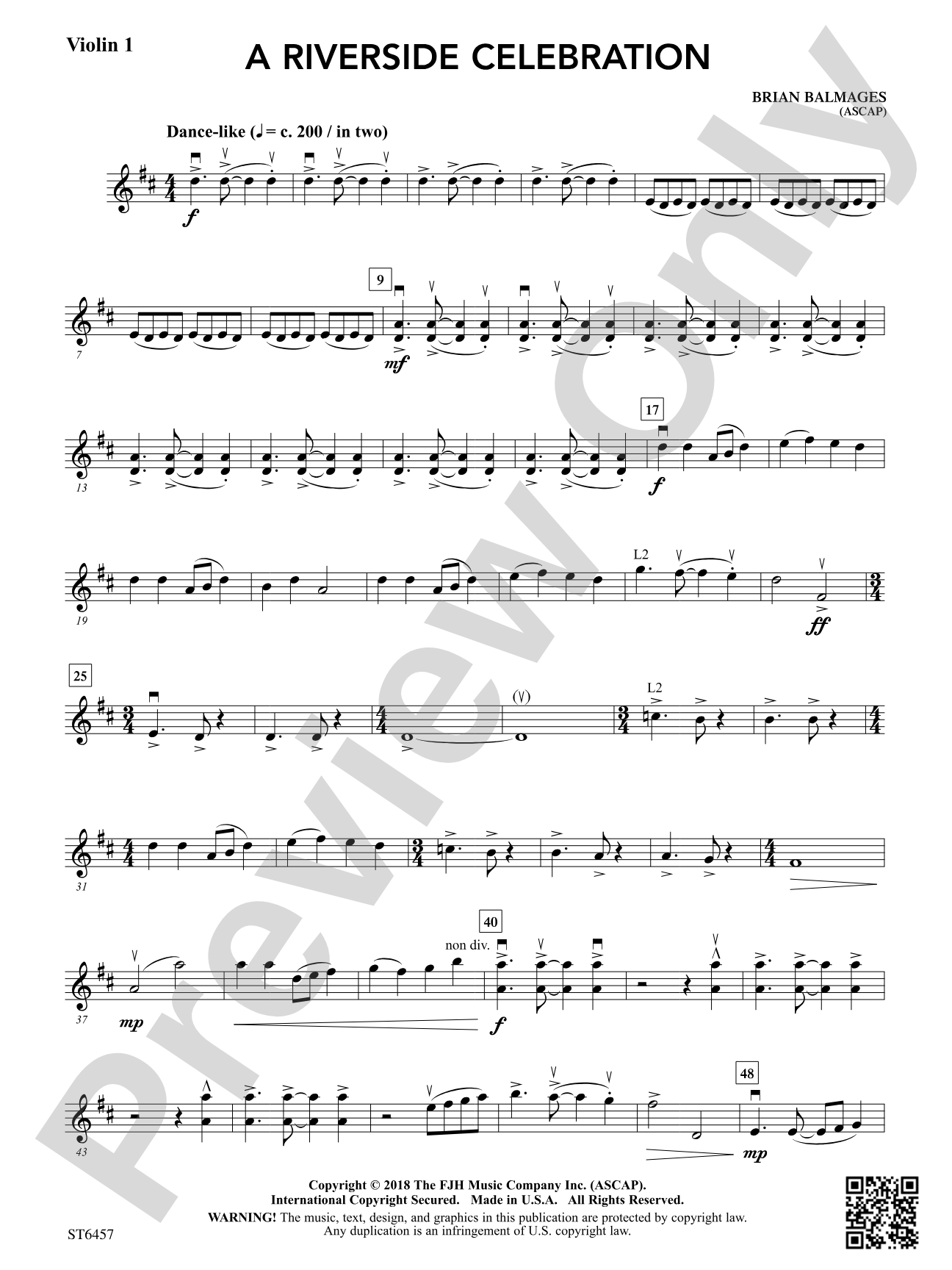

A Riverside Celebration: Violin 1
By Brian Balmages
Grade: 2.5;3
Item: 98-PC-DST6457_VN1
$7.00
Pickup currently not available
Description
Opening with a thriving energetic rhythm, this exciting piece features a dance-like, memorable melody that will stay with the listener long after this celebration is over! Moving through simple meter changes that create additional momentum, the various sections include moments of slight restrain contrasted with carefree child-like fun. Get ready to experience the soundtrack of one giant celebration!


Don't just read it, hear it, play along with it, and watch your students grow with it. In MakeMusic Cloud, A Riverside Celebration: Violin 1 comes alive with professional accompaniment, adjustable tempo, and built-in practice tools that turn solo practice into real progress.
Open in the Player
Jump straight in and assign it today.
Start Your Free Trial
Open this title and explore the full library in minutes.
Sample Audio
1
Audio File
--:--
0:00
0:00
Sample Video
Additional Details
Series:
FJH Developing Strings
Publisher:
The FJH Music Company, Inc.
SKU:
98-PC-DST6457_VN1
More about this title
About the Composer: Brian Balmages

Brian Balmages has established himself as a prolific voice across orchestral, band, and chamber music, with performances spanning from professional symphony orchestras to school ensembles in spaces like Carnegie Hall, the Kennedy Center, and Sydney Opera House. His compositional achievements include the A. Austin Harding Award from the American School Band Directors Association, the 2020 NBA William D. Revelli Composition Contest for Love and Light, and membership in the American Bandmasters Association. He holds Distinguished Alumni status from James Madison University's School of Visual and Performing Arts and was commissioned by the University of Miami to compose for the inauguration of the institution's sixth president.
As a conductor, Balmages maintains regular guest engagements with all-state and regional ensembles, university groups, and professional orchestras worldwide. His conducting appearances have included the Midwest Clinic, Western International Band Clinic, and numerous state ASTA conferences, alongside international guest conducting in Italy and Australia. Currently, he serves as Director of MakeMusic Publications and Digital Education for Alfred and MakeMusic.
Why we love this
Balmages writes with a clear ear for what young orchestras can execute and enjoy. The meter changes feel purposeful rather than arbitrary, building momentum without overwhelming players still developing their sight-reading confidence. The contrast between restrained passages and uninhibited joy mirrors how real students experience music making, making it rewarding to teach and satisfying to perform.
What to expect
Imagine the opening moments of a festival where anticipation becomes movement. The melody carries an infectious, almost playful quality that feels danceable, while subtle restraint in the middle sections gives the piece breathing room before it breaks free again into celebration. The whole thing hums with the kind of honest joy that comes from a group playing together in real time.
Who it's for
String orchestras at the Grade 2.5-3 level who want an energetic showpiece that doesn't demand virtuosity but does require ensemble awareness and rhythmic independence. This works equally well for orchestras in their first or second year of developing string technique.
How to get the most out of it
- Lock the rhythmic energy from the opening. This piece depends on the ensemble feeling the underlying pulse even when meter shifts arrive; a steady conductor's beat prevents the transitions from feeling accidental.
- Shape the dance-like melody across phrase boundaries rather than stopping at bar lines. Help students hear it as a continuous idea that weaves through the section parts.
- Emphasize the contrasts between restraint and exuberance by adjusting ensemble dynamics and tone color. The child-like passages benefit from lighter bow pressure and a brighter sound.
- Balance the energy so the piece arrives at its celebration fully realized. Avoid front-loading all excitement; the arc should build naturally through the meter changes.
How to use it
This is a strong opener for a concert program that needs to establish energy and goodwill early. It also fits naturally into festival or contest settings where you want a piece that showcases rhythmic sophistication without becoming a technique competition, leaving room on the program for more serious or contrasting works.
Skills your students will build
- Reading meter changes in simple time (3/4 and 4/4 transitions)
- Maintaining ensemble unity during rhythmic shifts and tempo momentum changes
- Sustaining a melodic line across section parts and phrase boundaries
- Balancing tone and dynamics to create contrast between sections
- Responding to conductor cues for transitions between restrained and energetic passages