
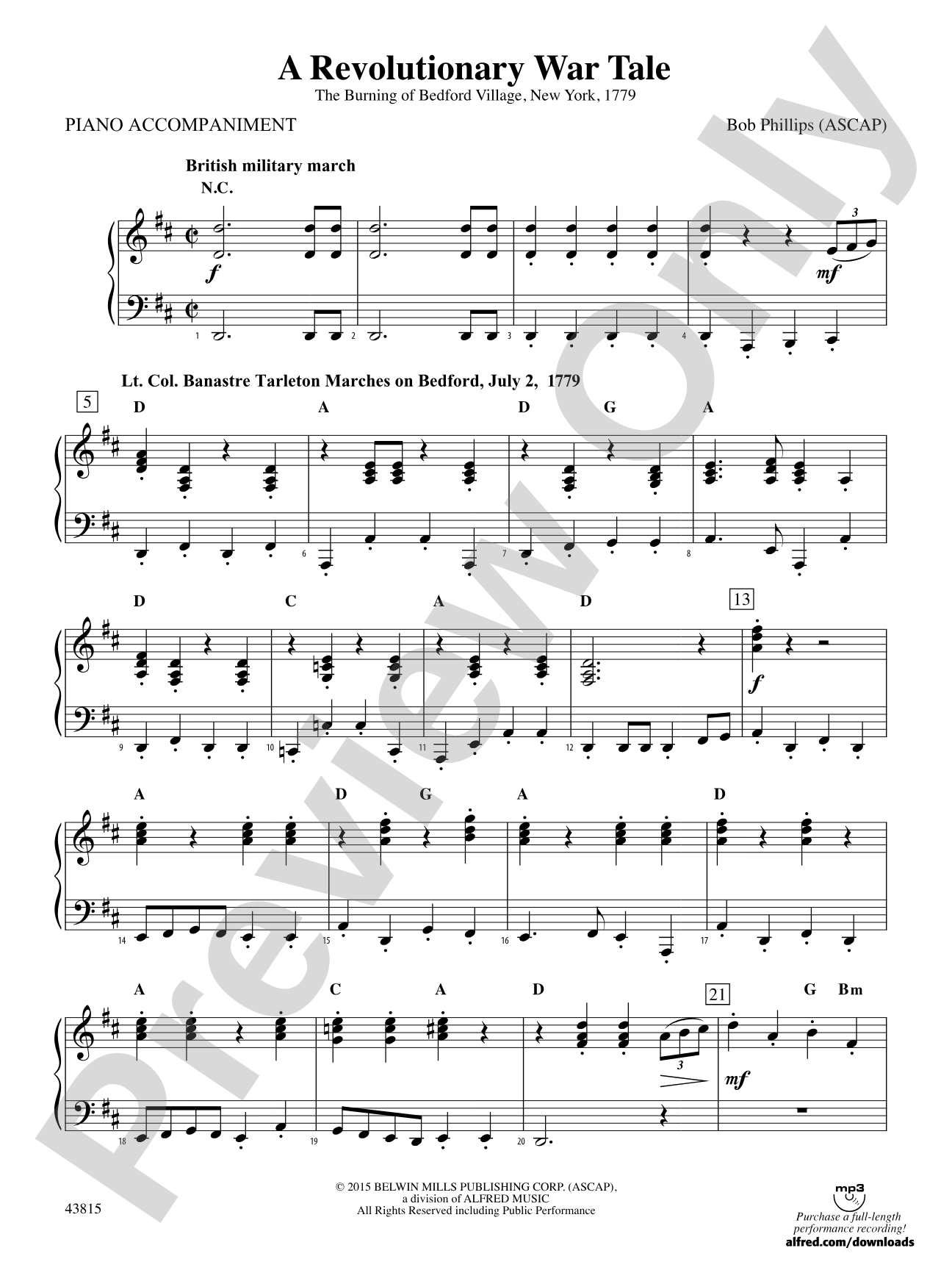
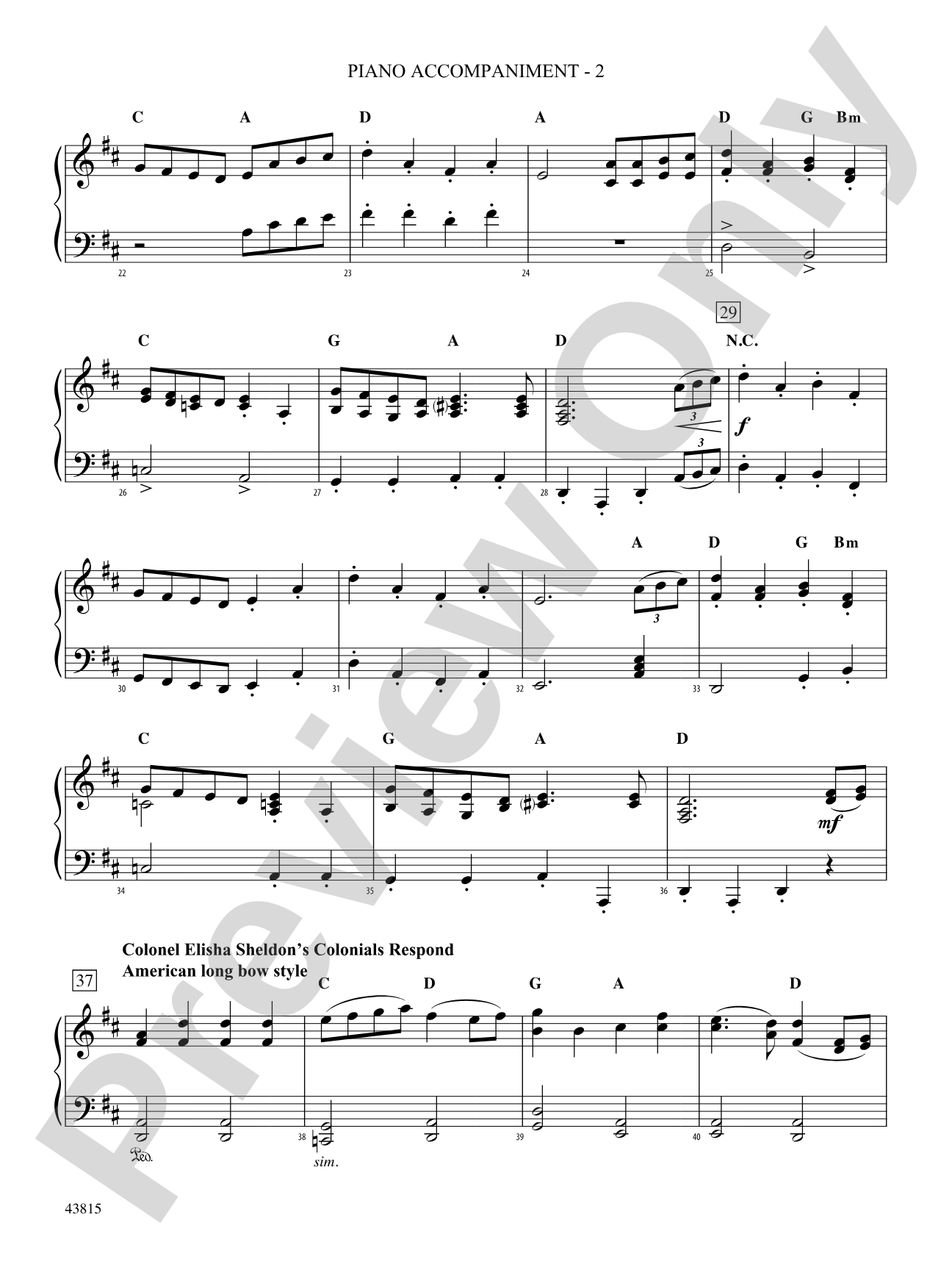

A Revolutionary War Tale: Piano Accompaniment
The Burning of Bedford Village, New York, 1779
By Bob Phillips
Grade: 2.5
Item: 00-PC-0016911_K
$5.99
Pickup currently not available
Description
A programmatic tale of a key battle, this piece tells the story of the burning of Bedford, New York in 1779, utilizing a wide variety of technical skills. A great opportunity for cross-curricular lessons or writing, the historical facts are included. (3:50)


Don't just read it, hear it, play along with it, and watch your students grow with it. In MakeMusic Cloud, A Revolutionary War Tale: Piano Accompaniment comes alive with professional accompaniment, adjustable tempo, and built-in practice tools that turn solo practice into real progress.
Open in the Player
Jump straight in and assign it today.
Start Your Free Trial
Open this title and explore the full library in minutes.
Sample Audio
1
Audio File
--:--
0:00
0:00
Sample Video
Additional Details
Series:
Sound Innovations for String Orchestra
Publisher:
Alfred Music
Page Count:
152
SKU:
00-PC-0016911_K
More about this title
About the Arranger: Bob Phillips

Bob Phillips has spent decades shaping how string students engage with music across genres and styles. Beginning with his 27-year tenure building the Saline, Michigan string program to over 700 students, he established himself as a master of large-group pedagogy and a champion of eclectic repertoire. His six-level Sound Innovations series and publications like Fiddlers Philharmonic, Jazz Philharmonic, and Rock Philharmonic have become staples in string classrooms nationwide, performed by thousands of students annually.
Beyond the classroom, Phillips has conducted extensively at state and national honor orchestras, served as resident conductor for Seattle's Wintergrass Festival for 12 years, and been recognized as an ASCAP award-winning composer with over 200 published works. His approach combines rigorous musicianship with accessibility, making challenging repertoire and diverse musical styles available to young players at every level.
Why we love this
A Revolutionary War Tale pairs musical storytelling with genuine curriculum integration. Rather than treating history as window dressing, Phillips grounds the piece in a specific documented event and invites students to engage with both the musical narrative and the historical context, creating a rich opportunity for interdisciplinary learning that deepens engagement with the music itself.
What to expect
A Revolutionary War Tale unfolds like a dramatic documentary, moving between moments of tension, action, and reflection. The orchestral colors shift to evoke the historical moment, creating a vivid musical picture that holds listeners' attention while remaining accessible to intermediate players.
Who it's for
String orchestras at the solid intermediate level (grade 2.5) who are ready to combine technical growth with meaningful musical interpretation. Teachers seeking repertoire that naturally bridges music study and history curriculum will find this piece particularly valuable for ensemble concerts and festival performances.
How to get the most out of it
- Prepare students for the programmatic arc by sharing the historical background before rehearsal begins; knowing the narrative of the 1779 burning of Bedford helps performers shape phrases with intentionality rather than simply reading notes.
- Identify the technical demands early and drill them in isolation. At grade 2.5, students are capable of handling sophisticated rhythms and articulations, but these passages benefit from targeted sectional work before full orchestra rehearsals.
- Use the three-minute fifty-second duration to your advantage in concert planning; this piece fits naturally into thematic programs without requiring padding or awkward segues.
- Balance the ensemble carefully around the programmatic moments. The descriptive passages depend on clear dynamic shaping and collective listening to project the story to your audience.
How to use it
Program this alongside other American-themed repertoire to create a concert centered on music and national history. It also serves beautifully as a bridge between a standard classical set and more contemporary or eclectic works, offering both substance and audience appeal without stretching rehearsal time.
Skills your students will build
- Reading and executing varied articulations in a programmatic context
- Shaping phrases to support musical narrative and historical storytelling
- Sustaining ensemble focus through longer form structures
- Balancing technical demands (varied rhythmic patterns, dynamic contrasts) with musical expression
- Integrating factual historical knowledge into interpretive performance choices