
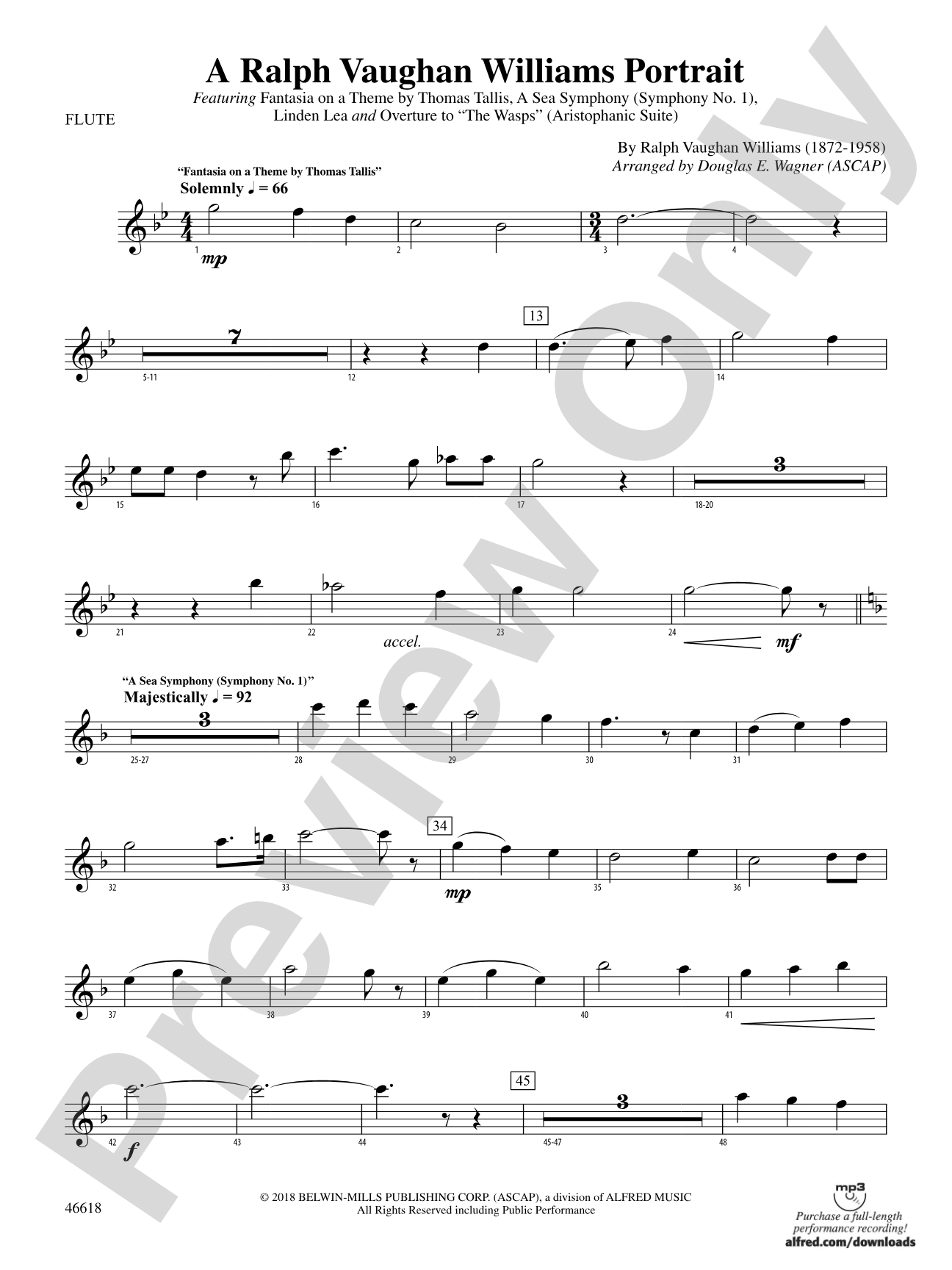

A Ralph Vaughan Williams Portrait: Flute
Featuring: Fantasia on a Theme by Thomas Tallis / A Sea Symphony (Symphony No. 1) / Linden Lea / Overture to "The Wasps" (Aristophanic Suite)
By Ralph Vaughan Williams / arr. Douglas E. Wagner
Grade: 2 (Easy)
Item: 00-PC-0018052_F1
$3.00
Pickup currently not available
Description
Vaughan Williams' work represents the height of English Post-Romanticism after the turn of the century, which was characterized by fervent nationalistic spirit and a corresponding surge of interest in discovering, preserving, and performing traditional folk music. This arrangement includes elements of "Fantasia on a Theme by Thomas Tallis," A Sea Symphony, "Linden Lea," and "Overture to The Wasps," all seamlessly intertwined.


Don't just read it, hear it, play along with it, and watch your students grow with it. In MakeMusic Cloud, A Ralph Vaughan Williams Portrait: Flute comes alive with professional accompaniment, adjustable tempo, and built-in practice tools that turn solo practice into real progress.
Open in the Player
Jump straight in and assign it today.
Start Your Free Trial
Open this title and explore the full library in minutes.
Sample Audio
1
Audio File
--:--
0:00
0:00
Sample Video
Additional Details
Series:
Belwin Young Band
Publisher:
Alfred Music
Page Count:
236
SKU:
00-PC-0018052_F1
More about this title
About the Composer: Ralph Vaughan Williams
Ralph Vaughan Williams (1872-1958) shaped the sound of twentieth-century English music by mining his nation's deep folk traditions and medieval heritage. His harmonic language, rooted in Renaissance polyphony and English hymnody, broke free from Germanic Romanticism to establish a distinctly British modernism that remains foundational to concert music curricula worldwide.
Vaughan Williams collected folk songs across rural England, a practice that infused his compositions with modal melodies and open harmonies. His influence extends across every genre he touched: symphonies, choral works, film scores, and band arrangements. For young musicians, his music offers an accessible entry into twentieth-century compositional thinking without sacrificing depth or artistic substance.
Why we love this
Douglas E. Wagner's arrangement distills Vaughan Williams' most beloved gestures into a single portrait that serves Grade 2 bands without sacrificing the composer's architectural vision. A director gains access to multiple masterworks—from the soaring modal melodies of "Fantasia on a Theme by Thomas Tallis" to the seaborne sweep of "A Sea Symphony"—woven into one coherent concert experience that audiences genuinely want to hear.
What to expect
The portrait unfolds with pastoral serenity and emotional depth, moving from the meditative contemplation of Tallis's theme through moments of heroic aspiration and maritime grandeur. English restraint blends with genuine warmth; melodies seem to emerge from the landscape itself, unhurried and inevitable, inviting listeners into a world of modal harmony and unhurried beauty.
Who it's for
Concert bands at Grade 2 level seeking a substantial, musically coherent concert work that connects young players to major twentieth-century repertoire. Directors who want students to experience Vaughan Williams' harmonic language and melodic mastery without the technical demands of his symphonic originals will find this arrangement ideal for spring concerts, festival programming, or music appreciation units.
How to get the most out of it
- Emphasize the modal character of the thematic material by allowing sustained notes to ring without pressing for vibrato; this restraint honors Vaughan Williams' English aesthetic.
- Balance the arrangement's layered textures by keeping inner voices warm but subordinate; the outer parts carry the narrative weight across movements.
- Shape phrase contours with gentle rubato rather than strict metronomic precision; Vaughan Williams' writing invites subtle breathing and natural pacing.
- Let the folk-derived melodies breathe at their natural harmonic arrival points; resist rushing toward cadences.
How to use it
Program this as a concert centerpiece alongside lighter fare, allowing its thirty-six pages to anchor a well-balanced program without monopolizing rehearsal time. The work functions equally well as a festival submission or as the capstone of a unit on twentieth-century nationalism, giving students meaningful context for understanding how traditional music shaped modernist composition.
Skills your students will build
- Sustaining phrase lines across modal harmonic progressions
- Balancing inner and outer voices in thick choral textures
- Executing smooth doublings and voice leading without doubling roots unnecessarily
- Reading concert band transpositions and maintaining ensemble blend in layered accompaniment figures
- Responding to subtle dynamic and tempo nuance within a structured form