A Quiet Music: Bassoon Sheet Music Preview

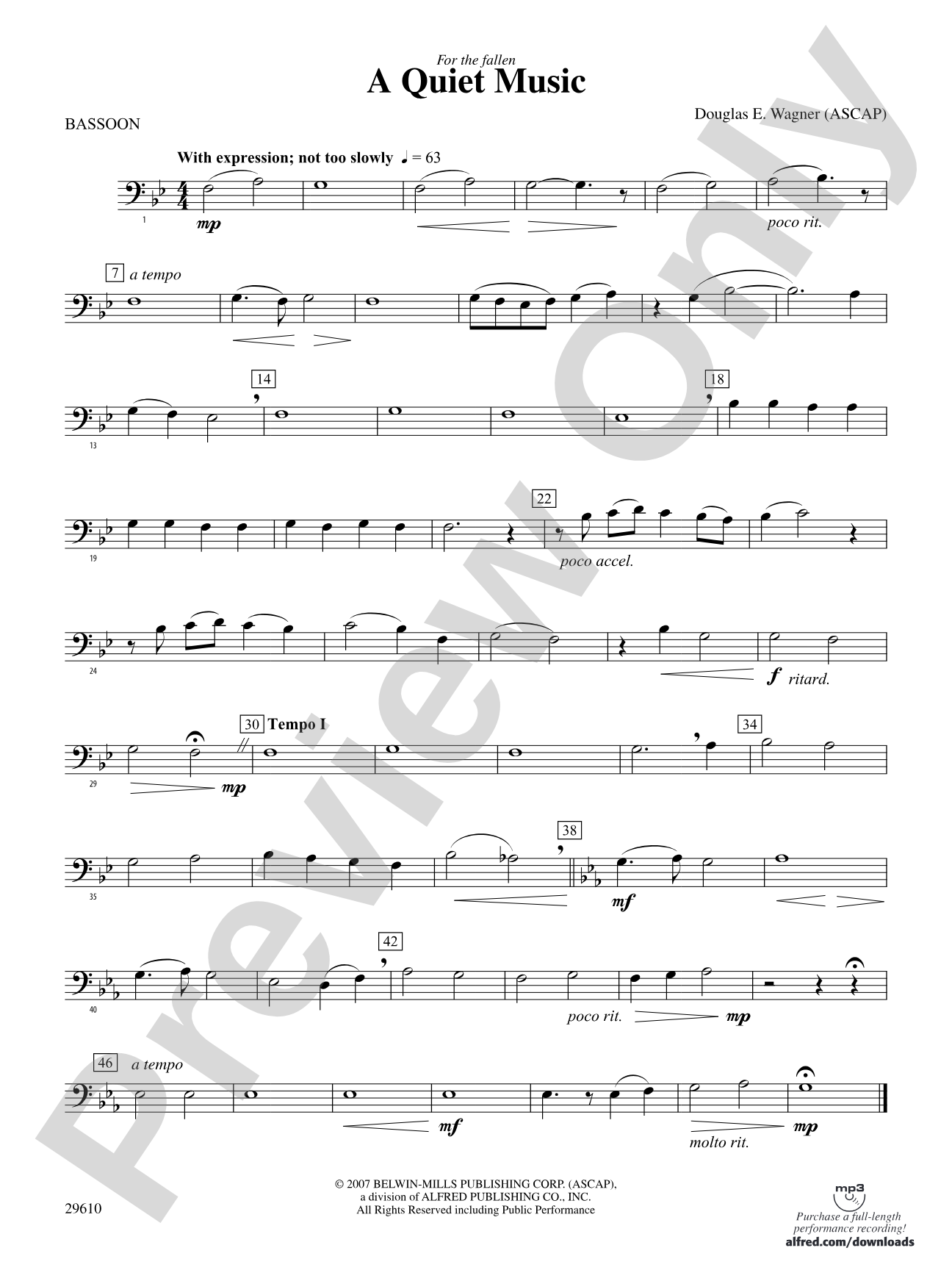
A Quiet Music: Bassoon

By Douglas E. Wagner

Grade: 3 (Medium Easy)

Item: 00-PC-0001500_B1

Digital Download
$3.00
Description
This flowing work commences with dignity and charm. The teaching possibilities, such as legato, control, and dynamic shadings, are limitless. As rewarding to play as it is to hear, "A Quiet Music" will present programming opportunities year after year. Enjoy the seamless flow of the pensive melody and harmony in the fabric of this cherished work! (4:11) This title is available in MakeMusic Cloud.

Don't just read it, hear it, play along with it, and watch your students grow with it. In MakeMusic Cloud, A Quiet Music: Bassoon comes alive with professional accompaniment, adjustable tempo, and built-in practice tools that turn solo practice into real progress.

Sample Audio
0:00
0:00
Sample Video
Additional Details
Series: Belwin Concert Band
Publisher: Alfred Music
Page Count: 120
SKU: 00-PC-0001500_B1

More about this title

About the Composer: Douglas E. Wagner

Douglas E. Wagner

Douglas E. Wagner grew up in Chicago and earned degrees in music from Butler University before launching a thirty-year career as a high school music educator and administrator. Since 1973, he has composed and arranged over 3,500 works across nearly every musical medium: concert band, orchestra, choir, handbell ensemble, organ, piano, and vocal music. His output has reached millions of performers worldwide, with his scores performed regularly in concert halls, on broadcast radio and television, and at festivals across the United States and internationally.

Wagner's three decades in the classroom shaped his compositional voice. He understands what works in rehearsals, what engages students, and what produces satisfying musical results at multiple ability levels. He now lives in Indianapolis with his wife, Sandy, and focuses entirely on composition and music publishing.

Why we love this

Wagner's gift for melody and harmonic movement makes this piece rewarding at the Grade 3 level without requiring advanced technical facility. The score opens doors for teaching legato phrasing, dynamic subtlety, and ensemble balance, yet the music never feels pedagogical or thin. Directors return to this work year after year because students genuinely want to play it and audiences respond to its expressive sincerity.

What to expect

Introspective and flowing, the piece establishes a contemplative mood from the opening. Warm harmonies and lyrical melody create an atmosphere of quiet reflection, inviting the listener into moments of genuine musical conversation rather than spectacle. The pensive character rewards attentive listening and patient ensemble work.

Who it's for

Grade 3 concert bands seeking repertoire that builds musicianship without demanding virtuosity. This work suits developing ensembles that are ready to explore expressive playing and bands preparing for festival or contest programming where musical maturity matters as much as technical display.

How to get the most out of it

  • Shape the initial melody through careful dynamic control rather than relying on tempo fluctuation; let the harmonic progression provide forward motion.
  • Balance the inner voices that support the main melodic line so the harmony registers without overpowering the shape of the tune.
  • Attend to the transitions between sections to maintain the seamless flow Wagner describes; mark breath points in parts but avoid sudden tempo shifts.
  • Work legato technique across the ensemble before drilling sections; even Grade 3 bands benefit from focused attention to sustained tone and phrase connection.

How to use it

Program this in a concert context where it can anchor a set of contrasting works, offering audiences a moment of genuine repose. It also pairs effectively with more energetic pieces on festival or contest programs, demonstrating your band's range and maturity. Consider reserving it for concerts where musical substance takes precedence over crowd appeal.

Skills your students will build

  • Legato phrasing and sustained tone production
  • Dynamic shading and control within a phrase
  • Harmonic balance between melody and accompaniment
  • Listening to ensemble sound rather than individual parts
  • Connecting sustained passages without breaking line

You May Also Like