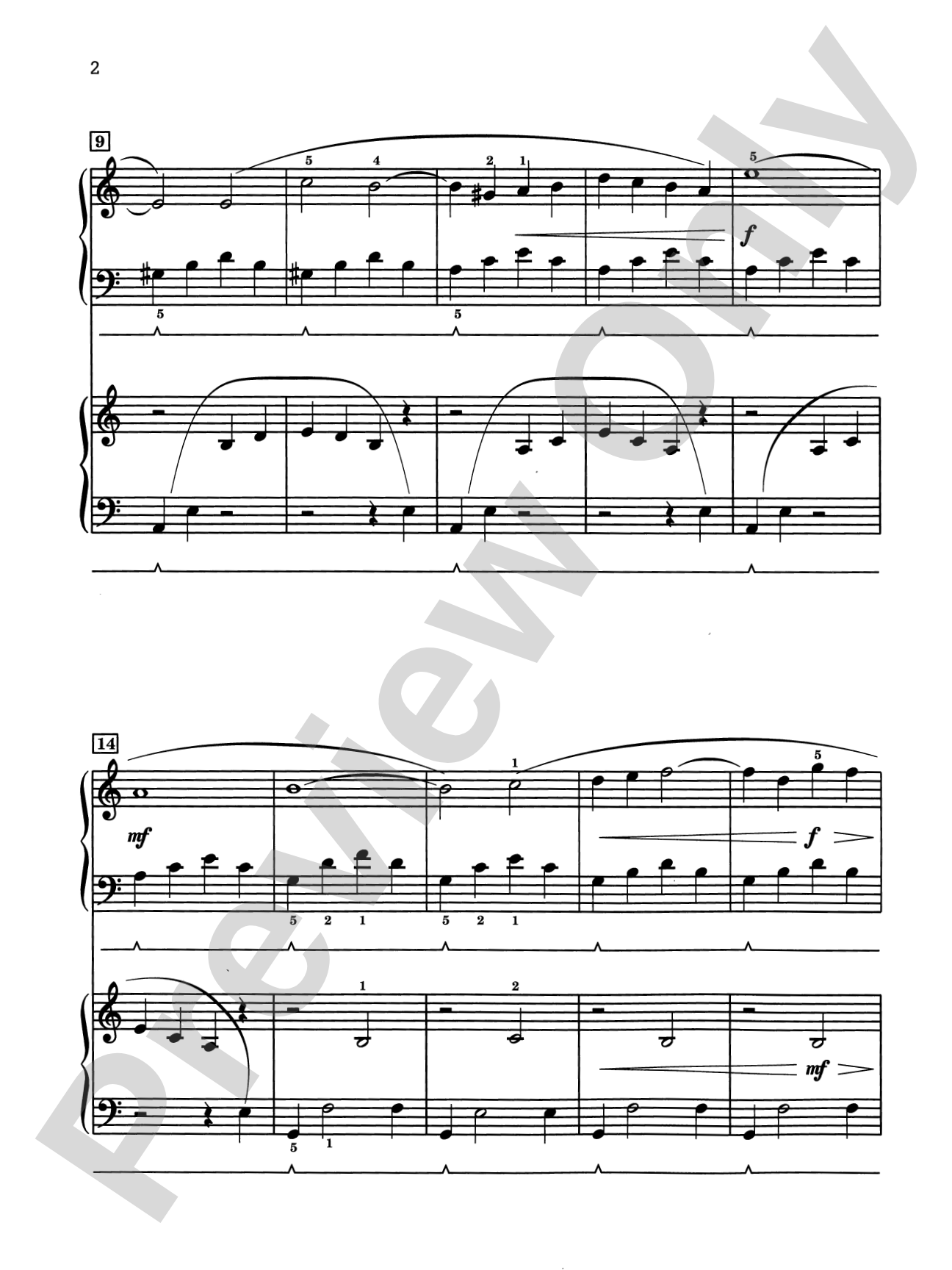
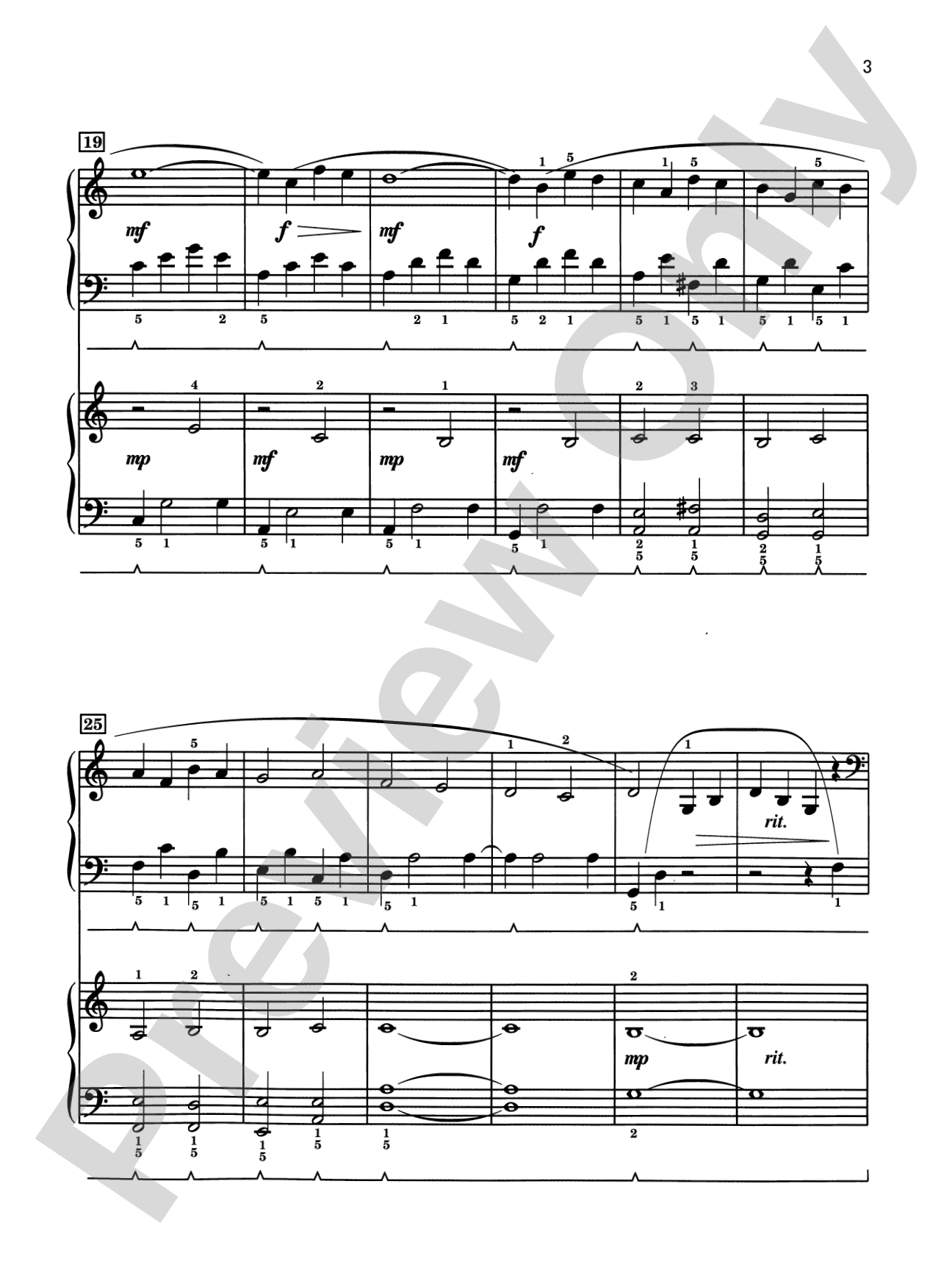
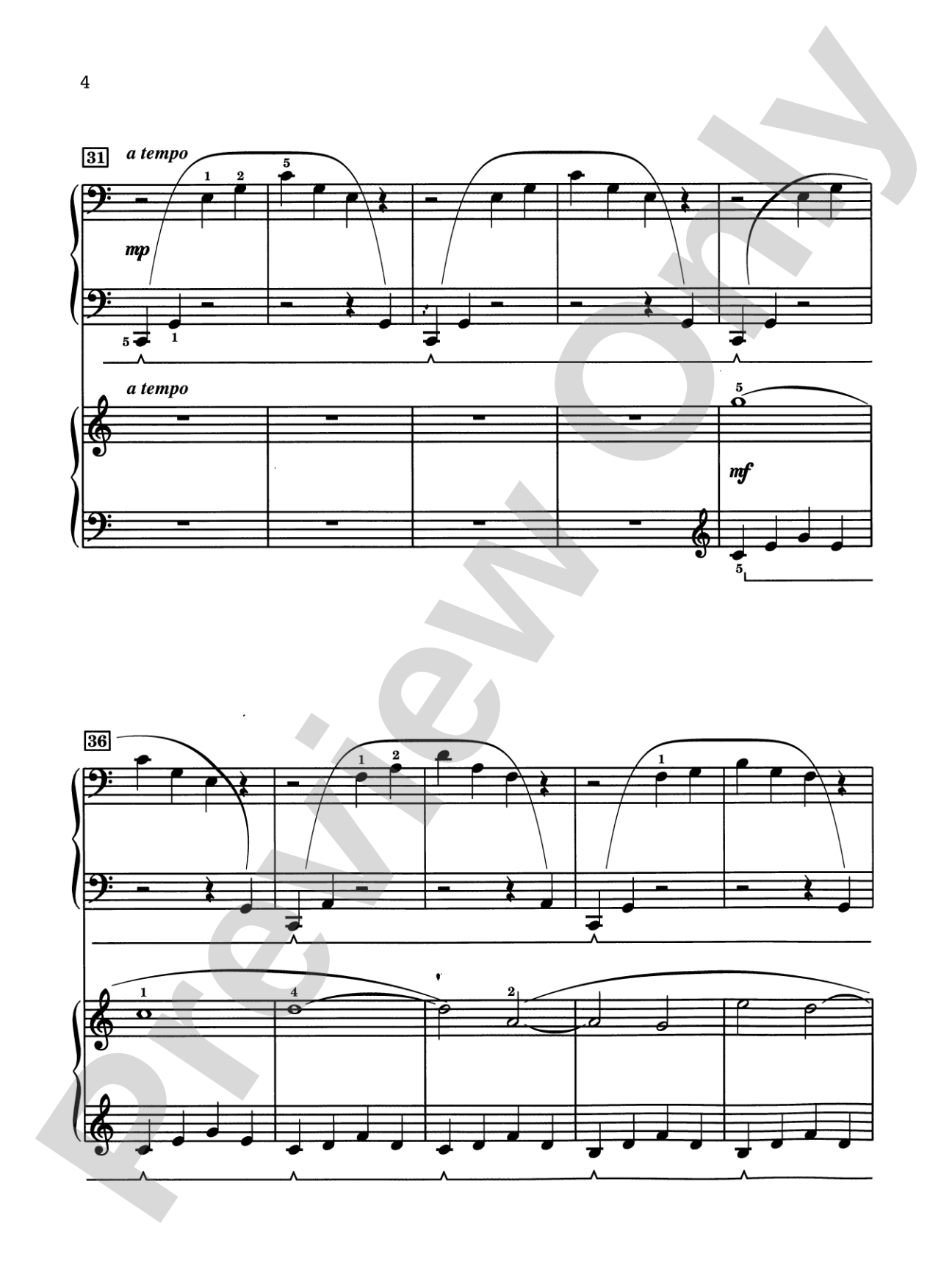
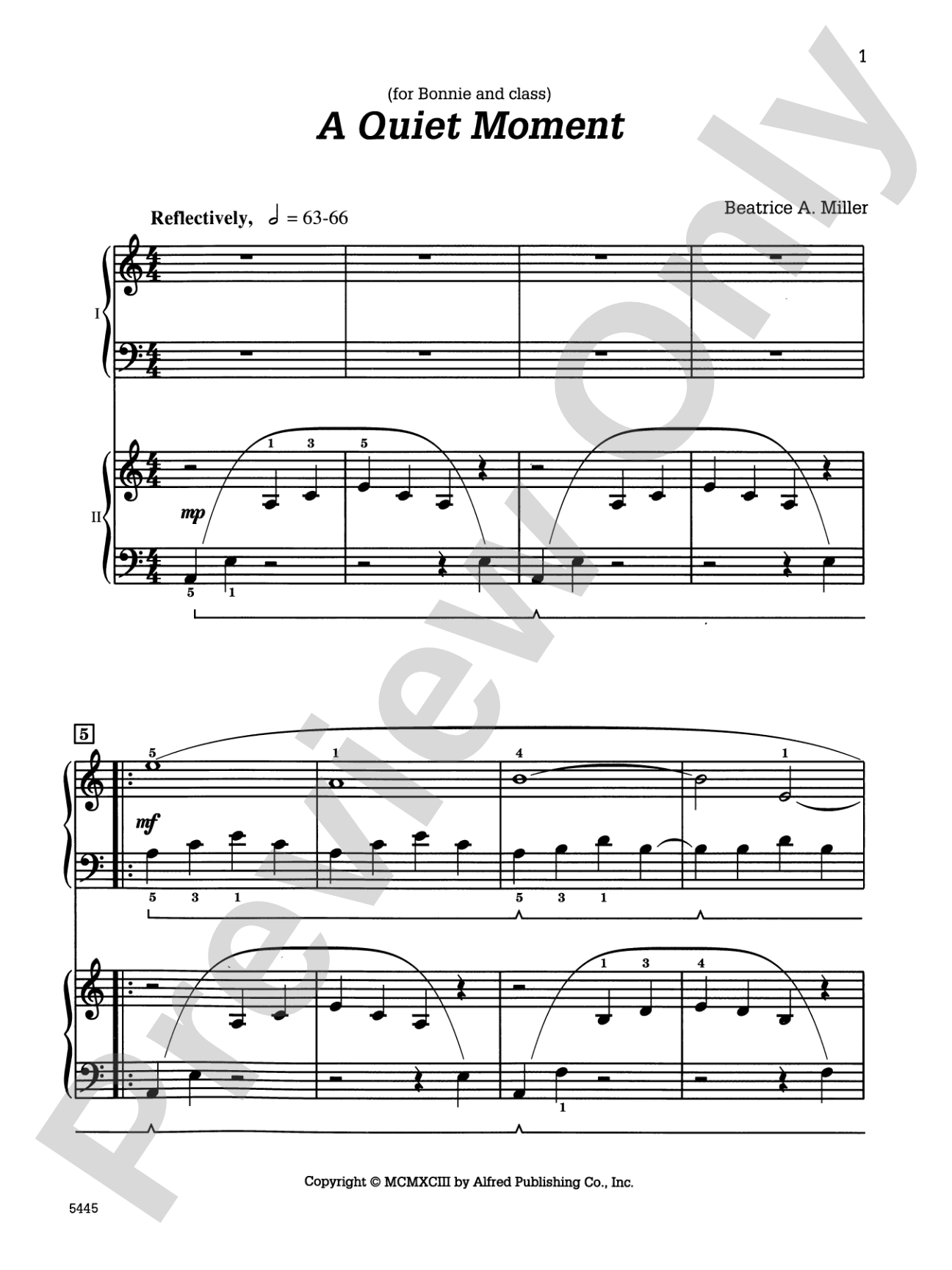
A Quiet Moment - Piano Duo (2 Pianos, 4 Hands) Sheet Music Preview

A Quiet Moment - Piano Duo (2 Pianos, 4 Hands): Piano Duo (2 Pianos, 4 Hands)

By Beatrice A. Miller

Level: Early Intermediate

Item: 00-PS-0017575

Digital Download
$4.99
Description
The reflective mood of this piece for early intermediate piano ensemble---two pianos, four hands---is established in the introduction, with a flowing A minor quarter-note arpeggio in Part II. Part I enters with a lyrical melody and the pattern continues throughout the piece, with a modulation to C major. Two copies are included. A Federation Festivals 2024-2028 selection.

A Quiet Moment - Piano Duo (2 Pianos, 4 Hands): Piano Duo (2 Pianos, 4 Hands) isn't in MakeMusic Cloud just yet...but it could be. Let us know you'd like to see it, and you'll help shape what comes next. In the meantime, start a free trial and dive into thousands of interactive titles your students can play along with today.

Sample Audio
No sample audio found.
Sample Video
Additional Details
Series: The Alfred Ensemble Series
Publisher: Alfred Music
Page Count: 8
SKU: 00-PS-0017575

More about this title

About the Composer: Beatrice A. Miller

Beatrice A. Miller

Beatrice A. Miller grew up in Detroit in a musical household shaped by her father's work as a Lutheran pastor and choir director. Her family's tradition of singing hymns after evening prayer became the foundation of her deep connection to sacred music, a passion that has defined her compositional voice throughout her career.

Miller earned her Master's degree in music composition from Northwestern University and spent decades as a piano teacher, organist, and choir director in Corvallis, Oregon before fully dedicating herself to composition in 1979. The Oregon Music Teachers Association named her Composer of the Year in 1997, recognizing her significant contributions to music education and the repertoire.

Why we love this

Miller crafts a piece that sounds more sophisticated than its early intermediate level suggests. The interplay between the flowing arpeggios in Part II and the lyrical melody in Part I creates an engaging musical dialogue that holds students' attention while remaining technically accessible, and the shift from A minor to C major provides a natural dramatic arc without requiring complex harmonic language.

What to expect

The piece unfolds with contemplative elegance, beginning in introspective A minor before gradually warming toward the brightness of C major. There's a stillness to it, a sense of quiet reflection that invites both performers to listen deeply to each other and shape the music with sensitivity.

Who it's for

Early intermediate duet pianists preparing for festival performance or recital, particularly students who have developed basic ensemble skills and are ready for pieces that demand musical maturity alongside technical control. This work suits pairs of pianists at similar levels and appeals to teachers seeking accessible yet artistically rewarding repertoire.

How to get the most out of it

  • Balance the arpeggiated accompaniment in Part II so it supports rather than overwhelms the melody; the rippling pattern should feel like water moving beneath the surface, not dominating the texture.
  • Shape the entrance of Part I's melody with a gentle dynamic lift, allowing it to bloom over the established accompaniment pattern.
  • Find the natural breathing points within the lyrical line and use them to guide phrasing; let the melody breathe as singers would.
  • Approach the modulation to C major as a gradual brightening rather than an abrupt shift, allowing listeners to settle into the new tonal center before the resolution.

How to use it

Pair this with other reflective works on a recital to create a cohesive mood, or use it as an opening piece to set an intimate tone for your program. Its accessible difficulty and emotional resonance make it well-suited for spring festival competitions or student showcase concerts where you want to feature chamber music without requiring advanced technical demands.

Skills your students will build

  • Ensemble balance and blend across two pianos
  • Sustaining lyrical phrasing over arpeggiated accompaniment patterns
  • Managing modulation between tonal centers (A minor to C major)
  • Coordinating rhythmic independence while maintaining musical cohesion
  • Expressive use of dynamics to shape narrative arc in a two-part texture

You May Also Like