
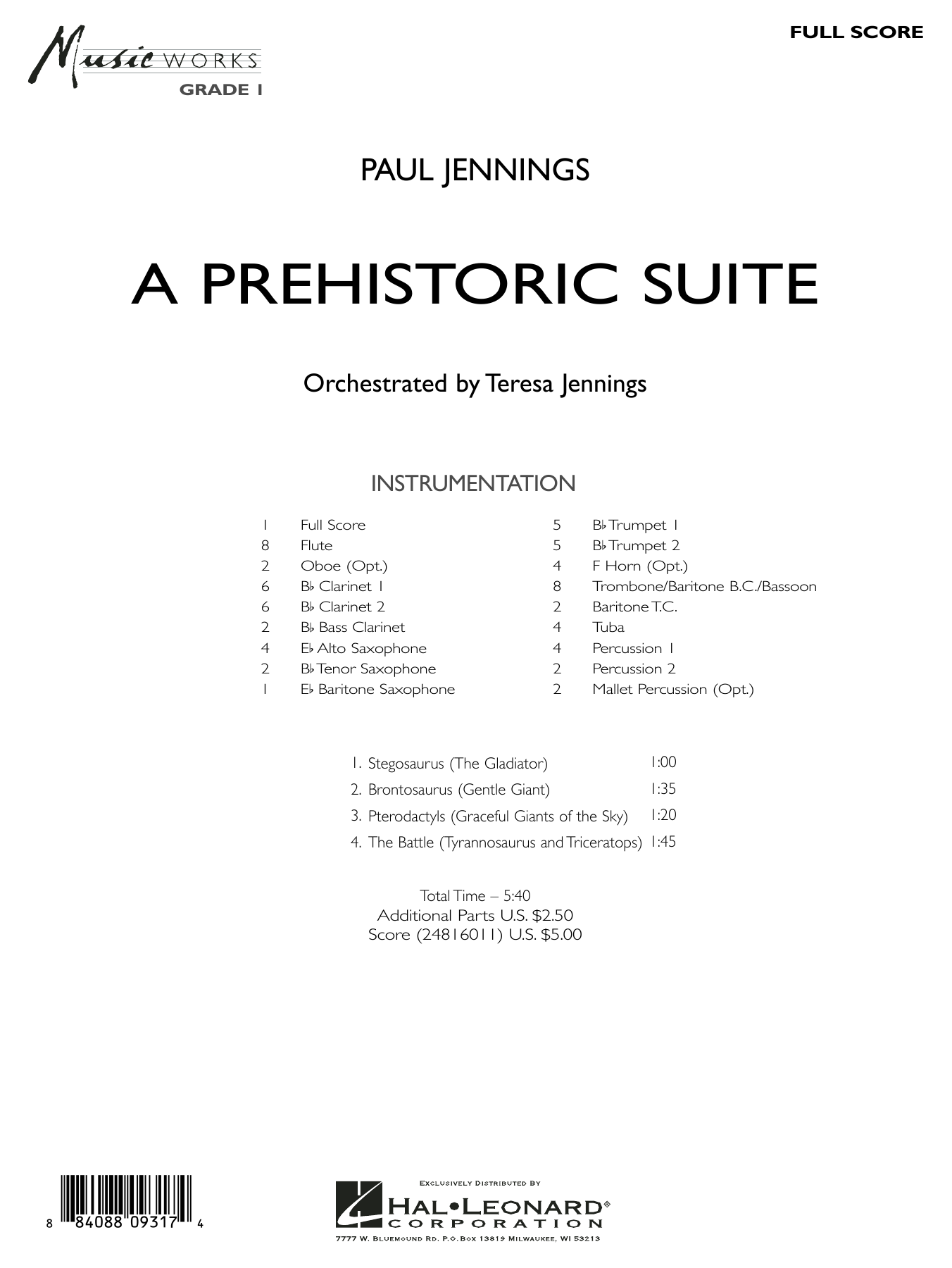

A Prehistoric Suite: Concert Band Conductor Score & Parts
By Paul Jennings / Arranged by Teresa Jennings
Grade: 1.5
Item: 35-PK01091621
$55.00
Pickup currently not available
Buy Extra Parts (Digital PDF Download)
| Product | Price | Quantity |
|---|---|---|
| A Prehistoric Suite - Full Score | $7.50 | |
| A Prehistoric Suite - Flute | $6.00 | |
| A Prehistoric Suite - Oboe | $6.00 | |
| A Prehistoric Suite - Bb Clarinet 1 | $6.00 | |
| A Prehistoric Suite - Bb Clarinet 2 | $6.00 | |
| A Prehistoric Suite - Bb Bass Clarinet | $6.00 | |
| A Prehistoric Suite - Eb Alto Sax | $6.00 | |
| A Prehistoric Suite - Bb Tenor Sax | $6.00 | |
| A Prehistoric Suite - Eb Baritone Sax | $6.00 | |
| A Prehistoric Suite - Bb Trumpet 1 | $6.00 | |
| A Prehistoric Suite - Bb Trumpet 2 | $6.00 | |
| A Prehistoric Suite - F Horn | $6.00 | |
| A Prehistoric Suite - Trombone | $6.00 | |
| A Prehistoric Suite - Baritone T.C. | $6.00 | |
| A Prehistoric Suite - Tuba | $6.00 | |
| A Prehistoric Suite - Percussion 1 | $6.00 | |
| A Prehistoric Suite - Percussion 2 | $6.00 | |
| A Prehistoric Suite - Mallet Percussion | $6.00 |
Parts Added to Cart!
Description
Beginning groups will love this unique programmatic suite of four short movements, each of which portrays a well known prehistoric creature (or two!). Clever and very easy, it includes: "Stegosaurus, Brontosaurus, Pteradactyls" and "The Battle (Tyrannosaurus and Triceratops)". A really different work at this level! Originally published in 1987. (5:40)


A Prehistoric Suite: Concert Band Conductor Score & Parts isn't in MakeMusic Cloud just yet...but it could be. Let us know you'd like to see it, and you'll help shape what comes next. In the meantime, start a free trial and dive into thousands of interactive titles your students can play along with today.
Request This Title
Tell us you want it.
Start Your Free Trial
Explore everything that's ready to play right now.
Sample Audio
No sample audio found.
Sample Video
No sample videos found.
Additional Details
Publisher:
Hal Leonard
SKU:
35-PK01091621
More about this title
About the Composer: Paul Jennings
Paul Jennings is a composer who carved out a distinctive niche writing accessible, imaginative works for developing ensembles. His ability to craft memorable melodies paired with straightforward orchestration made him a trusted voice for directors seeking repertoire that engages young musicians without sacrificing musical substance.
Jennings understood that novelty pieces don't have to be throwaway material. His programmatic works use vivid imagery to draw students into the score, making rehearsals feel purposeful rather than perfunctory. This approach has kept his music in circulation among school bands for decades.
Why we love this
A Prehistoric Suite succeeds because it grabs student attention immediately without resorting to cheap gimmicks. Four distinct movements give your band repeated chances to nail focused musical goals, while the dinosaur narrative keeps everyone invested across the entire 5:40 runtime. Most importantly, the writing respects your ensemble's musicianship; the simplicity comes from confident compositional choices, not condescension.
What to expect
Playful and slightly mischievous, with just enough musical substance to feel legitimate. The suite bounces along with genuine melodic hooks, never winking at the audience but never taking itself too seriously either. Prehistoric creatures stride across the stage in broad strokes of sound and color.
Who it's for
Beginning concert bands and developing Grade 1 to 1.5 ensembles will find immediate appeal here. Teachers looking for novelty repertoire that actually teaches something musical, not just entertains, will appreciate the craftsmanship underneath the fun concept.
How to get the most out of it
- Characterize each dinosaur through tone. The Stegosaurus benefits from a heavier, grounded sound, while the Pterodactyls should feel lighter and more agitated.
- Balance the melodic lines across sections rather than letting one instrument dominate. Jennings distributes themes generously, and your ensemble shines when everyone hears their own contribution.
- Keep "The Battle" movement crisp and articulate. Clear rhythmic attacks separate the two combatants and prevent the final movement from becoming rhythmically muddy.
- Establish a consistent tempo for each movement before rehearsal and stick to it. Younger players gain security from predictable pacing, which frees them to focus on articulation and intonation.
How to use it
Schedule this as a standalone concert opener to establish a lighter tone for an evening program, or pair it with one more substantial work and a classical standard for a balanced opening concert of the year. It also works beautifully as a community engagement piece, especially if you can tie it to a school assembly or educational event about natural history.
Skills your students will build
- Sustaining consistent tone through four connected movements
- Responding to programmatic imagery to shape phrasing and dynamics
- Articulation clarity in a primarily rhythmic context
- Balancing independent melodic lines within a textured ensemble
- Maintaining ensemble cohesion during tempo changes between movements