
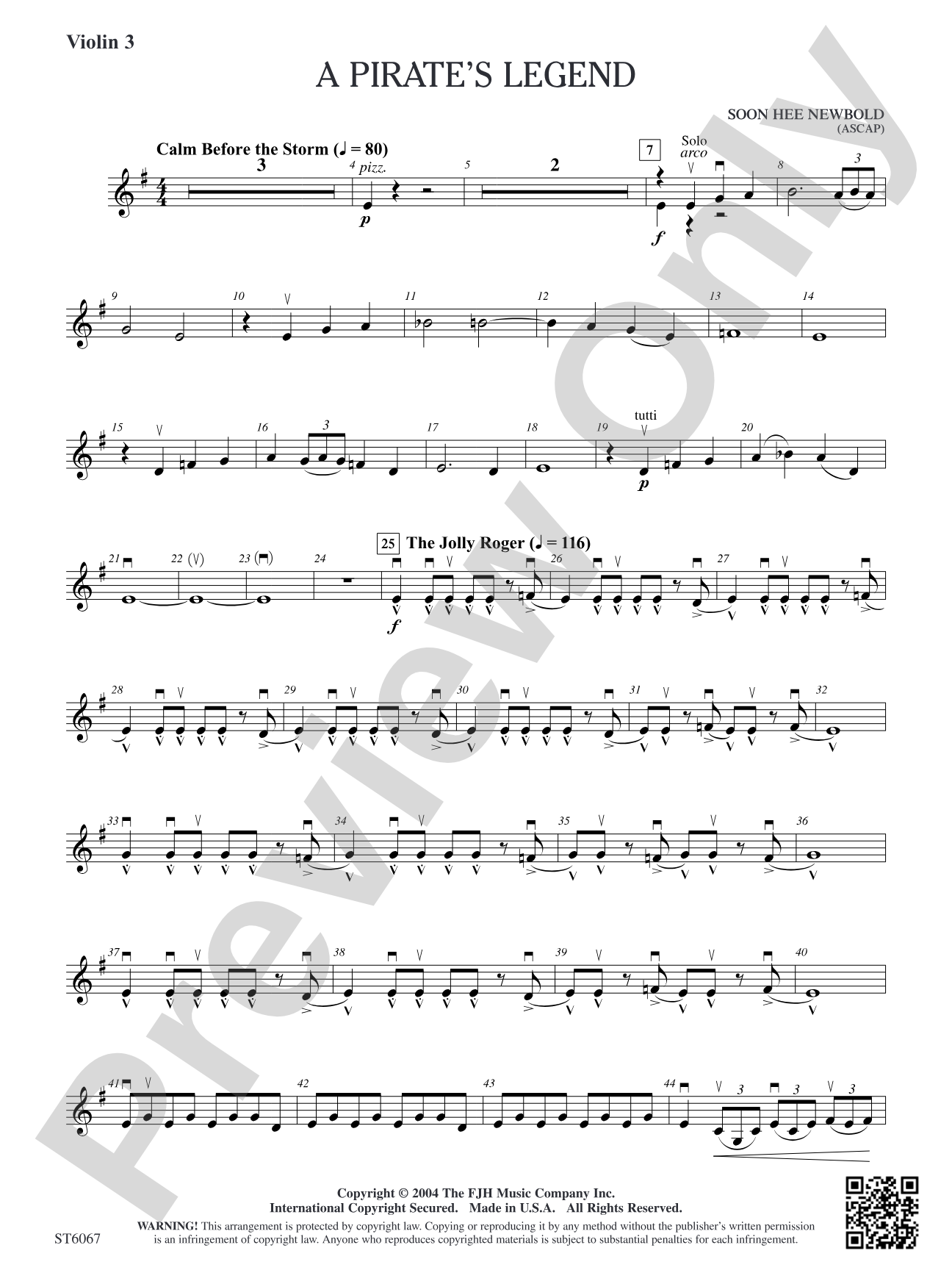

A Pirate's Legend: Optional Violin 3 (Viola)
By Soon Hee Newbold
Grade: 3
Item: 98-PC-DST6067_VN3
$7.00
Pickup currently not available
Description
Fabulous! Soon Hee Newbold incorporates a wide variety of effects in this thrilling, programmatic work including harmonics, col legno, and mutes. Celli even use artificial harmonics (clearly explained in the notes) to create the sound of seagulls flying over a deserted island. The opening viola solo is cued in all instruments so you can easily feature any soloist, section, or mixed group. Come experience a pirate story complete with the dreaded flag, the Jolly Roger, buried treasure, and adventure on the high seas!


Don't just read it, hear it, play along with it, and watch your students grow with it. In MakeMusic Cloud, A Pirate's Legend: Optional Violin 3 (Viola) comes alive with professional accompaniment, adjustable tempo, and built-in practice tools that turn solo practice into real progress.
Open in the Player
Jump straight in and assign it today.
Start Your Free Trial
Open this title and explore the full library in minutes.
Sample Audio
1
Audio File
--:--
0:00
0:00
Sample Video
No sample videos found.
Additional Details
Series:
FJH String Orchestra
Publisher:
The FJH Music Company, Inc.
SKU:
98-PC-DST6067_VN3
More about this title
About the Composer: Soon Hee Newbold

Soon Hee Newbold brings a globally influenced compositional voice to her work, shaped by travels across continents and deep musical training beginning in childhood. Her pieces span from elementary ensembles to professional orchestras, performed at prestigious venues including Carnegie Hall, the Kennedy Center, and Lincoln Center. Beyond the concert stage, she has worked as a conductor and clinician internationally, collaborating with orchestras and bands throughout the United States, Europe, Asia, and Australia.
Newbold's career extends into film and media composition, where her music enriches visual storytelling in Hollywood projects. Her reputation as a keynote speaker and guest clinician reflects her commitment to music education and ensemble development at all levels.
Why we love this
Newbold writes programmatic storytelling that Grade 3 orchestras can actually execute. The cued viola solo design means any conductor can reshape the texture around their strongest players, whether that's a single soloist or a section feature, without forcing awkward rewrites. Extended techniques (harmonics, col legno, artificial harmonics for cello seagulls) feel freshly motivated by the narrative rather than tacked on for show, which keeps students engaged with the 'why' behind the musical choices.
What to expect
You're witnessing a swashbuckling adventure unfold through string color and texture. The opening draws you into a deserted island soundscape with its viola solo voice; artificial harmonics shimmer like seagulls overhead; percussive col legno strikes suggest the clang of pirate encounters and treasure-hunting tension. The work captures the theatrical energy of a story unfolding rather than the stiffness of a technical study.
Who it's for
String orchestras at Grade 3 level seeking a narrative-driven work that teaches extended techniques in a musical context rather than isolation. This score engages students who respond to storytelling and visual imagery, making it ideal for ensembles preparing for festival performances or concerts themed around adventure and world music.
How to get the most out of it
- Mark the artificial harmonics passage in your cello section during the first rehearsal. Newbold includes explanatory notes, but a quick demonstration of the finger placement and how it produces the seagull effect transforms the sound from technical exercise into dramatic storytelling.
- Balance the opening viola solo carefully in relation to the sustained textures around it. Since the cue is written into all parts, your accompaniment voices should sit underneath the soloist's narrative line without drowning the melodic thread.
- Prepare your muted passages with precision: mark exactly where mutes go on and off, and conduct a separate run-through of the mute transitions before the full sectional rehearsal to prevent chaos in the strings.
- Use the col legno and harmonics sections as opportunities for expressive control rather than technical displays. The pirate story asks for atmosphere and color, not virtuosity.
How to use it
Program this as a festival submission or as part of a spring concert celebrating world music and storytelling. Its Grade 3 accessibility pairs well with contrasting repertoire (a lyrical Baroque arrangement or contemporary short work) to showcase your orchestra's range. The extended techniques and programmatic angle make it equally strong as a concert closer that leaves audiences entertained rather than drained.
Skills your students will build
- Playing natural and artificial harmonics on cello and violin
- Executing col legno technique with clear articulation and control
- Using mutes expressively to shape tone color and dynamics
- Following cued lines to understand flexible textural arrangement
- Interpreting programmatic cues to inform phrasing and character choices