
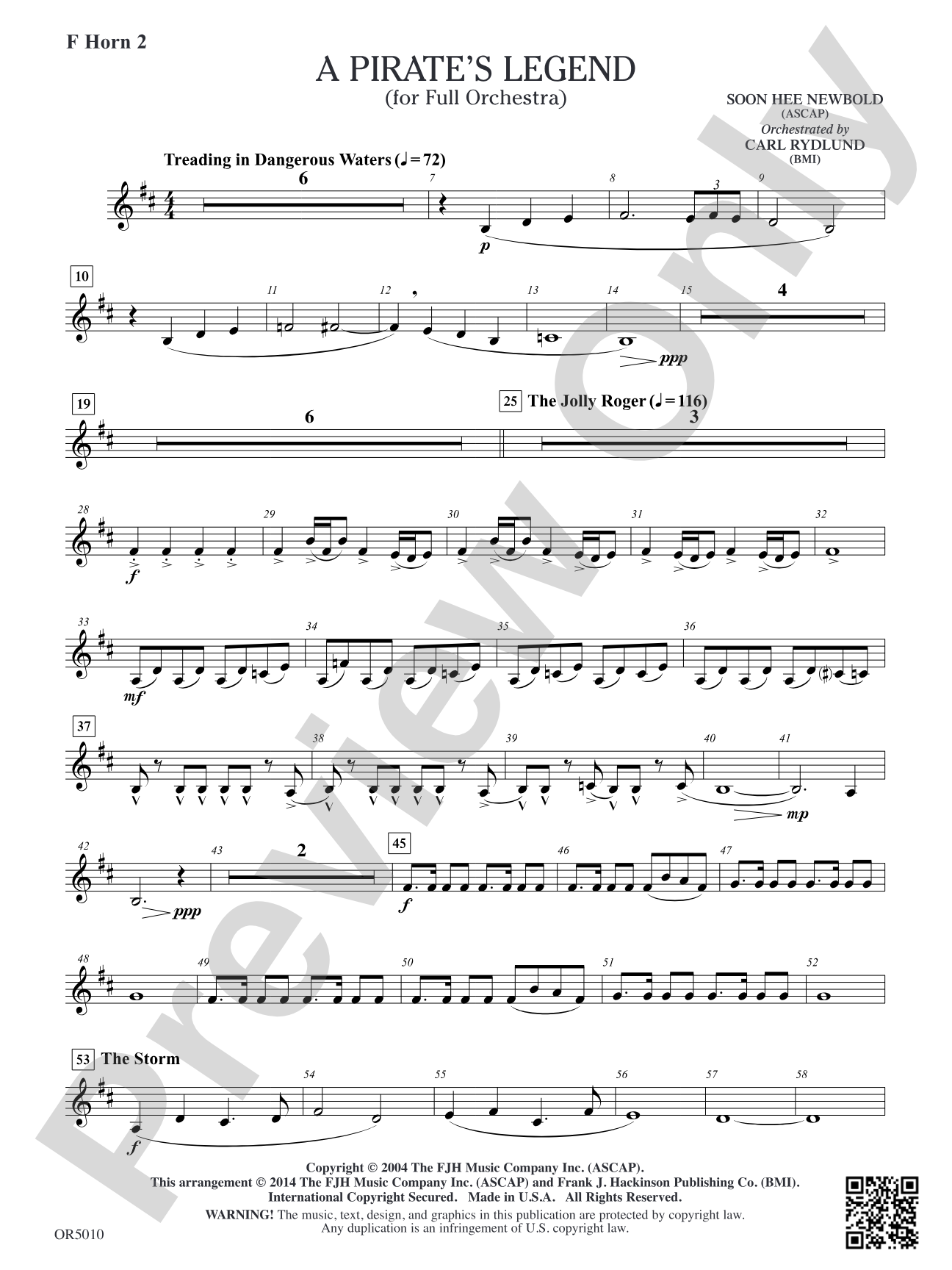

A Pirate's Legend: F Horn 2
By Soon Hee Newbold
Grade: 3
Item: 98-PC-DOR5010_H2
$7.00
Pickup currently not available
Description
Experience the high seas with this programmatic work for full orchestra complete with mystery, adventure, sword battles and buried treasure. A multitude of effects add to the drama and intensity, including the unique sound of glissando cello harmonics simulating the sound of seagulls on a desert island. This arrangement includes optional parts for your concert band members as well (not playable by concert band alone) to give you added performance flexibility and possibly combine your two groups. (5:15)


Don't just read it, hear it, play along with it, and watch your students grow with it. In MakeMusic Cloud, A Pirate's Legend: F Horn 2 comes alive with professional accompaniment, adjustable tempo, and built-in practice tools that turn solo practice into real progress.
Open in the Player
Jump straight in and assign it today.
Start Your Free Trial
Open this title and explore the full library in minutes.
Sample Audio
1
Audio File
--:--
0:00
0:00
Sample Video
No sample videos found.
Additional Details
Series:
FJH Full Orchestra
Publisher:
The FJH Music Company, Inc.
SKU:
98-PC-DOR5010_H2
More about this title
About the Composer: Soon Hee Newbold

Soon Hee Newbold brings a global perspective to orchestral writing shaped by decades of performance, travel, and cross-cultural collaboration. Beginning her musical training at five on piano and continuing with violin at seven, she developed into a concert artist who performed with professional ensembles internationally before establishing herself as a prolific composer and conductor.
Newbold's works span the full spectrum of ensemble levels, from professional orchestras to elementary groups, and have graced stages including Carnegie Hall, the Kennedy Center, Lincoln Center, and Disney Hall. Her influence extends worldwide through guest conducting, clinician work, and film scoring in Hollywood. Her distinctive compositional voice consistently weaves cultural and ethnic elements throughout her catalog, reflecting her lived experience across North America, Europe, Asia, and beyond.
Why we love this
This score delivers genuine narrative drive without sacrificing musical coherence. Newbold crafts an adventure that Grade 3 orchestras can execute with confidence; the programmatic elements (especially those glissando cello harmonics evoking seagulls) spark student imagination while remaining technically manageable and genuinely exciting to perform.
What to expect
A swashbuckling journey unfolds across five minutes of nautical adventure, complete with moments of shadowy intrigue and bursts of action that feel genuinely heroic. The sound palette shifts from the atmospheric (those haunting seagull cries) to the thrilling (clashing swords and dramatic reveals), creating a musical experience that captivates both players and listeners.
Who it's for
This work suits Grade 3 orchestras ready to tackle programmatic storytelling without excessive technical hurdles. It works equally well for groups seeking festival or contest repertoire with strong audience appeal and for ensembles that want to explore dramatic, character-driven music with imaginative orchestral effects.
How to get the most out of it
- Bring out the layered orchestration in the mystery passages; balance your inner parts so the harmonic color shifts with each new development rather than becoming muddied.
- Reserve your full dynamic range for the sword battle section. A judicious use of the orchestra's complete power makes the quieter moments that follow land with greater impact.
- Rehearse the cello glissando harmonics separately from the full ensemble first. Secure the technique and tone before layering in upper string support so the seagull effect reads clearly.
- If incorporating your concert band members on optional parts, check voicing balance during rehearsal; the added instrumentation can easily overshadow the original orchestration if not monitored.
How to use it
Program this as a centerpiece novelty work on a concert that balances it with lyrical or chamber selections; its dramatic intensity and length make it a natural standalone feature rather than a filler piece. For festival seasons, it offers the kind of character-driven storytelling that judges and audiences remember, while the optional concert band parts let you showcase ensemble flexibility if your program includes combined instrumentation.
Skills your students will build
- Balance and blend in programmatic contexts where different instrumental families carry narrative elements
- Execution of special techniques including cello harmonics and glissandos under ensemble control
- Shaping dramatic arcs and contrasting sections (mystery, battle, resolution) for musical coherence
- Dynamic control and dramatic timing in syncopated rhythmic passages and fast-moving exchanges
- Intonation precision in chromatic writing and harmonic transitions typical of Grade 3 full orchestra repertoire