A One-Horse Open Sleigh (In A Jingly Minor Way) Sheet Music Preview

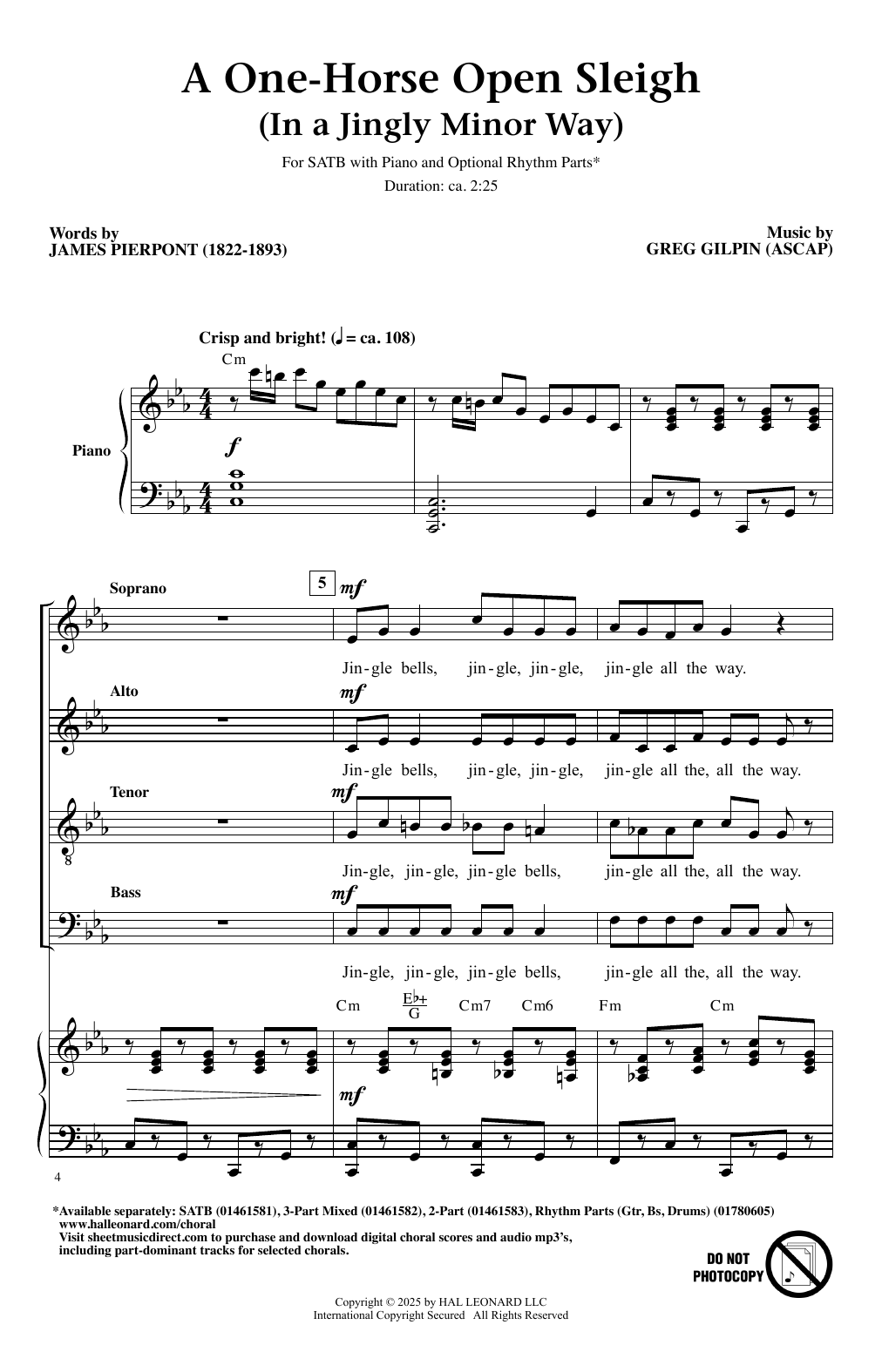
A One-Horse Open Sleigh (In A Jingly Minor Way): SATB Choral Octavo

By Greg Gilpin

Item: 35-DS01562063

Digital Download
$2.75
Description

A One-Horse Open Sleigh (In A Jingly Minor Way): SATB Choral Octavo isn't in MakeMusic Cloud just yet...but it could be. Let us know you'd like to see it, and you'll help shape what comes next. In the meantime, start a free trial and dive into thousands of interactive titles your students can play along with today.

Sample Audio
No sample audio found.
Sample Video
Additional Details
Publisher: Hal Leonard
Page Count: 15
SKU: 35-DS01562063

More about this title

About the Composer: Greg Gilpin

Greg Gilpin

Greg Gilpin stands among today's most prolific and performed choral composers, with his work heard regularly in concert halls across North America and internationally. His credentials span Carnegie Hall and Lincoln Center in New York, Ryman Auditorium in Nashville, the Sydney Opera House, Royal Festival Hall in London, and Harpa in Reykjavik. As Director of Educational Choral Publications for Shawnee Press and an ASCAP award-winning composer, Gilpin has shaped the landscape of accessible yet sophisticated choral music for ensembles at every level.

Beyond the music world, Gilpin has built a parallel career as a certified financial coach and professional organizer, even appearing on network television and the reality series "Hoarders." In 2021, he composed the award-winning score for the short film "Rosie's Rescue" and collaborated with soprano Angela Brown on a world premiere arrangement of "What Child is This?" with the Indianapolis Symphonic Choir. A Life Loyal Member of Phi Mu Alpha Sinfonia and active member of ACDA, NAfME, and SAG-AFTRA, Gilpin continues to teach, compose, conduct, and mentor musicians nationwide.

Why we love this

Gilpin takes one of the most recognizable winter melodies and reframes it entirely through harmonic color and choral texture. The minor setting strips away the straightforward cheeriness of the original and invites singers into a more introspective, sophisticated interpretation of the tune. It's the kind of arrangement that lets a choir surprise their audience and themselves.

What to expect

Imagine the quiet of a winter evening, snow falling under starlight. The melody you know becomes something you discover again, its shape unfolding through minor chords and sophisticated voice leading. There's nostalgia here, but also mystery and depth.

Who it's for

This arrangement suits mature choral ensembles comfortable with harmonic independence and nuance. It works equally well for community choirs seeking something beyond standard holiday fare and for select high school or college choirs looking to program a familiar tune that challenges singers musically.

How to get the most out of it

  • Balance the minor tonality by keeping the overall tone warm rather than dark. The juxtaposition of familiar melody with minor harmony should feel contemplative, not melancholic.
  • Pay attention to the text painting throughout. Gilpin's setting likely offers specific moments where the harmonic language shifts to support the imagery of the sleigh ride.
  • Lock the harmonic foundation early in rehearsals. With 15 pages of material and a non-traditional harmonic approach, spending time on voice part security will pay dividends once you layer in phrasing and interpretation.
  • Record a rehearsal section and listen back as an ensemble. Hearing the minor harmony in context helps singers commit to the color choices and builds confidence in the less familiar harmonic space.

How to use it

Place this early in your winter concert before moving into more traditional holiday selections, or use it as a finale that recontextualizes the season entirely. The piece works beautifully as the closing number of a program where you want the audience to leave reflective rather than purely festive.

Skills your students will build

  • Singing in minor tonality with secure intonation
  • Maintaining melodic clarity while navigating chromatic harmony
  • Interpreting harmonic color and its emotional impact
  • Ensemble balance when melody and harmony occupy unexpected vocal registers

You May Also Like