
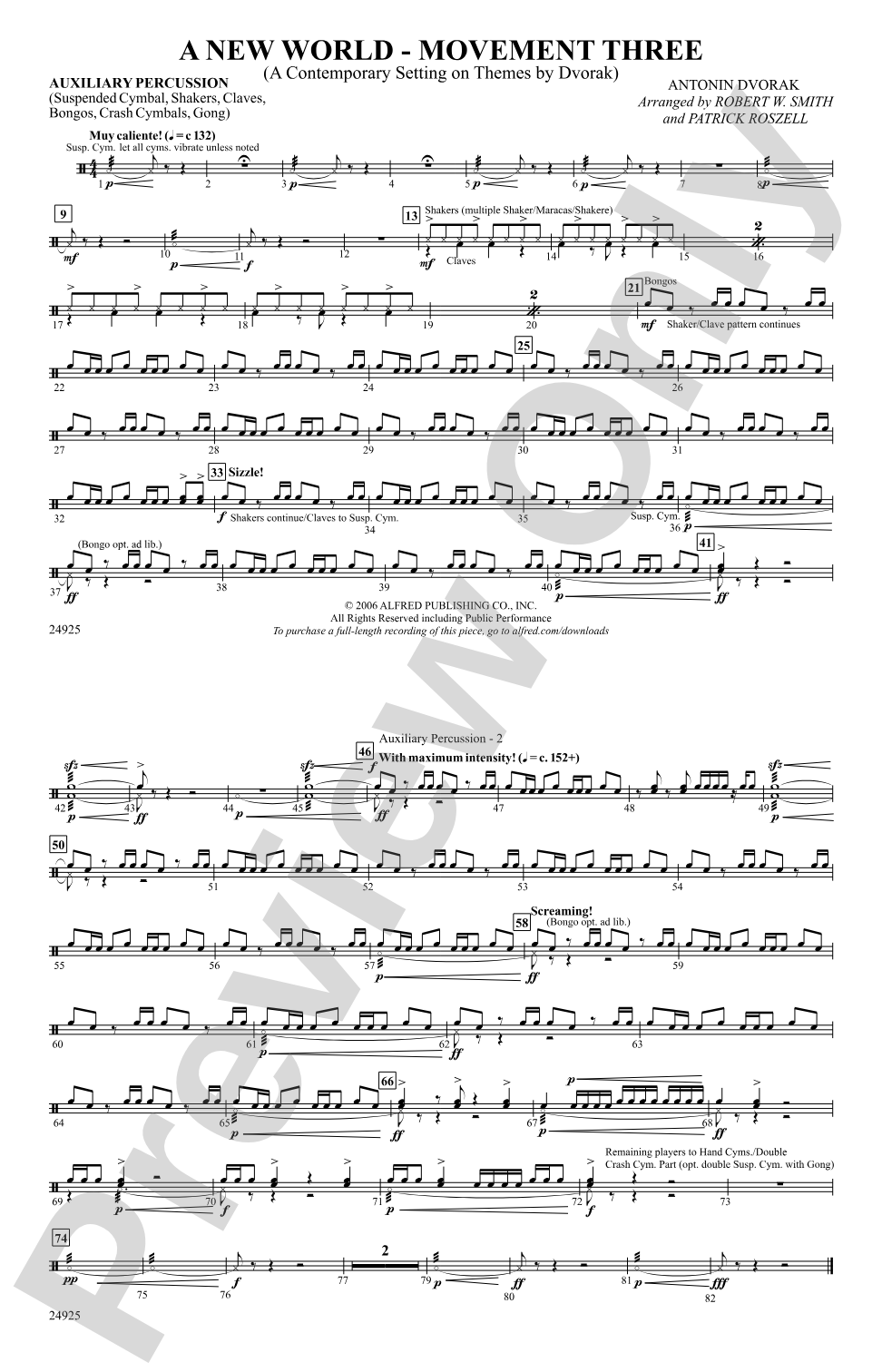

A New World---Movement Three: Auxiliary Percussion
Arr. Robert W. Smith and Patrick Roszell
Grade: 3 (Medium)
Item: 00-PC-0018120_APC
$3.00
Pickup currently not available
Description
To conclude A New World, Robert W. Smith and Patrick Roszell give Dvorák's music a Latin treatment - the chart begins hot and just keeps on building to the powerful finish. This is the show the Glassmen took to the DCI finals last year, but it has been re-scored for today's high school bands. This is a marvelously conceived contemporary show that is sure to last! (2:52)


Don't just read it, hear it, play along with it, and watch your students grow with it. In MakeMusic Cloud, A New World---Movement Three: Auxiliary Percussion comes alive with professional accompaniment, adjustable tempo, and built-in practice tools that turn solo practice into real progress.
Open in the Player
Jump straight in and assign it today.
Start Your Free Trial
Open this title and explore the full library in minutes.
Sample Audio
1
Audio File
--:--
0:00
0:00
Sample Video
No sample videos found.
Additional Details
Series:
Mega Sounds for Marching Band
Publisher:
Alfred Music
Page Count:
140
SKU:
00-PC-0018120_APC
More about this title
About the Arranger: Robert W. Smith

Robert W. Smith stands among America's most prolific and performed composers for concert band and orchestra, with over 400 publications representing decades of innovation in wind music. His education at Troy State University and the University of Miami shaped a compositional voice that balances accessibility with sophisticated orchestration, earning performances across North America, Europe, Australia, Asia, and beyond.
Beyond the concert hall, Smith's work has reached audiences through Olympic broadcasts, the Macy's Thanksgiving Day Parade, major network television, and iconic American events from Dodger Stadium to the Ringling Brothers circus. His symphonies (The Divine Comedy, The Odyssey) and works for developing ensembles like The Tempest have become repertoire standards that directors return to year after year.
Why we love this
Smith and Roszell have reimagined Dvořák's themes through a contemporary Latin lens, transforming classical source material into propulsive, high-energy marching repertoire. The arrangement carries genuine competitive pedigree (refined from the Glassmen's DCI championship show) while remaining fully accessible to the high school level, which means your students get an authentically conceived show design, not a watered-down transcription.
What to expect
The movement launches into propulsive Latin rhythms that give Dvořák's melodies an irresistible forward drive. What begins hot only intensifies as layers accumulate, building toward a finish that feels inevitable and earned rather than forced.
Who it's for
High school marching bands seeking contemporary competitive or exhibition material that combines classical substance with modern energy. This score works equally well for bands aiming at DCI-style performance or simply wanting a finale that builds from hot opening to powerful conclusion without requiring an abnormal instrumentation or skill set.
How to get the most out of it
- Lock the Latin percussion groove early in rehearsal before layering melodic lines; the rhythmic foundation drives everything that follows.
- Balance the brass entrances during the building sections so each layer adds presence without drowning out what came before.
- Treat the final push to the finish as a sprint, not a sprint to exhaustion; the piece itself provides the momentum if you keep articulation clean and forward.
- Test your field setup during sectional rehearsals to ensure the melodic content (which passes between sections) stays coherent across your marching spacing.
How to use it
This functions as an ideal show closer or finale within a larger program, particularly if you've built your season around concert and marching repertoire that bridges classical and contemporary styles. Its 2:52 runtime fits seamlessly into both competitive schedules and exhibition-focused performances.
Skills your students will build
- Maintaining rhythmic precision through layered Latin percussion patterns
- Balancing individual parts within a dense, multi-sectional texture
- Executing clean articulation during fast-moving passages and builds
- Marching and playing simultaneously while tracking melodic lines that move between instrument sections
- Responding to dynamic and tempo shaping cues in a high-energy ensemble context