
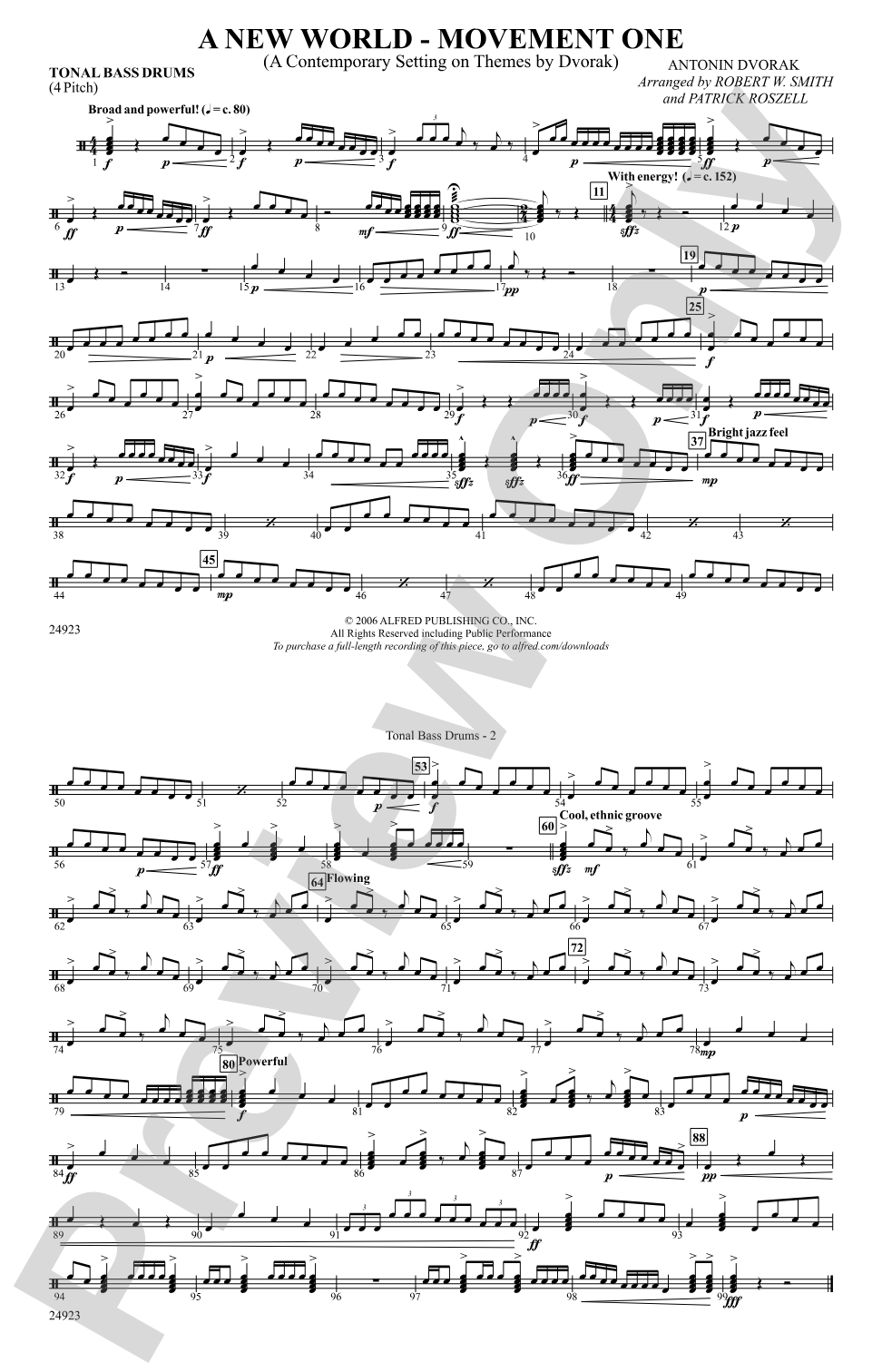

A New World---Movement One: Tonal Bass Drum
Arr. Robert W. Smith and Patrick Roszell
Grade: 3 (Medium)
Item: 00-PC-0018118_TBD
$3.00
Pickup currently not available
Description
The music is based on themes from Dvorák's Symphony #9 from the New World, but imagines how Dvorák might have scored it had he lived in today's musical environment, with jazz, rock, hip-hop, R&B, and Latin influences. A truly unforgettable offering! (3:35)


Don't just read it, hear it, play along with it, and watch your students grow with it. In MakeMusic Cloud, A New World---Movement One: Tonal Bass Drum comes alive with professional accompaniment, adjustable tempo, and built-in practice tools that turn solo practice into real progress.
Open in the Player
Jump straight in and assign it today.
Start Your Free Trial
Open this title and explore the full library in minutes.
Sample Audio
1
Audio File
--:--
0:00
0:00
Sample Video
No sample videos found.
Additional Details
Series:
Mega Sounds for Marching Band
Publisher:
Alfred Music
Page Count:
138
SKU:
00-PC-0018118_TBD
More about this title
About the Arranger: Robert W. Smith

Robert W. Smith has established himself as a leading voice in American band and orchestral composition, with over 400 works published primarily through Alfred Music. He holds degrees from Troy State University (AL) and the University of Miami (FL), and his original compositions for concert band and orchestra have circulated internationally across North America, Europe, Australia, and Asia. His symphonies The Divine Comedy and The Odyssey, along with works like The Tempest, have become foundational repertoire in the band world.
Beyond the concert hall, Smith's music has reached audiences through major television broadcasts, Olympic ceremonies, the Macy's Thanksgiving Day Parade, and other high-profile venues. He remains active as both a conductor and clinician, maintaining a presence across the United States, Canada, and internationally. His arrangements bridge classical sources with contemporary musical idioms, demonstrating a keen ear for what moves modern ensembles and audiences alike.
Why we love this
Smith and Roszell's reimagining of Dvorák's New World Symphony proves that classic themes can speak powerfully to today's marching students when filtered through the musical languages they already inhabit. The arrangement respects the original's melodic integrity while injecting hip-hop, R&B, Latin, jazz, and rock textures that feel organic rather than forced. A Grade 3 score this sophisticated opens doors for programs seeking substantial, contemporary-sounding literature that challenges ensemble musicianship without requiring virtuoso technical demands.
What to expect
Encountering Dvorák's beloved melodies dressed in the rhythmic language of urban music creates an immediate sense of discovery and relevance. The piece moves fluidly between introspective moments rooted in the symphony's character and energetic sections propelled by Latin grooves, R&B textures, and hip-hop rhythms. It feels both grounded in tradition and unmistakably of the present moment.
Who it's for
Marching bands at the Grade 3 level seeking music that respects their audiences' contemporary tastes while building on a world-class classical foundation. Directors who want to program something that sparks genuine student engagement without sacrificing musical substance or the marching arts' roots in concert repertoire.
How to get the most out of it
- Establish the groove early in rehearsal by isolating the rhythm section (percussion, low brass, saxophones) and locking the foundational pocket before layering the thematic material. Contemporary idioms live or die on rhythmic precision.
- Balance the Dvorák melody carefully against the modern accompaniment texture. The recognizable themes need clarity without dominating the contemporary arranging details that make this version distinctive.
- Pay attention to articulation and note length across the full band; the mix of legit band voicing with hip-hop and R&B sensibilities requires consistent execution of both lyrical lines and tight rhythmic figures.
- Use the 3:35 runtime as a guide for pacing and energy management during rehearsals. The piece moves through multiple stylistic sections, so map those transitions deliberately so they feel purposeful rather than abrupt.
How to use it
Position this as your season's statement piece on artistic relevance. A spring or summer concert featuring A New World alongside traditional concert band selections demonstrates to your community and students that marching and concert repertoire can expand each other's possibilities. The piece also works as a compelling halftime show centerpiece that transcends typical marching entertainment.
Skills your students will build
- Balancing legit concert band scoring with contemporary groove-oriented rhythmic patterns
- Reading and executing syncopated figures grounded in jazz, R&B, and hip-hop idioms
- Executing precise articulations across multiple stylistic sections
- Understanding thematic development and recognition across radically different arranging contexts
- Maintaining groove integrity and rhythmic cohesion in moderately complex textures