
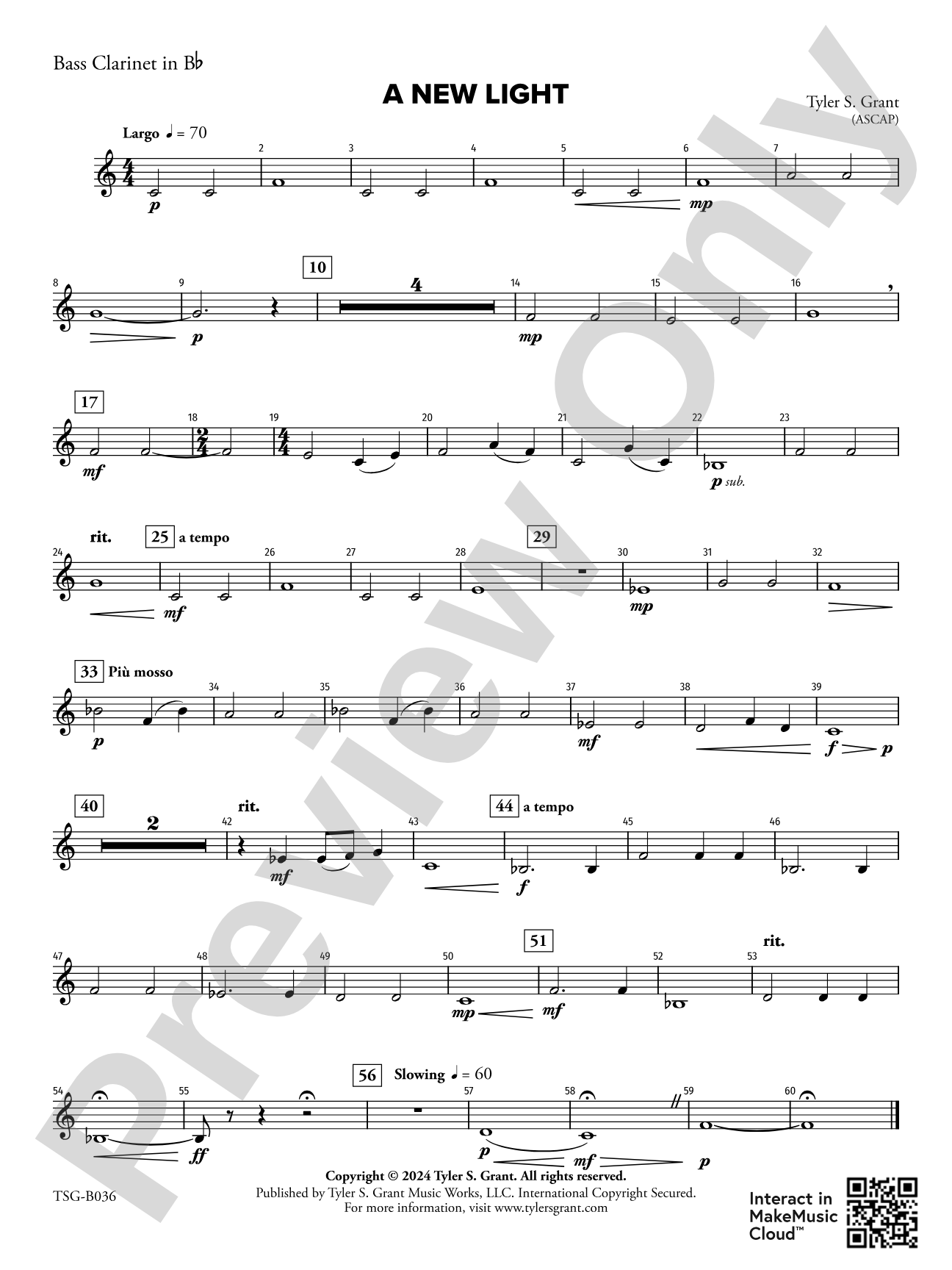

A New Light: B-flat Bass Clarinet
A Sequel to... At Twilight
By Tyler S. Grant
Grade: 1.5
Item: 98-PC-TGB036_BBC
$4.50
Pickup currently not available
Description
A sequel to his best-selling work At Twilight, Tyler S. Grant once again contributes a captivating lyrical work for developing bands with A New Light. Colorful orchestrations have a chance to shine through modest ranges and easy technical demands. Intriguing harmonic progressions surrounded by memorable melodies will build maturity in your ensemble's listening skills. A gorgeous and colorful work! (3:30)
Original Item#: TSG-B036


Original Item#: TSG-B036
A New Light: B-flat Bass Clarinet isn't in MakeMusic Cloud just yet...but it could be. Let us know you'd like to see it, and you'll help shape what comes next. In the meantime, start a free trial and dive into thousands of interactive titles your students can play along with today.
Request This Title
Tell us you want it.
Start Your Free Trial
Explore everything that's ready to play right now.
Sample Audio
1
Audio File
--:--
0:00
0:00
Sample Video
Additional Details
Series:
Tyler S. Grant Music Works
Publisher:
Tyler S. Grant Music Works, LLC.
SKU:
98-PC-TGB036_BBC
More about this title
About the Composer: Tyler S. Grant

Tyler S. Grant has built a distinguished career as a composer and arranger whose music reaches developing and advanced ensembles across North America. His works appear regularly on honor ensemble programs and earn consistent recognition on national repertoire lists. Panoramic Fanfare, winner of the Dallas Wind Symphony's 2014 "Call for Fanfares" Competition, has become a staple at collegiate and professional venues including Carnegie Hall, The Midwest Clinic, and the Meyerson Symphony Center.
Beyond the page, Grant contributes actively to music education through clinician engagements with over 100 school programs across 15 states and conducting appearances at regional and all-state festivals. He studied instrumental music education and conducting at the University of Alabama under Professor Randall Coleman and credits mentor Brian Balmages as central to his development as a composer. Since 2010, he has maintained a steady output of new commissions and publications for bands and orchestras.
Why we love this
Grant's sequel to At Twilight proves that accessible writing and genuine musical substance are not mutually exclusive. The harmonic language here stretches young ears while the orchestration gives every section something worth playing; no one sits idle while others carry the melody. The result is a concert work that builds ensemble maturity without punishing your rehearsal schedule.
What to expect
A slow unfurling of melodic ideas set against rich harmonic backdrops. The piece feels contemplative and mature, with orchestral color emerging naturally from modest range requirements, creating an intimate yet ensemble-focused listening experience.
Who it's for
Developing concert bands ready to explore harmonic sophistication without scaling technical difficulty. This work suits ensembles in their first or second year of concert band experience, or any group seeking a thoughtful lyrical concert selection that challenges ears and musicality instead of technique.
How to get the most out of it
- Balance the colorful orchestrations by voicing each harmonic layer distinctly; the intriguing progressions only land if listeners hear them clearly rather than as a sonic blur.
- Shape the memorable melodies with a long phrase line, even in sections marked quietly; younger players often associate soft playing with lack of direction.
- Allow space in rehearsal to discuss how the piece moves harmonically from moment to moment; students who understand the harmonic journey play with deeper intention.
How to use it
Position this as a centerpiece concert selection where you want to showcase your band's growing musical maturity to parents and peers. Its three-and-a-half minute runtime makes it ideal as an opener or closer on a mixed program, and the lyrical character provides strong contrast alongside faster-paced or more rhythmically driven works.
Skills your students will build
- Listening for harmonic progression and functional harmony
- Phrasing and legit singing tone across soft and moderate dynamics
- Orchestral balance and blend across sections with equal musical responsibility
- Understanding how modest ranges and simple technical demands can serve expressive musical goals