
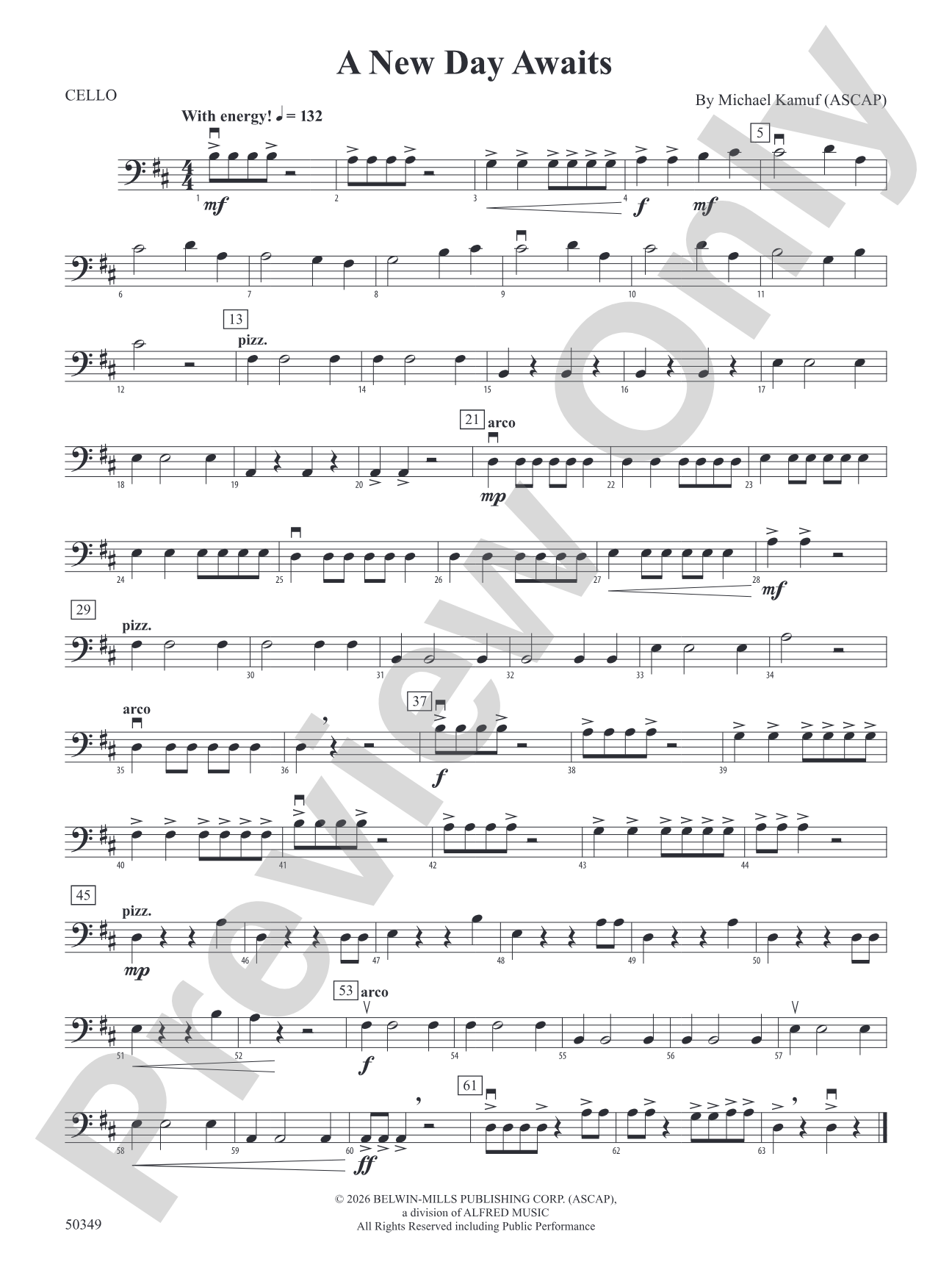

A New Day Awaits: Cello
By Michael Kamuf
Grade: 1.5
Item: 00-PC-0019825_VC1
$3.00
Pickup currently not available
Description
With soaring melodies, driving rhythms, and various textures, A New Day Awaits, by Michael Kamuf, brings a portrayal of the excitement and wonder surrounding the start of a new day to your students. Perfect as an opener or closer for your concert or festival performance!


A New Day Awaits: Cello isn't in MakeMusic Cloud just yet...but it could be. Let us know you'd like to see it, and you'll help shape what comes next. In the meantime, start a free trial and dive into thousands of interactive titles your students can play along with today.
Request This Title
Tell us you want it.
Start Your Free Trial
Explore everything that's ready to play right now.
Sample Audio
1
Audio File
--:--
0:00
0:00
Sample Video
Additional Details
Series:
Belwin Beginning String Orchestra
Publisher:
Alfred Music
SKU:
00-PC-0019825_VC1
More about this title
About the Composer: Michael Kamuf

Michael Kamuf earned degrees in Jazz Performance and Music Education from Youngstown State University and completed graduate work in Instrumental Conducting at George Mason University. His compositions and arrangements have been performed by prestigious ensembles including the Woody Herman and Glenn Miller Orchestras, the USAF Airmen of Note, and soloists such as James Moody, Eddie Daniels, and Sean Jones. He serves as an exclusive composer and arranger for the Belwin Division of Alfred Music Publishing, with works across jazz, orchestra, and concert band catalogs, along with additional publications through UNC Jazz Press, Neil A. Kjos Music, and FJH Music Company.
Kamuf taught instrumental music in Montgomery County Public Schools (Maryland) for thirty years, serving as Director of Bands and Orchestras and Music Department Chairperson at John T. Baker Middle School in Damascus for twenty-seven of those years. Under his leadership, the school's ensembles consistently earned high ratings at festivals and commissioned works for young concert bands. He currently leads the Mike Kamuf Little Big Band, a jazz octet featuring musicians from the Baltimore and Washington, DC region. With over 100 published works in print, many of his jazz ensemble arrangements have become standard repertoire for young musicians.
Why we love this
This piece captures genuine excitement without sacrificing clarity at the Grade 1.5 level. Kamuf builds energy through rhythmic drive and accessible melodic writing rather than technical complexity, making it rewarding for early string orchestras to learn and genuinely satisfying to perform. Its dual function as concert opener or closer gives you real flexibility in your programming strategy.
What to expect
The opening conveys that particular sense of anticipation and freshness when something new begins, supported by soaring melodic lines that feel open and unbounded. Driving rhythms maintain momentum throughout, creating a piece that feels energized and forward-moving rather than tentative or static.
Who it's for
String orchestras at the early intermediate level, especially ensembles ready to move beyond unison or two-part writing but still building confidence in independent part coordination. Directors seeking a programmatic piece that genuinely engages young players and audiences alike will find this accessible without feeling simplistic.
How to get the most out of it
- Balance the soaring melody line across your first violins and violas so it carries clearly over the rhythmic foundation beneath it.
- Lock the driving rhythms with your lower strings early in rehearsal; once the foundation feels solid, the energy will lift naturally.
- Attend to the textural variety Kamuf builds in. Mark where the orchestration shifts and ensure each section adjusts dynamics and color accordingly so the piece doesn't flatten.
How to use it
Open a concert with this piece to establish an immediate sense of optimism and forward motion, or close a program with it to send audiences out on an uplifted note. It pairs well alongside other Grade 1-2 works in mixed programming and serves as an effective festival selection where musicality and ensemble balance matter as much as technical precision.
Skills your students will build
- Independent part playing across multiple instrumental lines
- Dynamic control and phrasing over longer melodic arcs
- Rhythmic precision in ensemble contexts (maintaining driving rhythms while supporting melody)
- Reading and responding to textural changes within a single piece
- Collaborative balance between melody and accompaniment figures